
How to improve concentration: practical techniques, exercises and a 7-day plan
Understand what concentration is, why it's so hard to stay focused today and how to improve focus with practical techniques, exercises, apps and a 7-day plan.

What will we see in this post

You sit down to work, open the file and, five minutes later, you’re on your phone answering a message that was “just a quick one.” 📱 If that sounds familiar, it isn’t a lack of willpower: the way we use screens, how we sleep and everyday stress all have a direct effect on our ability to focus.
The good news is that focus can be trained. In this guide, you’ll learn how to improve concentration based on what science already knows: what attention is, why it’s so hard to concentrate today, step-by-step techniques, exercises, apps and a 7-day plan to put it all into practice. 🎯
| Question | Quick answer |
|---|---|
| What is concentration? | The ability to keep your attention on one task while ignoring what doesn’t matter at that moment |
| Why is it so hard to concentrate? | Notifications, constant task switching, poor sleep and stress |
| Which technique works best? | Combining focus blocks (Pomodoro or time blocking) with one task at a time and your phone out of reach |
| Do exercises help? | Yes: short daily meditation and physical activity have evidence of improving attention |
| When should I get help? | When the difficulty is constant and gets in the way of school, work or relationships |
What is concentration (and how is it different from attention)?
Concentration is the ability to keep your attention on a single task for a period of time, setting aside stimuli that don’t matter at that moment. In psychology, it’s called sustained attention: noticing something isn’t enough, you have to stay with it.
Attention, on the other hand, is the mental process that chooses, among everything reaching your senses, what will be processed. It’s limited, so the brain has to filter, and concentrating means choosing that filter well.
This control depends heavily on the prefrontal cortex, the part of the brain linked to planning and self-control, which quickly feels the effects of poor sleep, fatigue and stress. The good news: focus can be trained through habits.
Why it’s so hard to concentrate today
It’s so hard to concentrate today because the digital environment competes for our attention all the time, and the brain pays a price every time it switches tasks. The main culprits are:
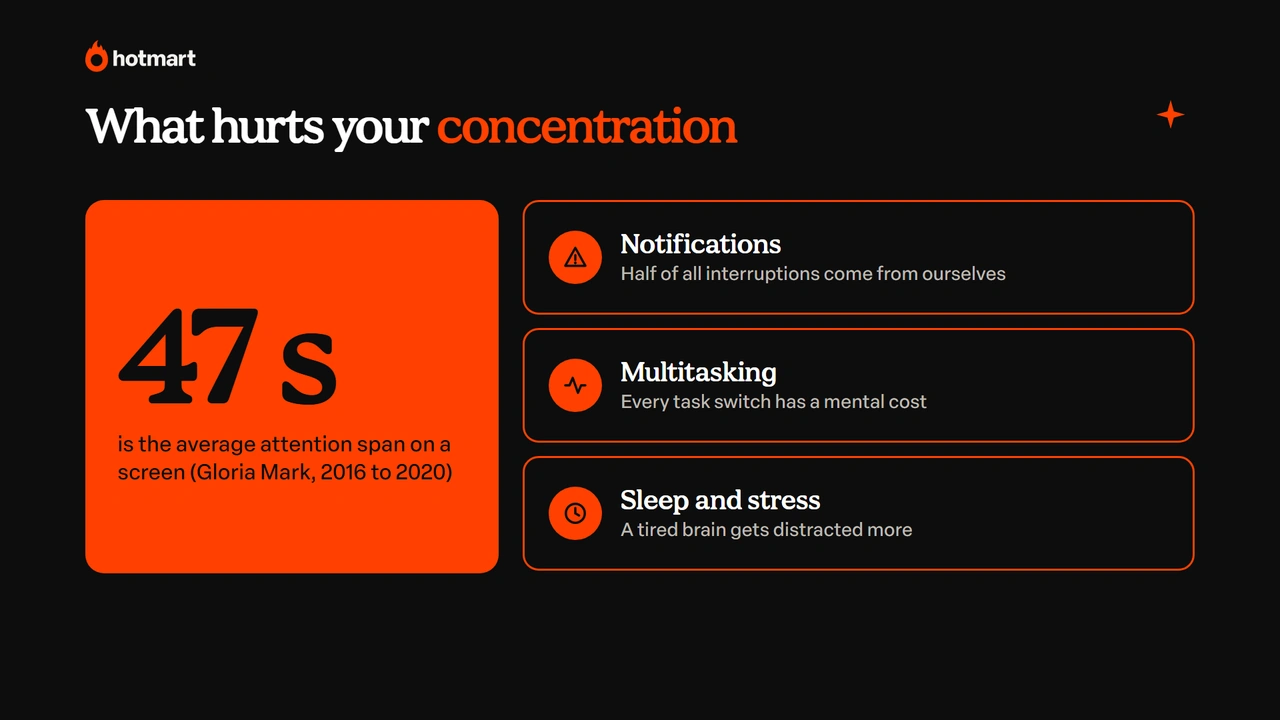
- screens and notifications: researcher Gloria Mark, from the University of California, Irvine, found that the average attention span on a screen dropped from about 2.5 minutes in 2004 to about 47 seconds between 2016 and 2020, and that half the time we interrupt ourselves, according to an interview with the American Psychological Association (APA);
- multitasking: the APA explains that every task switch has a mental cost, and researcher David Meyer estimates these mental blocks can eat up as much as 40% of productive time;
- the time it takes to get back: in an interview with Gallup, Mark said that interrupted work is resumed, on average, 23 minutes later;
- short sleep, stress and anxiety: they leave the brain more tired and more sensitive to distractions.
In other words, trouble concentrating has more to do with your environment and habits than with “laziness,” and that’s something you can adjust.
How to improve concentration: 10 step-by-step techniques
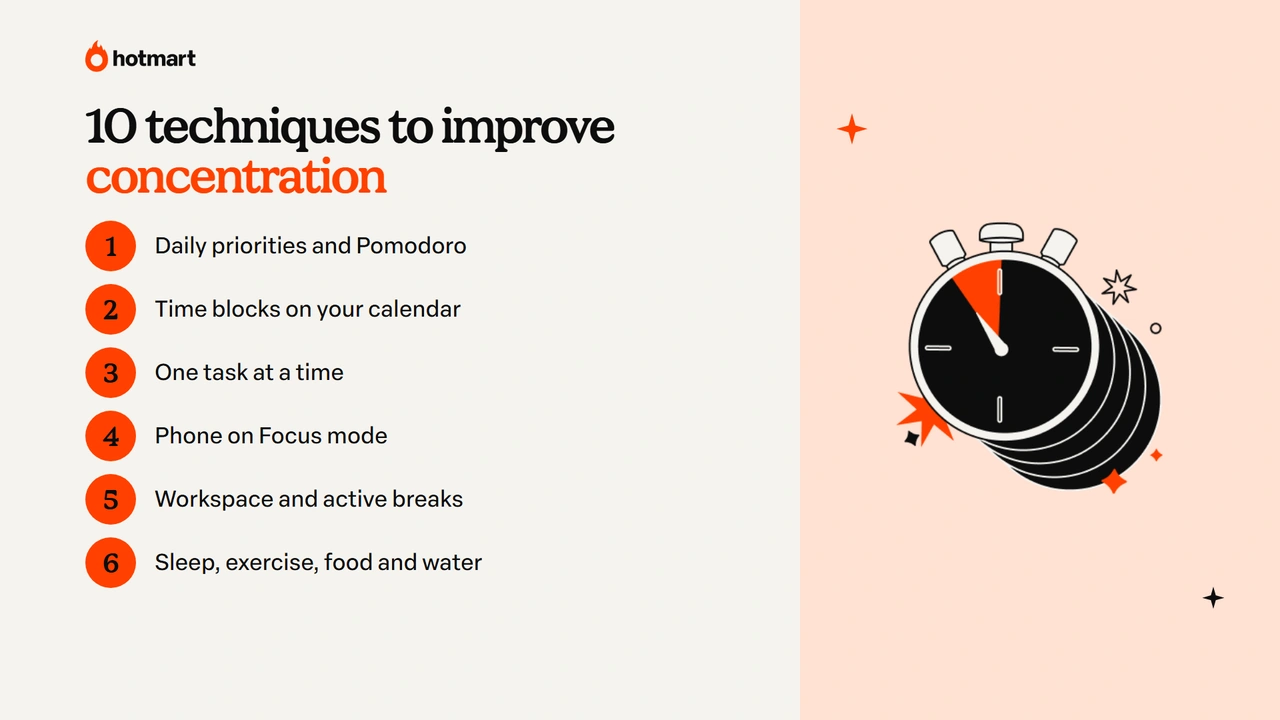
Improving concentration comes down to three fronts: organizing the task, protecting your focus time and taking care of your body. These are the 10 techniques we’ll cover in detail:
- set your priorities for the day;
- use the Pomodoro Technique;
- block focus time on your calendar (time blocking);
- do one thing at a time;
- turn on your phone’s Focus mode;
- prepare your environment;
- take active breaks;
- get enough sleep;
- move your body;
- eat well and drink water.
Start with two or three and add more over time. Below is the step-by-step for each one.
1. Set your priorities for the day to improve focus
Setting your priorities for the day is the first step to improving concentration, because the brain focuses better when it knows exactly what it needs to do. In practice:
- write down everything that’s on your mind;
- pick 1 to 3 tasks that really move your day forward;
- break each one into a concrete next action (“write the introduction,” not “do the report”);
- use the two-minute rule from David Allen’s GTD method: if something takes less than 2 minutes, do it now; if not, it goes on the list.
To give the effort a purpose, set SMART goals; to see how your tasks flow, a simple Kanban board does the job.
2. Use the Pomodoro Technique to concentrate
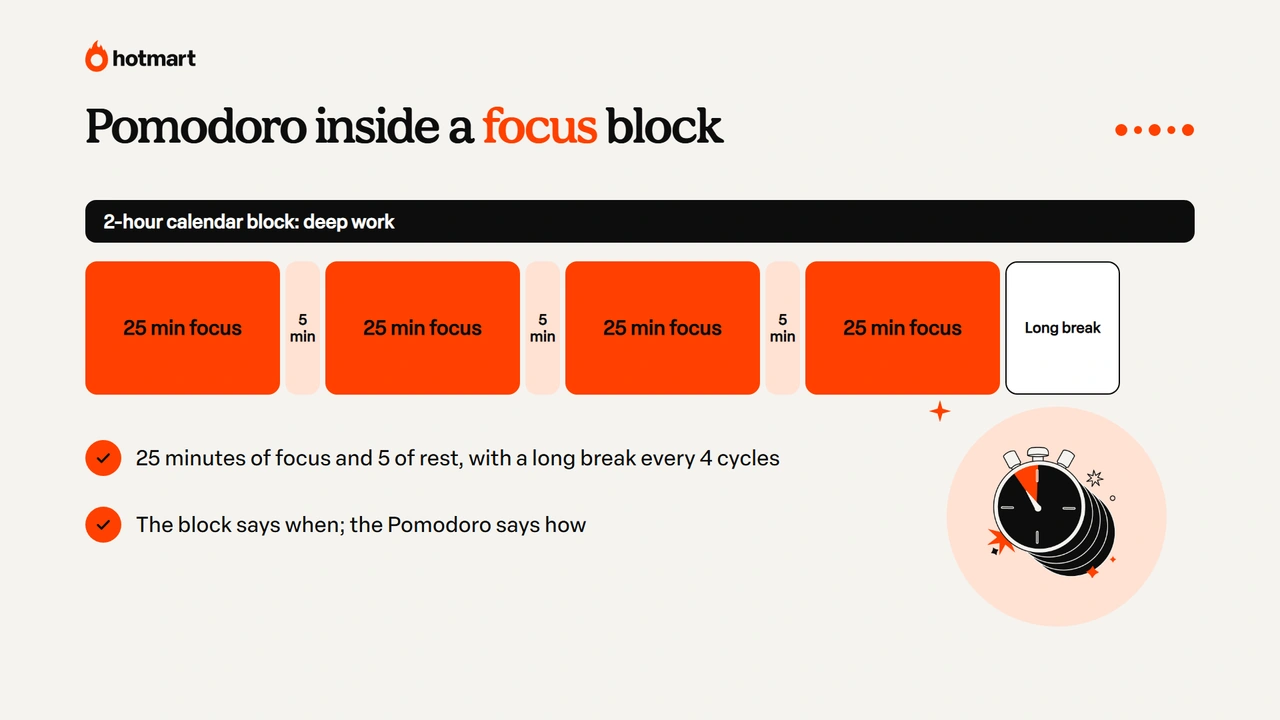
The Pomodoro Technique is a time management method created by Italian Francesco Cirillo in the late 1980s that alternates short focus blocks with breaks. Here’s how it works:
- choose a task;
- set a timer for 25 minutes and work only on that task;
- when it rings, take a 5-minute break away from the screen;
- every 4 cycles, take a longer break of 15 to 30 minutes.
If 25 minutes still feels like too much at first, start with 15 and build up gradually.
3. Block focus time on your calendar (time blocking)
Time blocking is the technique of reserving fixed periods on your calendar for each type of work, as if they were meetings with yourself. Author Cal Newport popularized the idea in his book *Deep Work* (2016). To apply it:
- set aside 1 or 2 blocks of 60 to 90 minutes for the work that demands the most focus, ideally at the time of day when you perform best;
- group similar tasks (email, messages, admin) into short blocks;
- leave free space for the unexpected.
Pomodoro and time blocking work well together: the block defines *when* you’ll focus, and the Pomodoro organizes *how* you get through that block.
4. Do one thing at a time to stay focused
Doing one thing at a time, known as single-tasking, is one of the most direct ways to improve concentration, since every task switch charges the brain a “toll.” Close tabs that have nothing to do with the task and only move on to the next one when you finish or reach a clear stopping point. Remembered something else? Jot it down on paper and come back.
5. Turn on your phone’s Focus mode
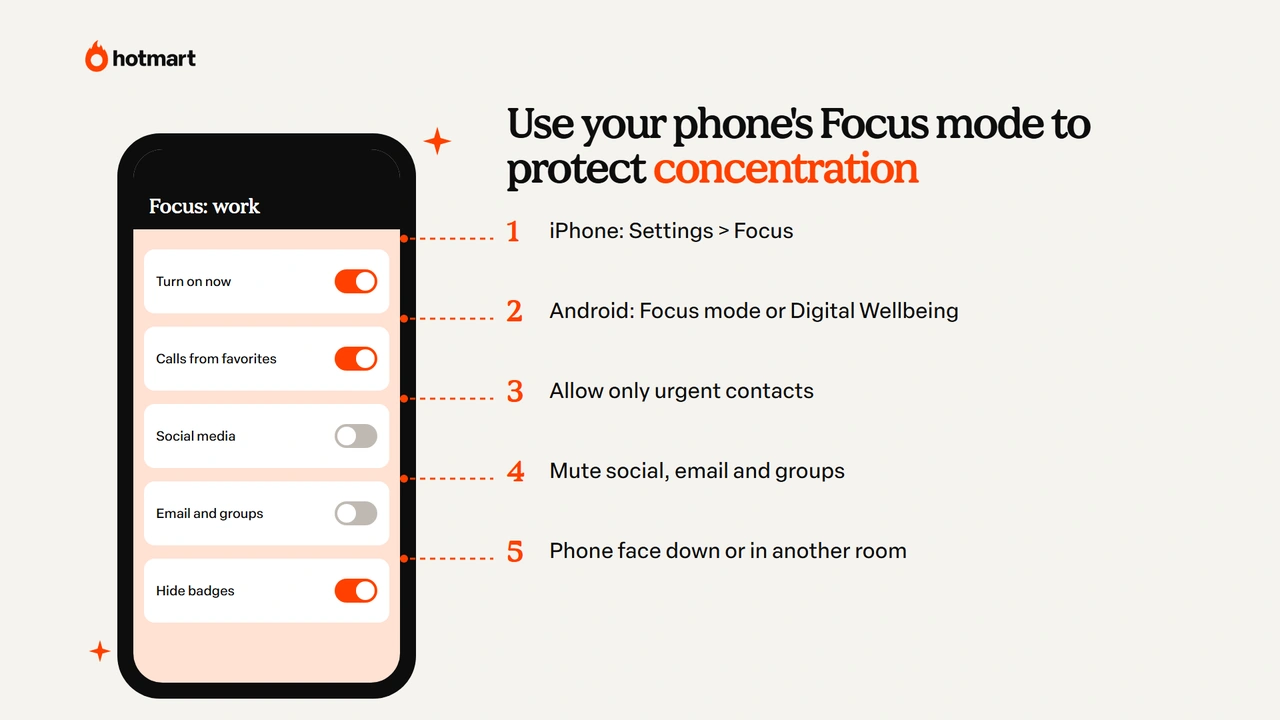
Turning on your phone’s Focus mode is a simple way to cut off one of the biggest sources of interruption. On iPhone, the feature is under Settings > Focus; on Android, look for “Focus mode” or “Digital Wellbeing” in your settings (the name varies by brand). Set it up like this:
- allow only truly urgent calls and contacts;
- silence social media, email and group chats during focus blocks;
- leave the phone face down or in another room.
A 2017 study suggested that just having your phone nearby reduced attention capacity, but later replications didn’t find the same effect. In other words: the main problem is interruptions, and Focus mode solves a good share of them.
6. Prepare your environment for concentration
Preparing your environment reduces distractions before they even show up. Before you start:
- keep only what the task requires in sight;
- work at a desk, not in bed or on the couch;
- use noise-canceling headphones, earplugs or low instrumental music if total silence isn’t possible;
- take care of lighting and posture.
An environment designed for the task keeps your brain from wasting energy filtering out what’s around it.
7. Take active breaks to recover your focus
Taking active breaks helps you maintain concentration for longer, because the brain tends to “tune out” stimuli that don’t change. A study by Atsunori Ariga and Alejandro Lleras at the University of Illinois (2011) showed that participants who took two brief breaks during a 50-minute task kept their performance steady, while the others got worse. During the break, stand up, stretch or drink water. Scrolling your feed doesn’t count: it pulls your attention somewhere else.
8. Get enough sleep to concentrate better
Getting enough sleep is the foundation of any strategy to improve concentration. The American Academy of Sleep Medicine (AASM) recommends that adults sleep 7 or more hours per night and links shorter nights to worse performance and more errors. To help: keep similar times for going to bed and waking up, avoid screens and caffeine close to bedtime and keep your bedroom dark and quiet.
9. Move your body to improve concentration
Moving your body improves concentration because physical activity helps the brain work better and reduces stress and anxiety. Since 2020, the World Health Organization (WHO) has recommended 150 to 300 minutes of moderate activity per week for adults and lists better thinking and learning among the benefits. Walking 30 minutes, five times a week, already meets the minimum goal.
10. Eat well and drink water to maintain concentration
Eating well and drinking water sustain the energy your brain uses to stay focused. A review by Ana Adan published in the Journal of the American College of Nutrition (2012) showed that losing 2% of the body’s water already impairs attention and short-term memory tasks. Keep a water bottle on your desk, don’t skip meals to “finish faster” and choose light snacks during breaks.
Concentration for studying and working from home
Concentration for studying and working from home calls for a few extra precautions, because in both cases nobody is keeping track of your time. Below are specific adjustments to:
- study with more focus;
- work from home without getting lost in everyday distractions.
How to improve concentration for studying
Improving concentration for studying starts with active learning, not just rereading the material. Some practices that work:
- define the goal of the session before opening the book (“solve 10 percentage problems”);
- study in Pomodoro blocks and write down questions for the end;
- test yourself with questions and summaries from memory instead of just highlighting;
- review the content over the following days, at increasing intervals.
Short sessions with a clear goal are less tiring and more productive than hours of passive reading.
How to focus when working from home
Working from home requires separating, even in a simple way, your work space and hours from the rest of your life. Some practical rules:
- have a fixed spot to work; this guide on well-being while working from home covers how to take care of your body and mind in a home office;
- start and end your workday at the same time and change clothes as if you were going out;
- agree on focus hours with the people you live with and leave household chores for longer breaks.
If the challenge is organizing your own day without a boss around, setting a clear end time, turning off work notifications after hours and creating a small ritual to “leave” work keep your job from taking over the whole house.
Exercises to improve concentration: how to train your focus
Exercises to improve concentration work like training: attention improves with regular practice, not with a single session. These are the ones with the most support:
- short daily meditation: a study by Julia Basso and colleagues at New York University, published in Behavioural Brain Research (2019), showed that 13 minutes of guided meditation a day for 8 weeks improved attention and memory in people who had never meditated (at 4 weeks there was still no difference). If you want to start, this mindfulness guide explains the practice;
- counted breathing: breathe in counting to 4, breathe out counting to 6 and repeat for 2 minutes, bringing your attention back whenever it wanders;
- mindfulness in an everyday activity: wash the dishes or drink your coffee paying attention only to that, with no phone;
- games that demand focus: chess, puzzles and crosswords are good for training sustained attention, but they work as a complement, not as a replacement for sleep and breaks.
The secret is consistency: a few minutes every day are worth more than an hour once a week. Watching yourself for a few days also helps you notice what distracts you most, so you can choose which technique to try first.
Apps and tools to help you focus
Apps and tools to help you focus are useful for blocking distractions, organizing tasks and reminding you to take breaks. Some well-known options:
- Forest: you “plant a tree” that grows as long as you don’t touch your phone;
- Freedom: blocks websites and apps on your computer and phone at the times you choose;
- Pomofocus or Focus To-Do: Pomodoro timers with a task list;
- Todoist, Notion or Trello: to list, prioritize and track tasks;
- Google Calendar: to set up your time blocks;
- Headspace, Calm and Insight Timer: guided meditations, including short ones.
Pick one or two and use them for a few weeks before switching. To compare more options, check out this list of apps to optimize your routine.
How to stay focused as a content creator or digital entrepreneur
Staying focused as a content creator or digital entrepreneur is a challenge of its own, because the same person creates, records, edits, replies to followers and sells, often all on the same day. A few practices help you keep your head on one job at a time:
- batch your production: one day or block for scripts, another for recording, another for editing; an editorial calendar organizes this in advance;
- separate creating from consuming: don’t open social media “for research” in the middle of writing;
- watch out for disguised procrastination: tweaking the thumbnail for the tenth time is also running away from the main task; these tips on how to stop procrastinating help you spot those patterns.
If content creation is at the heart of your business, these habits make the difference between publishing consistently and always playing catch-up. And when ideas get stuck, a brainstorming session helps get them moving again.
For anyone producing an online course, focus depends on a clear plan: dividing the course into modules, recording lessons in batches and following a script reduces the feeling of a never-ending project. This e-learning guide shows how to structure your course, and when you’re ready to host it, the Hotmart members area brings your lessons together in one place, while Hotmart AI suggests the module structure and a launch plan so you start with your script already organized.
7-day plan to improve concentration
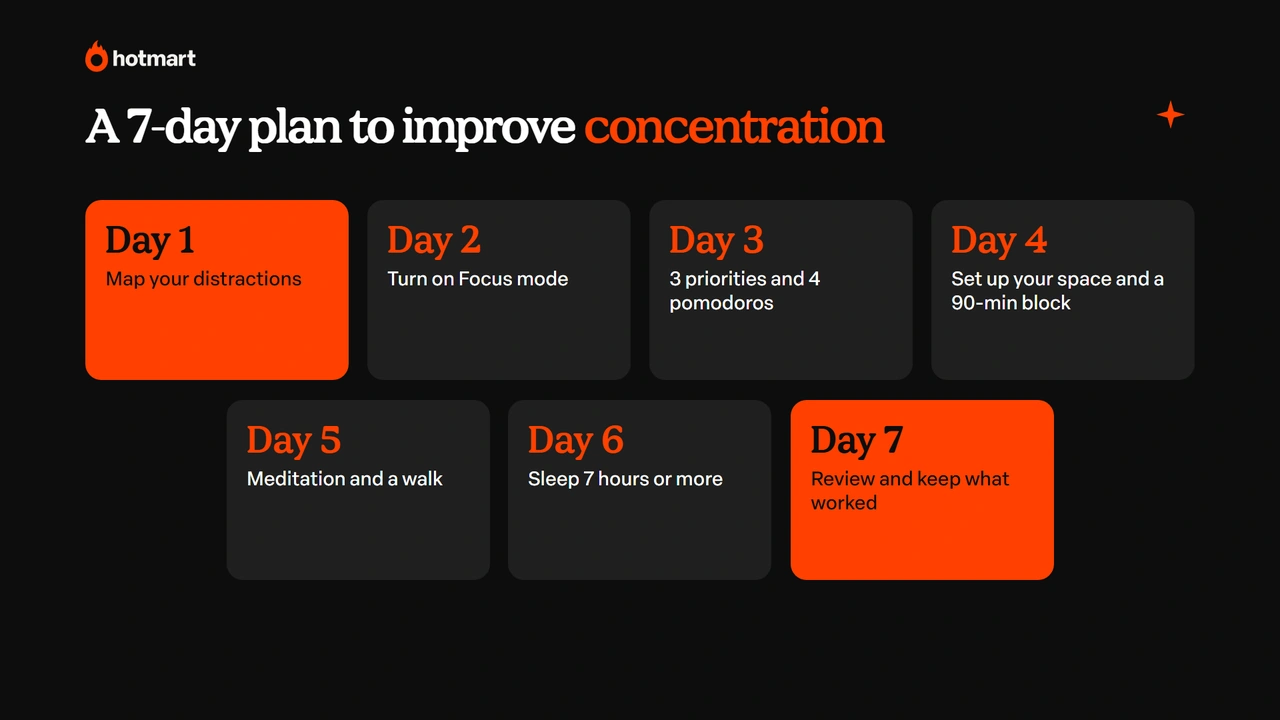
The 7-day plan to improve concentration brings the techniques in this guide together in a simple sequence, with one change per day. The idea is to stack habits, not swap one for another:
| Day | What to do |
|---|---|
| 1 | Write down how many times you pick up your phone for no reason and what interrupts you most |
| 2 | Set up your phone’s Focus mode and turn off notifications that aren’t urgent |
| 3 | Choose 3 priorities for the day and do 4 pomodoros on the most important one |
| 4 | Tidy up your study or work space and reserve a 90-minute block on your calendar |
| 5 | Start 10 minutes of guided meditation and take a 30-minute walk |
| 6 | Sleep at least 7 hours and keep your phone out of the bedroom |
| 7 | Review the week: what worked, what to keep and what to adjust |
After the first week, keep what worked and repeat it until it becomes routine. Remember that meditation, as Basso’s study showed, takes a few weeks to show results.
Trouble concentrating: when to get help
Trouble concentrating deserves a professional evaluation when it’s constant, shows up in several areas (school, work, home) and doesn’t improve with changes in habits. Some warning signs:
- you frequently miss deadlines, lose things and forget appointments, and have for a long time;
- inattention gets in the way of work, school or relationships;
- the problem goes back to childhood or adolescence;
- there’s extreme fatigue, persistent sadness, intense anxiety or sleep that doesn’t feel restful;
- the techniques in this guide don’t help after a few weeks.
These situations can have several causes, such as sleep disorders, anxiety, depression, hormonal changes or ADHD (attention-deficit/hyperactivity disorder), which, according to the National Institute of Mental Health (NIMH), is marked by an ongoing pattern of inattention and/or hyperactivity-impulsivity that interferes with daily functioning and can continue into adulthood. Only a health care provider, such as a psychiatrist or neurologist, can make a diagnosis, and online tests don’t replace an appointment: if these signs sound like you, talk to your primary care doctor or a local health service.
Ready to train your focus?
Improving concentration doesn’t depend on a miracle trick, but on small choices repeated over time: knowing what’s a priority, protecting blocks of time, putting your phone aside, taking real breaks and caring for your sleep and body. Each one helps a little, and together they make a big difference.
Why not start today with day 1 of the plan? In a week, you’ll already see where your focus slips and what works best for you. 💪
Frequently asked questions about how to improve concentration
Still have questions? Below, we answer some of the most frequently asked questions about how to improve concentration.
How long does it take to improve concentration?
The time it takes to improve concentration varies from person to person. Adjustments like turning off notifications and sleeping better show results within a few days, while habits like daily meditation take a few weeks: in Basso's study (2019), the improvement in attention appeared after 8 weeks of practice.
Does listening to music help you concentrate?
Listening to music can help you concentrate when it masks background noise, especially instrumental music at low volume. For tasks involving reading and writing, songs with lyrics tend to compete for your attention.
Can trouble concentrating be ADHD?
Trouble concentrating can have several causes, and ADHD is only one of them, along with poor sleep, anxiety, depression and overstimulation. If inattention is constant, goes back to childhood and gets in the way of your life, see a doctor for an evaluation.
What is the best exercise for concentration?
The best exercise for concentration is the one you can do every day. Short guided meditation, 10 to 15 minutes long, has good evidence of improving attention, and regular physical activity, like walking, helps the brain and reduces stress.