
How to Find a Hobby: Questions, Simple Tests and Tips to Discover Yours
Learn how to find a hobby with 4 simple steps, the right questions to ask yourself and budget-friendly ways to test new activities.


Have you ever wanted to start a hobby but couldn’t decide which one? Or maybe you found something interesting, jumped in with enthusiasm and gave up a few weeks later?
If that sounds familiar, know that finding a hobby can take a few tries. In this article, you’ll learn how to find an activity that matches your interests, see the questions that help you choose and discover ways to try new things without spending much. First, here’s a quick summary:
| Question | Answer |
|---|---|
| How do you find a hobby? | Look at what you already enjoy, answer a few questions about what you want from your free time, test two or three activities on a budget and fit the one you pick into your schedule. |
| Which hobby is right for me? | It depends on what you want to feel: relaxed, active, creative, connected to people, mentally challenged or immersed in tech. |
| How can you try a hobby for free? | Trial classes, drop-in workshops, free videos, borrowed supplies and low-cost activities at community centers, public libraries and parks and recreation programs. |
| What if no hobby seems interesting? | Lower your expectations, start with the simplest option and notice how tired you are. If losing interest in everything lasts for weeks, talk to a therapist or doctor. |
How to find a hobby in 4 steps
To find a hobby, the secret is to combine self-awareness with experimentation. In practice, that means getting to know yourself better, noticing what you already enjoy, understanding what you’re looking for in your free time and testing different activities until one fits your life.
You won’t always love something on the first try. Often, the interest grows as you learn, build skills and start enjoying the process.
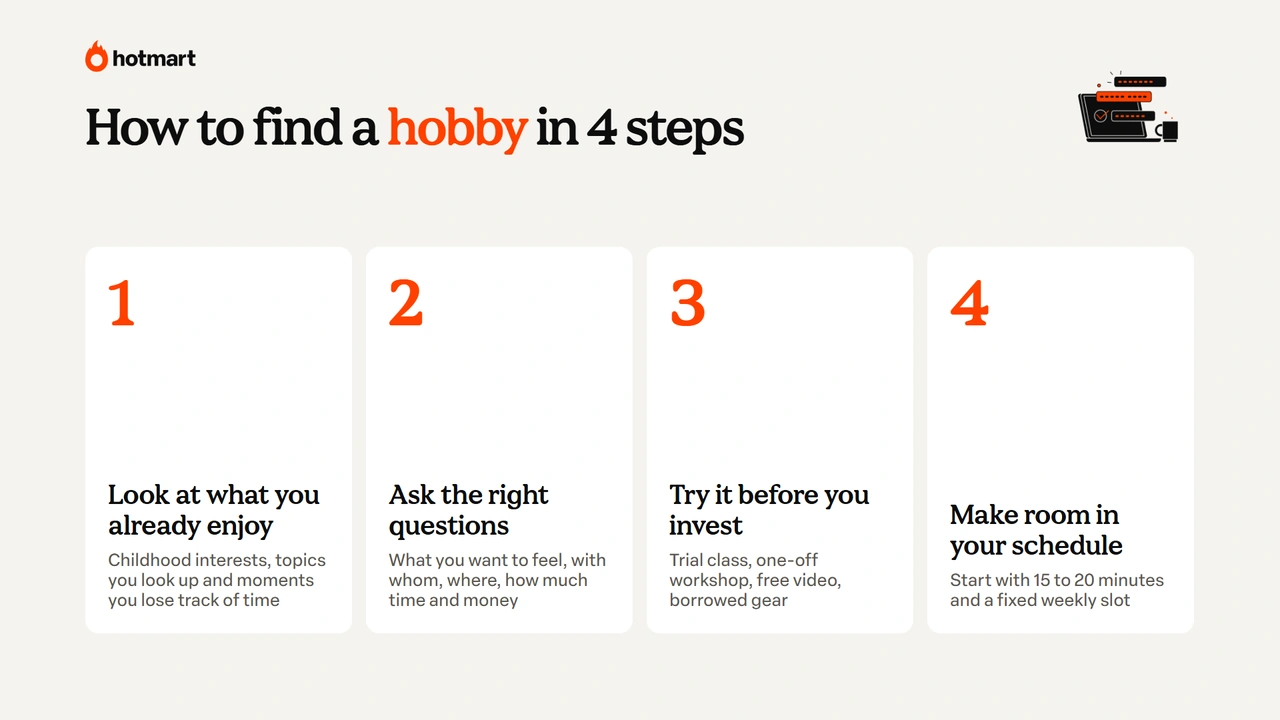
If you’re asking yourself “how do I find my hobby?”, start with these four steps:
- Look at what you already enjoy.
- Ask yourself the right questions.
- Test the hobby before investing.
- Fit the hobby into your schedule.
1. Look at what you already enjoy
The first step is to pay attention to the interests that are already part of your life. Think about what you loved doing as a kid, the topics you look up just for fun and the activities that make you lose track of time. That last sign is what psychologist Mihaly Csikszentmihalyi called flow: total focus on something challenging but doable, which tends to come with the hobbies we love. That kind of focus can also help you improve your concentration in other areas of life.
For example, if you spend hours watching recipe videos, you might enjoy trying your hand at cooking. If you follow plant accounts on social media, you might discover a love for gardening. The key is realizing that a new hobby can grow out of something that already sparks your curiosity.
2. Ask yourself the right questions
To figure out which hobby suits you, think about what you want to get out of it. After all, some people are looking for a way to unwind, while others want to move, learn or meet new people.
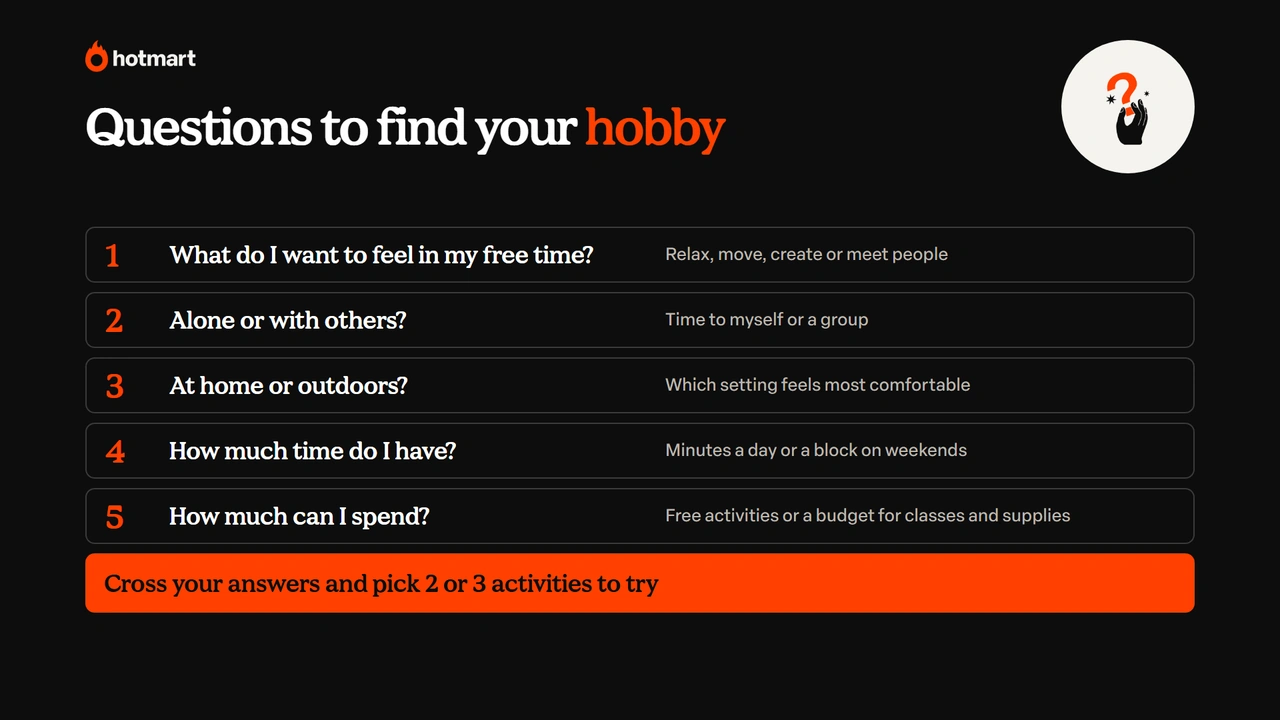
Start by answering these questions:
- What do I want to feel in my free time? Relaxed, active, creative or connected to other people?
- Do I prefer doing things alone or with others? Do I like having time just for me, or do I enjoy being part of a group?
- Do I want something to do at home or outdoors? Which setting makes me feel most comfortable?
- How much time do I have? Can I set aside a few minutes a day, or a longer block on the weekend?
- How much can I spend? Do I prefer free activities, or do I have a budget for classes and supplies?
It’s also worth thinking about what’s missing from your routine. Someone who spends the whole workday at a computer, for example, might enjoy hands-on or outdoor activities. And someone who works alone might love a hobby that involves other people.
Once you’ve answered, compare your preferences and pick two or three activities to try.
3. Test the hobby before investing
You don’t need to buy expensive gear or sign up for long-term commitments to find out whether you like an activity. Trying something new, little by little, is already a great way to get out of your comfort zone.
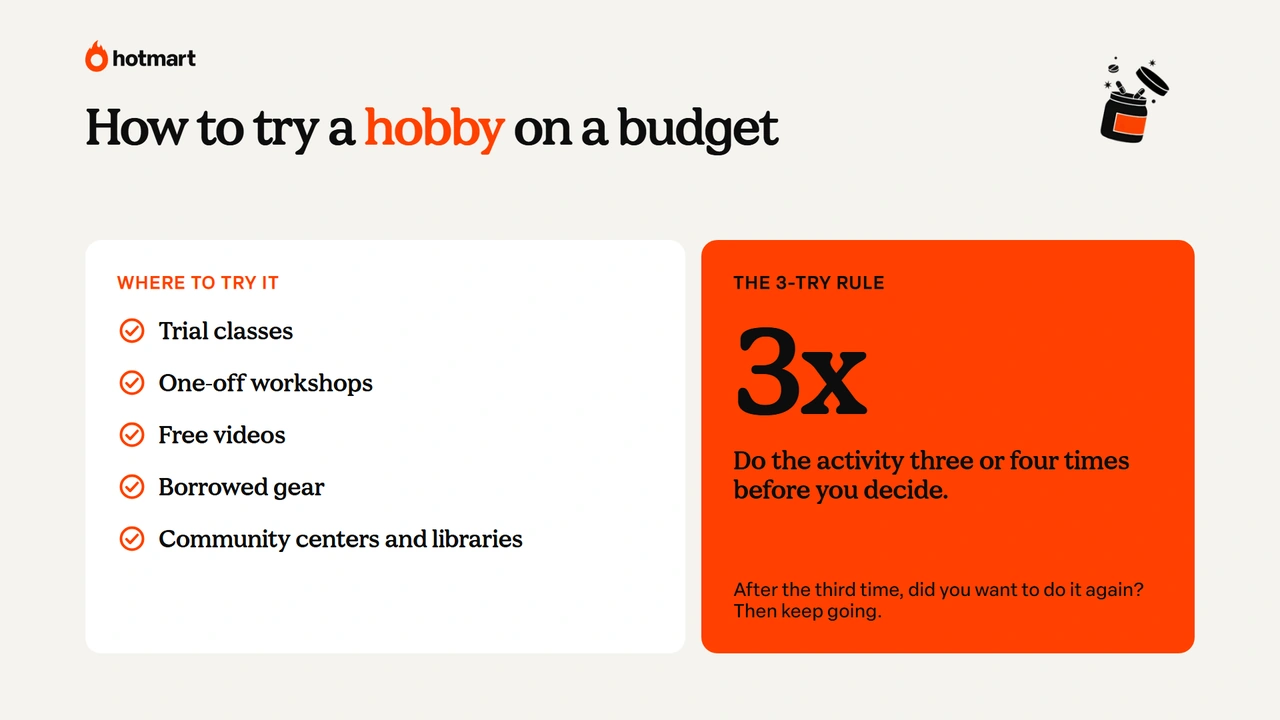
A good strategy is to look for trial classes, drop-in workshops, free videos or borrowed supplies. Community centers, public libraries and your city’s parks and recreation department also often offer low-cost classes where you can explore new interests.
If you want to learn photography, for example, start with your phone. To try painting, buy only the basic supplies.
And don’t give up after the first try. Do the activity three or four times before deciding whether it’s right for you. That way, you can tell the difference between beginner struggles and a real lack of interest. One question helps you decide: after the third time, did you feel like doing it again? If the answer is yes, it’s worth sticking with it.
4. Fit the hobby into your schedule
A hobby has to fit into the life you have now, not that ideal routine where you’d have hours of free time every day.
So start by setting aside 15 to 20 minutes for the activity. You can use your lunch break, your commute to listen to content about a topic you’re curious about or a few minutes on a Sunday morning.
It also helps to set a fixed time each week, without turning it into an obligation.
If you like drawing, for example, you don’t need to spend two hours a day on it. A few minutes of practice can be enough to find out whether it really brings you joy.
Which hobby is right for me? Hobby ideas by profile
The right hobby depends on your interests, your personality and what you’re looking for in your free time. Thinking about your profile can help narrow down the options, but there’s no single answer or scientific test that can tell you which activity you’ll enjoy.
To get started, here are a few possibilities:
| If you want to | Hobbies to try | How to test them on a budget |
|---|---|---|
| Relax and slow down | Embroidery and gardening | A basic embroidery kit or a pot of basil |
| Meet people and socialize | Dancing and board games | A trial dance class or game night at a board game café |
| Get moving | Running and climbing | A free run club in the park or an intro bouldering class |
| Explore your creativity | Drawing and pottery | A pencil and a sketchbook or a drop-in pottery class |
| Take on mental challenges | Chess and learning languages | Free games on Lichess or a language app |
| Dive into the world of tech | Coding and video editing | Free freeCodeCamp courses or CapCut on your phone |
These suggestions are just a starting point. You might enjoy activities from different categories or discover that something completely new suits you better.
If you want to explore more options, check out our list of 42 hobby ideas, with the cost to start and the first step for each one.
What to do when you can’t find a hobby you like
If no hobby seems right for you, start by lowering your expectations and choosing something really simple. You don’t need to find a great passion or uncover a hidden talent. Sometimes a hobby can be something as simple as walking around your neighborhood, listening to a podcast or cooking without rushing.
It’s also worth looking at how your routine is going. When we’re exhausted or overwhelmed, even activities that could be enjoyable seem to take too much energy. Simple mindfulness practices can help you notice that fatigue.
And if you’ve already started several hobbies and quit, that’s okay. Trying something and realizing it’s not for you is also part of the discovery process.
Just try to tell two situations apart: dropping an activity because you’re not good at it yet, or because you genuinely don’t enjoy it. In the first case, it may be worth sticking with it a little longer. In the second, there’s nothing wrong with trying something else.
A hobby doesn’t have to become an obligation, a performance goal or a new source of productivity. Its main purpose is to give you enjoyable moments.
On the other hand, if your lack of interest extends to almost every activity, including the ones you used to enjoy, and lasts for weeks, it’s worth talking to a therapist or doctor. This change may be related to things like burnout or depression and deserves attention.
Ready to find your hobby?
Finding a hobby is more about experimenting than getting it right the first time. And you don’t need the perfect activity to start making better use of your free time.
Looking at your interests, asking the right questions and testing options without spending much are simple ways to begin.
Remember, too, that a hobby has to make sense for your routine. There’s no point choosing an activity that looks interesting but takes more time or money than you can give it right now.
And if something doesn’t work out, that’s fine. You can change your mind, try something different and discover new interests along the way.
How about picking one activity to try this week?
Frequently asked questions about how to find a hobby
Still have questions? Below, we answer some of the most common questions about how to find a hobby.
Is it normal not to have a hobby?
Yes. Not everyone has a defined hobby, especially during busy seasons or when free time is scarce. You can start by trying simple activities, without the pressure of finding a great passion. What matters is discovering what you enjoy doing for fun, at your own pace.
How long does it take to find a hobby?
There’s no set timeline. Some people find an activity they love on the very first try, while others need to test different options. A good idea is to try each activity a few times before deciding. That way, you can see whether your interest grows as you learn and get more comfortable with it.
Can I have more than one hobby?
Yes! You can have as many hobbies as you want, as long as they fit your routine. You can enjoy very different activities, like reading, running and photography, without having to choose just one. Your interests can also change over time, and that’s part of the process.
Is there a quiz to find the right hobby?
There are online quizzes and tests that suggest hobbies based on your interests and preferences. They can help spark ideas, but they can’t tell you for sure which activity you’ll enjoy. The best way to find out is to combine self-awareness with hands-on experience, testing different options before you choose.