Hobbies: What They Are and 42 Hobby Ideas to Start Today, by Category
Discover what hobbies are, their benefits and 42 hobby ideas by category, with the cost to start and a pro tip for each one.

What will we see in this post

Between work, errands and everything else, finding time to do something just for fun feels harder every year. And when a free evening finally shows up, it’s not always easy to know how to spend it in a way that actually feels like a break.
If you’re looking for a new hobby, this article is for you. We’ve gathered 42 hobby ideas across seven categories, each one with how much it costs to start, who it’s best for and a pro tip to help you take the first step this week. First, here’s a quick summary:
| Type of hobby | Examples | Cost to start |
|---|---|---|
| Craft and handmade | Crochet, embroidery, pottery, macramé | Low |
| Artistic and creative | Drawing, watercolor, phone photography, writing | Low |
| Outdoor | Gardening, hiking, birdwatching, stargazing | Free to moderate |
| Sports and fitness | Running, dancing, yoga, climbing, pickleball | Low to moderate |
| Intellectual | Reading, languages, chess, board games | Free to low |
| Tech | Coding, video editing, podcasting, Arduino | Free to moderate |
| At home on a budget | Cooking, sourdough bread, origami, meditation | Free to low |
What are hobbies?
Hobbies are activities you do in your free time for pleasure, with no obligation and, usually, with no goal of making money. The word is a close cousin of pastime and can describe anything you enjoy doing, from cooking to playing a sport or learning a musical instrument.
Besides helping you unwind and break out of your routine, a hobby can be a chance to build new skills and meet new people, a lighthearted path to personal development.
The benefits of hobbies
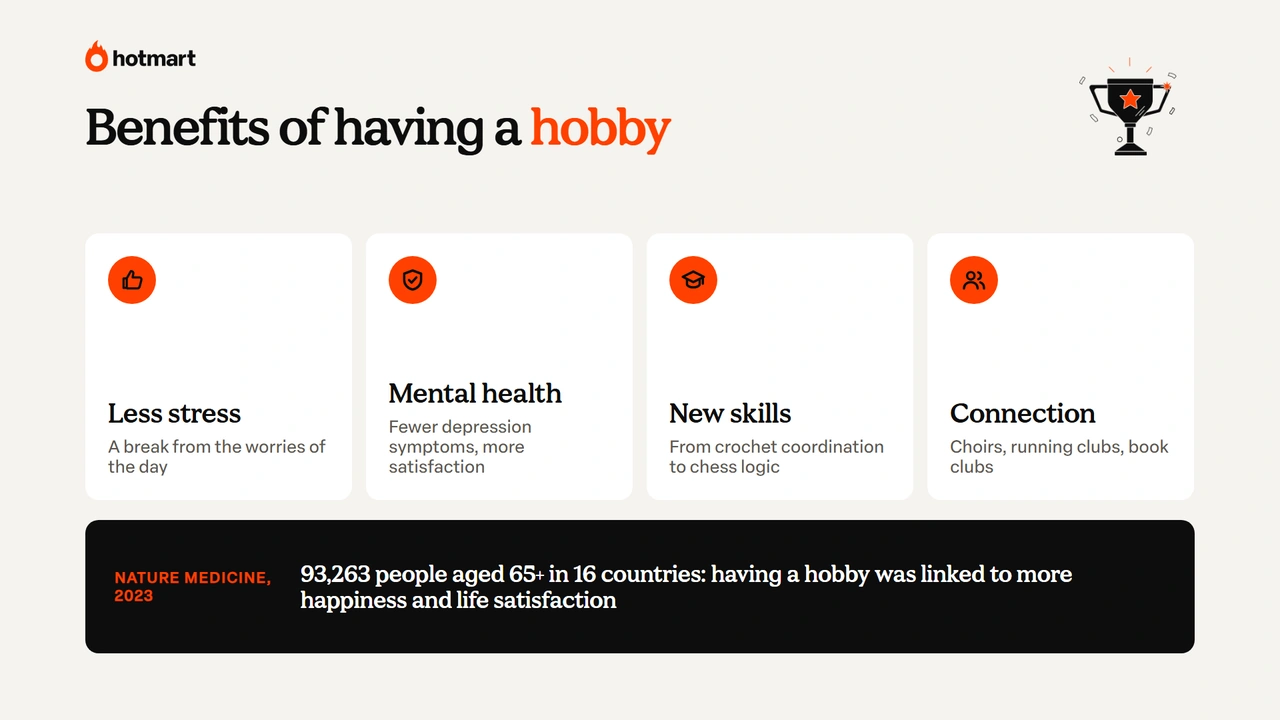
Having a hobby helps relieve stress, support your mental health, build new skills and connect with other people. And these benefits show up even when you spend only a few minutes a week on the activity:
- Less stress: focusing on something enjoyable gives your mind a break from the worries of the day.
- Mental health: hobbies are linked to fewer symptoms of depression and greater life satisfaction, as the study below shows.
- New skills: every hobby trains something different, from the fine motor skills of crochet to the logic of chess.
- Social connection: choirs, run clubs and book clubs bring together people with shared interests.
Many hobbies also lead to what psychologist Mihaly Csikszentmihalyi called flow: that moment when you’re so absorbed in a challenging but doable activity that you lose track of time. That kind of deep focus can also help you improve your concentration for the rest of the day.
A study published in Nature Medicine in 2023 analyzed data from 93,263 people aged 65 and older in 16 countries. The researchers found that having a hobby was associated with fewer symptoms of depression and higher levels of happiness and life satisfaction.
Because it’s an observational study, the results point to an association, not a direct cause and effect relationship.
List of hobbies: 42 hobby ideas for every taste
There are hobbies for every interest, schedule and budget. Some need nothing more than paper and a pen, while others can be tried out in a class, a club or a public park.
To make your choice easier, we’ve organized the 42 ideas into seven categories:
- Craft and handmade hobbies.
- Artistic and creative hobbies.
- Outdoor hobbies.
- Sports and fitness hobbies.
- Hobbies for curious minds.
- Tech hobbies.
- Cheap hobbies to do at home.
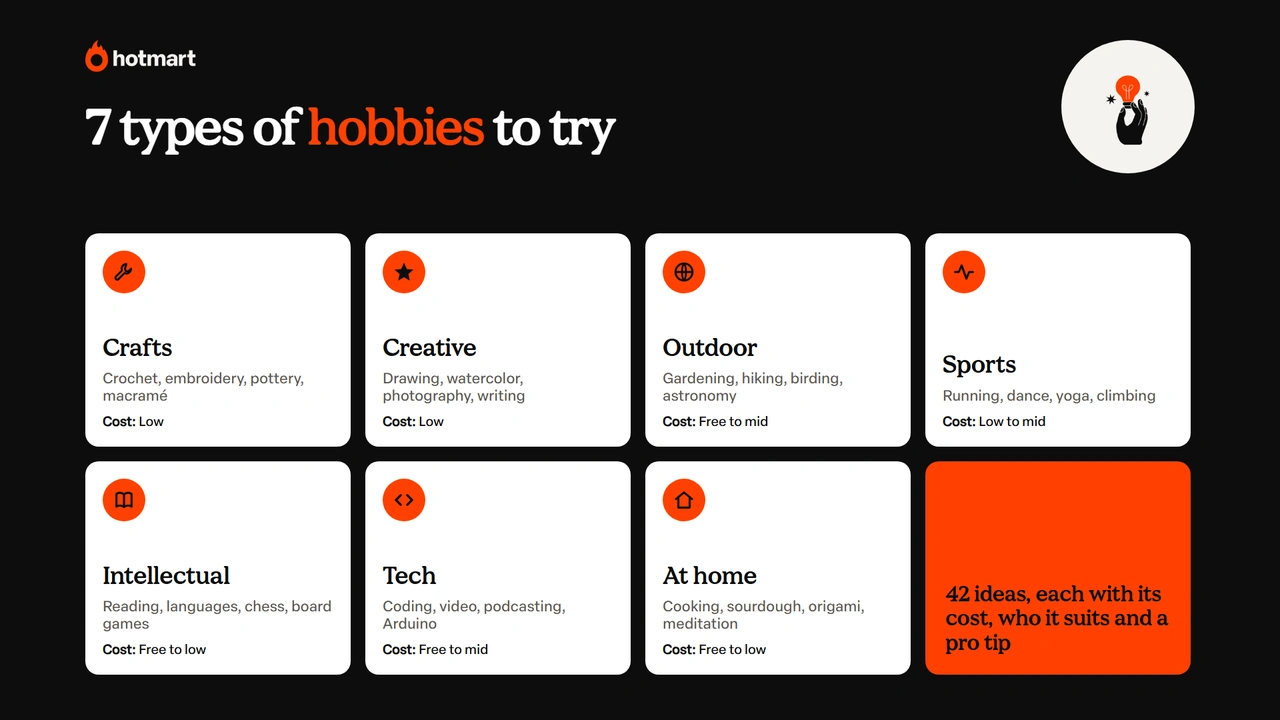
For each idea, you’ll find what it is, how to get started and a quick profile with the cost to start, who the hobby is best for and a pro tip. Browse the options and see which one you’d like to try.
Craft and handmade hobbies
If you like making things with your own hands, craft hobbies are a great bet. Besides sparking your creativity, they let you watch your work take shape little by little.
1. Crochet
Crochet is a craft that uses a hook and yarn to make pieces like bags, clothes, blankets and accessories.
To get started, you need a skein of yarn, a matching hook and free YouTube tutorials. Try making a coaster before moving on to bigger projects.
Cost to start: low (a skein of yarn and a hook). Best for: people who want to slow down and see the result grow in their hands. Pro tip: start with a thick, light-colored cotton yarn: it makes every stitch much easier to see.
2. Embroidery
Embroidery lets you personalize fabric with drawings, words and different kinds of stitches. For beginners, freehand embroidery and cross-stitch offer the most freedom to create designs.
A needle, some floss and a scrap of fabric are enough for your first attempts.
Cost to start: low (a hoop, a needle and a few skeins of floss). Best for: detail lovers who enjoy customizing clothes and tea towels. Pro tip: trace your design onto the fabric with a water-soluble or heat-erasable pen.
3. Pottery
Working with clay is a hobby for people who like shaping objects and playing with form. You can start at home with air-dry clay, making a ring dish or small decorative sculptures.
If you want to try traditional pottery, look for drop-in classes at a local studio that provides the materials and fires your pieces in the kiln.
Cost to start: low with air-dry clay, moderate with a studio class. Best for: people who want a hands-on, almost meditative activity. Pro tip: intro wheel-throwing classes, often sold as a one-night “date night” session, usually include the clay and the firing.
4. Woodworking
Woodworking means shaping wood to make functional or decorative objects.
To get started, choose small projects, like a storage box or a cutting board, using pre-cut lumber.
Before using saws and other tools, learn the safety basics and wear the right protective gear.
Cost to start: moderate. Best for: practical problem solvers who like making useful things. Pro tip: start with reclaimed pallet wood and hand tools before buying power tools. Some public libraries and makerspaces even lend tools or offer shop time.
5. Sewing and upcycling clothes
You probably have a forgotten piece of clothing in the back of your closet, right? It could become the first project of your new hobby.
Sewing lets you alter clothes, add embroidery, swap buttons and create new combinations. Start by learning basic hand stitches. That way, you can try the hobby before investing in a sewing machine.
Cost to start: low (a needle, thread and scissors). Best for: people who want to give old clothes a second life and create one-of-a-kind pieces. Pro tip: turn an old T-shirt into a tote bag as your first project.
6. Macramé
Macramé is a craft that uses knotted cords to make decorative pieces like plant hangers, wall hangings and keychains.
It’s one of the most beginner-friendly craft hobbies, since you basically need cord and scissors. A simple keychain makes a great first project.
Cost to start: low (cotton cord and scissors). Best for: people who love handmade home decor. Pro tip: learn just three knots (the square knot, the spiral knot and the half hitch) and you can already make a plant hanger.
Artistic and creative hobbies
Creative hobbies are perfect for anyone who wants to explore new ways of expressing themselves. And you don’t need experience or artistic talent to start.
7. Drawing
Drawing can be a way to look at the world more closely and capture your ideas.
All you need is a pencil and paper. Try keeping a sketchbook and spending a few minutes a day drawing everyday objects.
The goal isn’t to make perfect drawings, but to build the habit.
Cost to start: almost nothing (a pencil and paper). Best for: people who want to sharpen their eye for detail. Pro tip: draw the same coffee mug on different days and compare your progress after a month.
8. Watercolor painting
Watercolor uses paints diluted in water to create works with different intensities and effects. A basic paint set, a brush and the right paper are enough to try the technique.
Start by painting simple shapes, leaves or landscapes. Free tutorials can teach you how to control the water and blend colors on the paper.
Cost to start: low. Best for: people who love color and the effects that appear on their own on the paper. Pro tip: a thicker paper made for watercolor makes a bigger difference to your results than expensive paint.
9. Phone photography
You don’t need a professional camera to make photography your hobby. With your own phone, you can explore framing, lighting, color and perspective.
One idea is a photo-a-day challenge, capturing different themes like architecture, nature or everyday scenes. YouTube also has plenty of videos that explain the technical side and simple editing.
Cost to start: free. Best for: people who walk around town and love noticing details. Pro tip: wipe the lens before shooting and turn on the camera grid to frame your shots better.
10. Creative writing
Creative writing is a great option if you like imagining stories or putting your thoughts on paper.
You can write short stories, essays, poems or keep a personal journal.
To start, pick a topic and write for ten minutes without stopping to edit each sentence. The point is to let the ideas flow.
Cost to start: free. Best for: restless imaginations and word lovers. Pro tip: start a story from a line you overheard in the checkout line or on the bus.
11. Playing a musical instrument
Learning an instrument can be a lot of fun, even if you’ve never studied music.
Guitar, ukulele and keyboard are popular choices for beginners.
Before buying an instrument, look for trial lessons or see if you can borrow one. Then set small practice goals.
Cost to start: moderate (lessons and an instrument). Best for: people who want a long-term challenge with quick rewards. Pro tip: the ukulele has only four strings and is often one of the fastest instruments for playing your first songs.
12. Singing in a choir
If you love to sing, joining a choir can be a way to develop that skill and meet people.
There are amateur and community choirs at universities, churches and community centers, and some are free to join.
Many groups welcome beginners, but it’s worth checking the requirements and whether there’s an audition.
Cost to start: usually free. Best for: people who love to sing and want to make friends. Pro tip: many community choirs accept singers who can’t read sheet music, so ask before you give up on the idea.
Outdoor hobbies
If you spend most of your day indoors, outdoor hobbies are a chance to change the scenery, explore new places and enjoy some time in nature.
13. Gardening
Caring for plants can become a hobby even if you live in an apartment.
Start with a small container garden, growing basil, chives or other plants that suit the space you have.
Succulents are also popular, as long as they get the light and care they need.
Cost to start: low (pots, soil and seedlings). Best for: people who want a bit of nature at home. Pro tip: start with kitchen herbs, which grow fast and go straight to your plate. No yard? Many cities have community gardens where you can rent a small plot.
14. Hiking
Hiking lets you discover new landscapes, get some exercise and spend more time outdoors.
To start, choose short, well-marked trails, ideally in state or local parks with visitor facilities.
Bring water, wear comfortable clothes and proper shoes, check the weather and always tell someone which trail you’re taking.
Cost to start: low. Best for: people who want to unplug from screens and breathe some fresh air. Pro tip: apps like AllTrails show the distance, elevation gain and recent reviews from people who’ve hiked the trail.
15. Birdwatching
Birdwatching, or birding, means identifying birds and observing their behavior in their natural habitat.
You can start in a local park, a nature preserve or even from your window.
The free Merlin Bird ID app, from the Cornell Lab of Ornithology, helps you identify species from photos and sounds.
Cost to start: free. Best for: patient people who are curious about nature. Pro tip: the first hours of the morning are usually the best time to see and hear birds. Local Audubon chapters often lead free bird walks for beginners.
16. Camping
Camping is a way to enjoy nature and try out a different routine.
If you’ve never camped before, start at an established campground with restrooms and designated tent sites.
Before buying gear, look into rentals or borrow from friends. That way, you find out whether you enjoy the experience without a big investment.
Cost to start: moderate. Best for: adventurers who love sleeping under the stars. Pro tip: spend your first night at a campground with showers, close to home. Many state parks let you book a site online in advance.
17. Fishing
Recreational fishing appeals to people who enjoy calm activities by rivers, lakes or stocked ponds.
One popular approach is catch and release, where the fish is carefully returned to the water.
To start, look for approved fishing spots and check your state’s rules on fishing licenses, seasons and permitted gear.
Cost to start: moderate. Best for: people who enjoy quiet, peaceful activities. Pro tip: many states hold free fishing days with no license required, and some piers and bait shops rent rods, which makes the first try much easier.
18. Stargazing and amateur astronomy
Watching the Moon, the planets and the stars can be a fascinating hobby if you’re curious about the universe.
You can start without a telescope, using apps like Stellarium to identify what’s in the sky.
Planetariums and observatories also often host events open to the public, and local astronomy clubs organize star parties where members share their telescopes. Check what’s happening near you.
Cost to start: free. Best for: anyone curious about the universe. Pro tip: an ordinary pair of binoculars already shows the Moon’s craters in surprising detail.
Sports and fitness hobbies
If you want to get moving, sports hobbies offer options for every fitness level and preference.
19. Running
Running is an accessible way to exercise outdoors.
If you’re just starting, try alternating walking and running, gradually increasing the effort as your fitness improves. Programs like Couch to 5K follow exactly that idea.
It’s also worth looking for free run clubs in your area, which can help keep you motivated. Many running stores host weekly group runs.
Cost to start: low (a comfortable pair of running shoes). Best for: people who love goals and feeling their own progress. Pro tip: run at a pace where you can still hold a conversation: it’s a sign the effort is right for a beginner.
20. Cycling
Biking lets you explore your city, enjoy the outdoors and get some exercise.
To start, use bike lanes and greenways, and choose routes that match your experience level.
If you don’t have a bike, try a bike share program, like Citi Bike in New York or Divvy in Chicago, before deciding to buy one.
Cost to start: low to moderate. Best for: people who want to see their city from a new angle. Pro tip: keep an eye out for open streets events, when many cities close roads to cars on weekends so you can ride without traffic.
21. Dancing
Dancing is a way to move your body, meet people and learn new rhythms. Salsa, swing and ballroom are great options if you enjoy partner dancing.
Look for trial classes at dance studios or community centers. Many places offer beginner groups, and some bars and clubs host a free lesson before social dance nights.
Cost to start: moderate (classes). Best for: people who want to move and meet new people. Pro tip: you don’t need to bring a partner: many studios rotate partners during class.
22. Yoga
Yoga combines postures, breathing and body awareness. You can start with beginner classes, in person or online, respecting your physical limits.
A mat and a quiet space are enough to try the basic poses. If you have a health condition or physical limitation, get proper guidance first.
Cost to start: low (a mat). Best for: people who want flexibility and a moment of calm. Pro tip: start with 15 to 20 minute beginner classes and build up gradually. Many parks run free outdoor yoga in the summer.
23. Climbing
Climbing is a hobby for people who enjoy physical challenges and learning new skills.
One beginner-friendly option is bouldering, which is done on lower walls with crash pads underneath.
Climbing gyms usually offer intro classes and shoe rentals, so you can try it before investing in gear.
Cost to start: moderate. Best for: people who love physical challenges and solving problems. Pro tip: every bouldering route is a puzzle, so climbing trains your body and your brain at the same time.
24. Pickleball and beach tennis
Pickleball, one of the fastest-growing sports in the US, mixes elements of tennis, badminton and ping-pong. It’s played with paddles and a plastic ball, usually in doubles. Its sandy cousin, beach tennis, is played on the sand with rackets and a ball and is catching on in coastal towns.
To start, look for group lessons or open play sessions at courts near you. Many parks and recreation centers have courts, and a lot of tennis courts now have pickleball lines too.
Joining a group can help you split the cost of court rental and equipment and makes it easier to meet other players.
Cost to start: moderate (lessons and court rental). Best for: people who want a social sport played outdoors. Pro tip: many courts and clubs lend or rent paddles, so you can try before buying your own.
Hobbies for curious minds
Intellectual hobbies are great if you love learning, exploring new subjects and giving your brain a workout in your free time.
25. Reading and book clubs
Reading is a pastime that opens the door to new stories, ideas and perspectives.
You can start by picking books on topics that spark your curiosity, without setting goals that are too hard to reach.
Public libraries are a free option, and apps like Libby let you borrow ebooks and audiobooks with your library card. Book clubs, in person or online, help you share impressions and discover new titles.
Cost to start: free. Best for: people who want to travel without leaving home. Pro tip: follow the rule of 50 from American librarian Nancy Pearl: if a book hasn’t hooked you by page 50, it’s fine to switch to another.
26. Learning a language
Studying a new language can be a hobby for people who love discovering cultures and new ways to communicate.
Apps like Duolingo, free videos and shows with subtitles are good resources to start.
It’s also worth joining conversation groups, which you’ll often find at libraries or on Meetup, and practicing a little every day.
Cost to start: low. Best for: people who dream of traveling or exploring other cultures. Pro tip: switch your phone’s language to practice vocabulary every day without even trying.
27. Chess
Chess is a strategy game that calls for attention, planning and decision-making.
You can learn the rules and play for free on platforms like Lichess and Chess.com, which offer resources for beginners.
Start with simple games and piece movement puzzles.
Cost to start: free. Best for: strategic thinkers who like planning a few moves ahead. Pro tip: solve the Lichess daily puzzle: it’s short and trains your reasoning.
28. Jigsaw puzzles
Putting together jigsaw puzzles is something you can do on your own or with others.
If you’re just starting, choose puzzles with fewer pieces and increase the difficulty little by little.
Crosswords and sudoku are also great alternatives if you enjoy logic and reasoning challenges.
Cost to start: low. Best for: people who want to switch off from their worries. Pro tip: do the edges first and sort the pieces by color before tackling the middle.
29. Board games
Board games are great for getting friends together and meeting people with similar interests. Beyond the classics, you can try modern games like Catan, Ticket to Ride and Dixit.
Before buying, check out board game cafés or game nights, where you can try different titles.
Cost to start: moderate. Best for: people who want to bring friends and family together away from screens. Pro tip: cooperative games like Pandemic, where everyone plays together against the board, are perfect for beginners.
30. Collecting
Collecting can be a great hobby if you like researching the stories behind objects and hunting for special finds.
Vinyl records, stamps, coins and trading cards are a few examples.
To start, choose a theme that truly interests you and set a budget. Flea markets, swap meets and collector meetups can help you grow your collection without spending too much.
Cost to start: varies. Best for: treasure hunters who love the history of objects. Pro tip: narrow your focus, like records from a single genre, so your collection has its own identity and fits your budget.
Tech hobbies
If you love technology, there are hobbies that let you explore digital tools, build projects and learn new skills.
31. Coding
Learning to code can be a fun hobby if you enjoy solving problems and building things.
You can start by making simple web pages or small games, even with no prior experience.
Platforms like freeCodeCamp offer free courses to learn programming concepts and web development.
Cost to start: free. Best for: logical thinkers who love building things from scratch. Pro tip: Scratch, created by MIT, teaches programming logic visually by snapping blocks together.
32. Video editing
Video editing is a creative hobby that lets you turn raw footage into stories.
You can start with travel videos, moments with friends or clips from your everyday life.
Tools like CapCut and DaVinci Resolve have free versions so you can experiment with cuts, transitions, soundtracks and other editing features.
Cost to start: free. Best for: natural storytellers. Pro tip: for your first challenge, edit a 30-second video using photos from last weekend.
33. Music production on the computer
Making music on a computer is possible even if you don’t play an instrument yet.
Programs like GarageBand and BandLab have features for making beats, experimenting with sounds and recording your own songs.
Start by creating a short track and exploring the virtual instruments available.
Cost to start: free. Best for: music lovers, even if they don’t play an instrument. Pro tip: try recreating the beat of a song you love: it’s the most fun way to learn.
34. Podcasting
If you enjoy talking or sharing ideas, starting a podcast could be your next hobby.
Choose a topic, outline a few talking points and try recording a short episode. Here’s a step-by-step guide on how to start a podcast.
At first, a phone and earbuds with a mic may be all you need. What matters is finding a quiet space and testing your audio quality.
Cost to start: low (a phone and earbuds). Best for: people who love conversation and sharing ideas. Pro tip: record next to an open closet full of clothes: the fabric absorbs echo and makes you sound better.
35. Electronics with Arduino
Arduino is a platform used to build interactive electronics projects.
With it, you can learn basic programming concepts and put together simple circuits, like a soil moisture sensor for your plants.
To start, look for beginner tutorials and starter kits, and follow the safety guidelines for each component.
Cost to start: moderate (a starter kit). Best for: people who love figuring out how things work. Pro tip: the free Tinkercad Circuits simulates Arduino circuits in your browser before you buy any parts.
36. Video games
Playing video games can be a hobby too, especially if you love stories, challenges and interactive experiences.
There are adventure, strategy and simulation games, plus co-op modes to play with friends.
The key is to choose titles that match your interests and keep a healthy balance between game time and the rest of your routine.
Cost to start: varies. Best for: people who love interactive stories and playing with friends. Pro tip: online co-op games can become a weekly hangout with friends who live far away.
Cheap hobbies to do at home
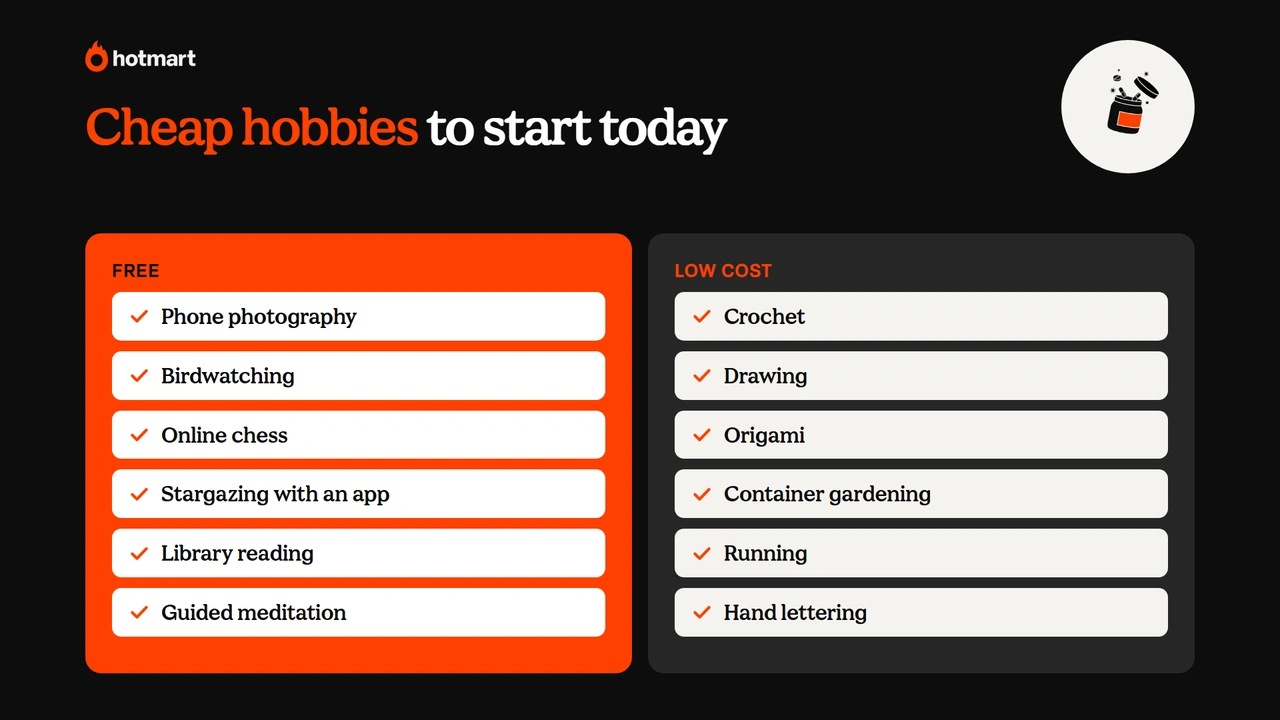
Not every hobby requires expensive gear or leaving the house. Some can start with things you already have, making them perfect for winding down.
37. Cooking
Cooking can stop being just another chore and become a time to experiment.
One idea is to pick a new recipe every week, exploring dishes from different regions or countries.
Start with ingredients you already have and write down your favorite recipes so you can make them again.
Cost to start: low. Best for: people who want to turn a daily chore into a pleasure. Pro tip: cook that family recipe and write down the steps before it gets lost.
38. Sourdough bread
Baking sourdough bread is a hobby for people who enjoy following a process and experimenting with recipes.
The technique uses a sourdough starter, a natural leaven grown from flour and water.
The basic ingredients are simple, but the process takes patience and attention to fermentation times. Free tutorials can help with your first loaves.
Cost to start: low (flour, water and salt). Best for: patient people who like watching a process unfold. Pro tip: a starter takes a few days, usually about a week, to become active: use that time to study recipes. Or ask a baker friend for a spoonful of theirs to skip the wait.
39. Origami
Origami is the Japanese art of folding paper into figures. It’s a very accessible hobby, since all you need to start is some paper.
Try simple models, like a paper boat and the traditional paper crane, before moving on to more complex figures.
Cost to start: almost nothing (paper). Best for: people who want a focused activity they can do anywhere. Pro tip: according to Japanese legend, folding a thousand paper cranes can make a wish come true.
40. Hand lettering
Hand lettering is the art of drawing letters, playing with different styles, shapes and layouts.
You can use it to make greeting cards, notebook headers or decorative pieces.
Start with a pencil and a regular pen. Then, if you enjoy it, try brush pens and the free practice sheets you’ll find online.
Cost to start: low. Best for: people who love beautiful letters and stationery. Pro tip: make your upstrokes thin and your downstrokes thick, even with a regular pen, to mimic calligraphy.
41. Meditation
Meditation is a practice that involves directing your attention and becoming more aware of the present moment.
You can start by setting aside a few minutes a day to follow a guided meditation.
There are free audio sessions on apps and video platforms. Find a quiet space and try different approaches until you find one that works for you. If you enjoy it, it’s worth exploring mindfulness practices too.
Cost to start: free. Best for: people who want more calm and focus. Pro tip: start with three minutes of paying attention only to your breath, every day at the same time.
42. Bullet journaling
The bullet journal, created by American designer Ryder Carroll in 2013, is a personal organization method that uses a notebook to keep track of tasks, appointments, ideas and goals. Besides helping you plan, it can become a creative hobby if you like drawing, decorating pages and organizing information.
All you need to start is a notebook and a pen. There’s no need to invest in fancy stationery. Your notebook is also a great place to track your SMART goals.
Cost to start: low (a notebook and a pen). Best for: people who love organization and creativity on paper. Pro tip: start with just the index and your daily task list: the decorated pages can come later.
How to choose among so many hobbies
To choose a hobby, think about how much time and money you have, which activities spark your curiosity and what you’d like to get out of your free time.
If you want to relax, try reading, painting or gardening. To get moving, running, dancing and cycling are good choices. And if you want to meet people, look for group classes, book clubs or board game nights.
It’s also worth looking at your routine. Someone who spends the whole day at a computer, for example, might enjoy trying hands-on or outdoor activities.
Before buying gear or signing up for long courses, give it a test run. That way, you find out whether you really enjoy the activity. Want to dig deeper into your preferences? Check out our guide on how to find a hobby, with questions and simple tests to help you find yours.
How to stick with a hobby
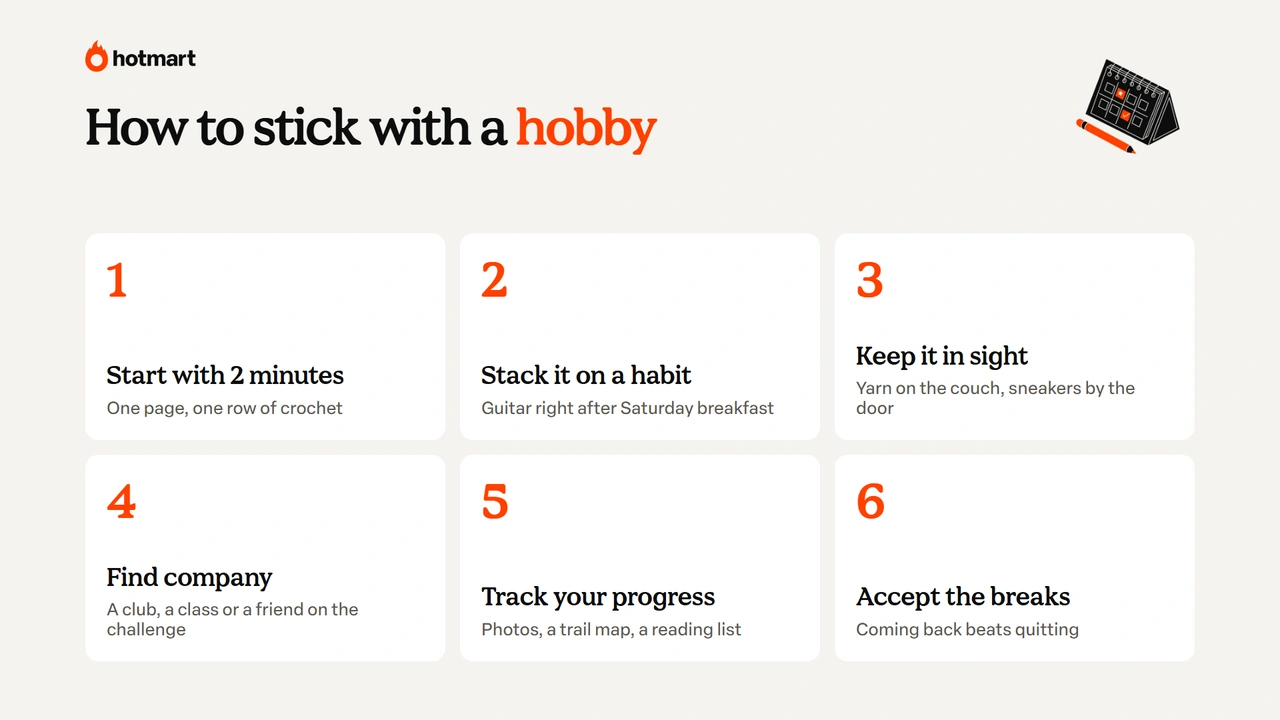
To stick with a hobby, start small, keep your supplies in sight and tie the activity to a habit you already have. The excitement of the beginning fades, and what keeps a hobby going is how easy it is to come back to it. These tips help:
- Start with two minutes: the two-minute rule, from James Clear’s book Atomic Habits, suggests starting with a version of the activity so short it’s hard to say no, like reading one page or crocheting one row.
- Stack the hobby on an existing habit: for example, ten minutes of guitar right after Saturday breakfast.
- Keep your supplies in sight: the hook and yarn on the couch, your sneakers by the door, the book on your nightstand.
- Find company: a run club, a dance class or a friend who takes on the same challenge helps you show up consistently.
- Track your progress: photos of your projects, a map of the trails you’ve hiked or a list of the books you’ve read show how far you’ve come.
- Accept the breaks: busy seasons are part of life. Coming back after a week off is better than quitting for good.
And remember: a hobby is supposed to bring you joy, not become one more thing on your to-do list. If it starts to feel like a chore, slow down or try something else.
Hobbies that make money: how to turn a pastime into a digital product
Some hobbies can become a source of income, especially when you teach what you’ve learned to other people.
Picture someone who started crocheting to relax and, over time, mastered all kinds of techniques. That person could create a course for beginners, teaching everything from the first stitches to finished pieces.
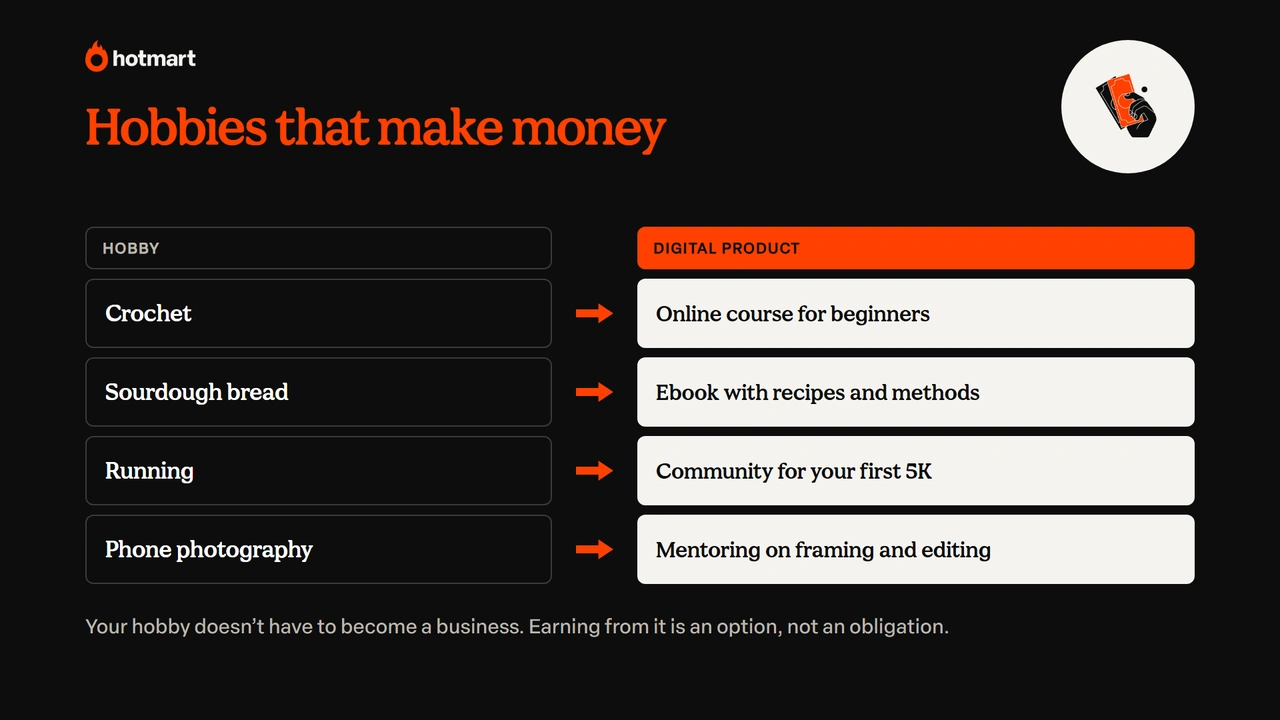
The same goes for many activities on this list. Here are a few examples:
- Crochet: an online course with lessons for beginners.
- Sourdough bread: an ebook with recipes and step-by-step baking guidance.
- Running: a membership community for people who want to finish their first 5K.
- Phone photography: a mentoring program for people who want to learn framing, lighting and editing.
If you decide to turn your knowledge into a digital product, Hotmart can help.
On the platform, you can create and list online courses and ebooks for free, with no required monthly fee to get started. In November 2026, Hotmart’s fee is 9.9% + US$1.00 per approved sale, charged only when you make a sale.
You can also build digital communities with recurring subscriptions, bringing together people interested in the same topic and offering them exclusive content.
But here’s something worth remembering: your hobby doesn’t have to become a business. Doing something simply because you enjoy it is reason enough. Turning it into a way to make extra money is an option, not an obligation.
Ready to start a new hobby?
Now that you know so many different types of hobbies, it’s easier to find an activity that matches your interests.
Whether it’s learning to play the guitar, crocheting, running in the park or putting together a puzzle, what matters is setting aside time to do something you truly enjoy.
And you don’t need to start with a big investment. Many hobbies can be tried at home, with simple supplies or free activities. Pick an idea from this list, give it a first try and see how you feel. Who knows, this pastime might become your new passion.
And if one day you want to share what you’ve learned with others, your knowledge could also open the door to creating a digital product.
Frequently asked questions about hobbies
Still have questions? Below, we answer some of the most common questions about hobbies.
Is it hobbys or hobbies?
The correct plural is hobbies. In English, when a word ends in a consonant followed by y, the y changes to ies in the plural, just like city and cities. So hobbys and hobbie are misspellings. The word itself comes from hobby horse, a children’s toy horse, and came to mean a favorite pastime in the early 1800s.
What’s a good hobby to do alone?
Reading, drawing, photography, crochet, gardening and creative writing are great hobbies to do alone. The best choice depends on your interests and how much free time you have. If you prefer calm activities, try origami or meditation. If you enjoy a challenge, chess and coding are good options.
Should you put hobbies on your resume?
Yes, as long as your hobbies relate to the job or help show qualities that matter for the role. For example, singing in a choir can show you enjoy teamwork, while coding as a hobby can be relevant for tech roles. Only include information that’s true and relevant.
How much time per week should you spend on a hobby?
There’s no required number of hours. You can start by setting aside 15 or 30 minutes a few times a week and adjust based on your schedule. What matters most is that the activity is enjoyable and doesn’t turn into one more obligation in your routine.