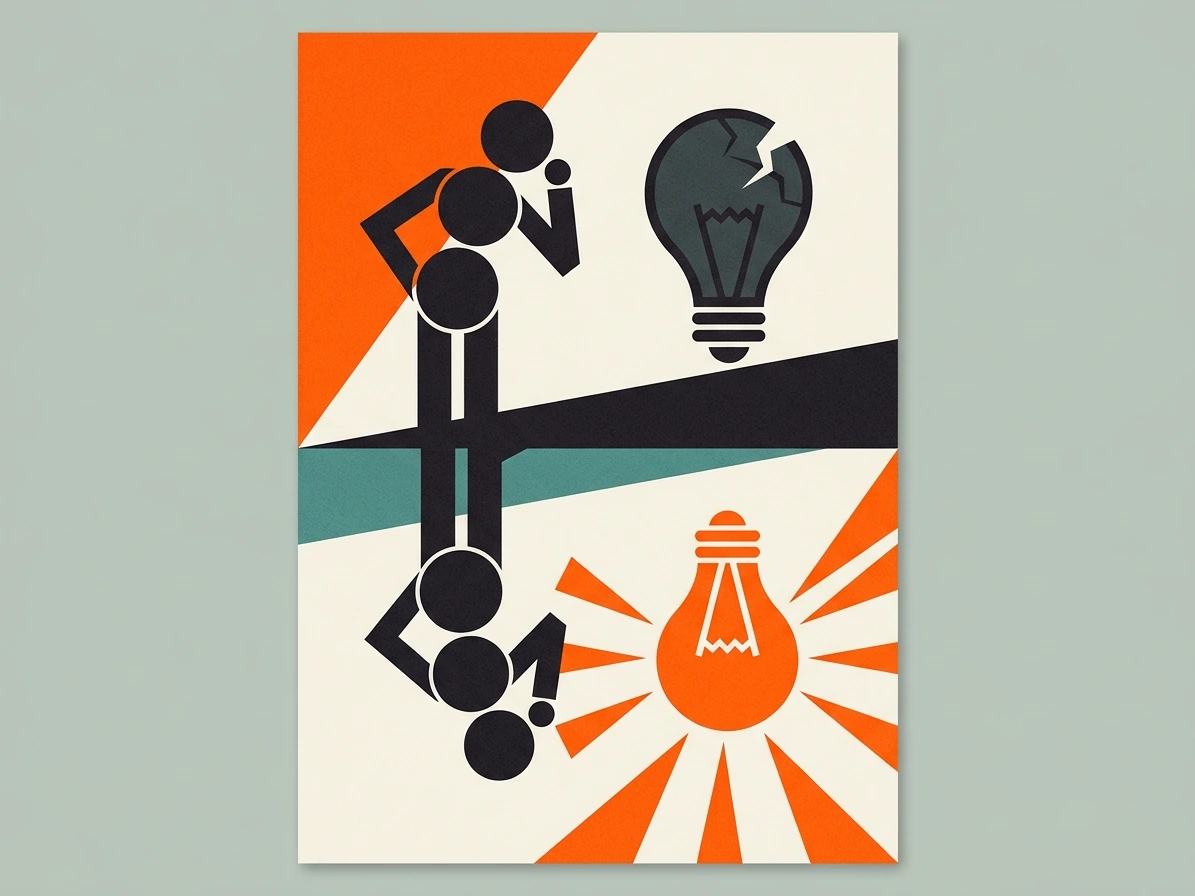
Reverse Brainstorming: What It Is, How to Do It and a Practical Example
Learn what reverse brainstorming is, how flipping the question helps you find solutions in 5 steps and a full example applied to an online course.

What will we see in this post

When ideas won’t come and your team can’t seem to find a solution, it may be time to ask the opposite question: what if, instead of solving the problem, we tried to make it worse?
That’s the idea behind reverse brainstorming, a technique that uses reverse thinking to find solutions. In this article, you’ll learn how it works, how to apply it in five steps and see a practical example of reducing student drop-off in online courses. First, here’s a quick summary:
| Question | Answer |
|---|---|
| What is reverse brainstorming? | It’s a technique that asks how to cause or worsen a problem, then turns each answer into a solution. |
| How is it different from brainstorming? | Traditional brainstorming looks for solutions directly; reverse brainstorming looks for the causes of a problem and then flips them. |
| How do you do reverse brainstorming? | Define the problem, reverse the question, list ways to make it worse, turn each idea into a solution and prioritize the actions. |
| When should you use it? | When ideas get stuck or when you need to anticipate risks, such as before a launch. |
What is reverse brainstorming?
Reverse brainstorming is an idea generation technique that flips the question of traditional brainstorming. Instead of asking “how can we solve this problem?”, the group tries to figure out “how can we cause or worsen this problem?”.
Also called reverse thinking or the reverse brainstorming technique, the method follows a simple logic: identify everything that could go wrong, then turn those situations into actions to prevent them.
The technique works because it’s often easier to spot flaws than to come up with the perfect solution right away. Thinking about absurd or exaggerated situations also takes the pressure off getting it right and sparks new perspectives.
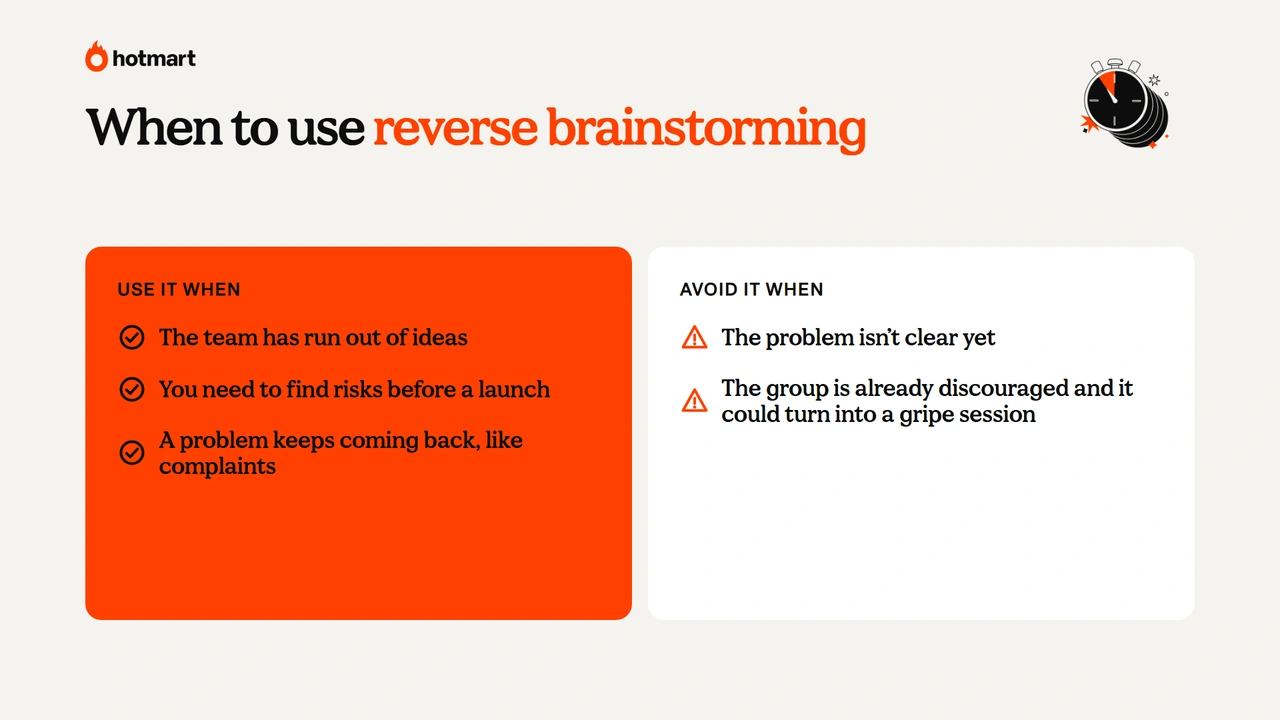
Reverse brainstorming is especially useful when a team is stuck, needs to identify risks before a launch or wants to improve processes, such as customer service and the student experience.
On the other hand, be careful if the problem isn’t clear yet or the group is already discouraged. Without a well-defined goal, the session can turn into a gripe session.
What’s the difference between brainstorming and reverse brainstorming?
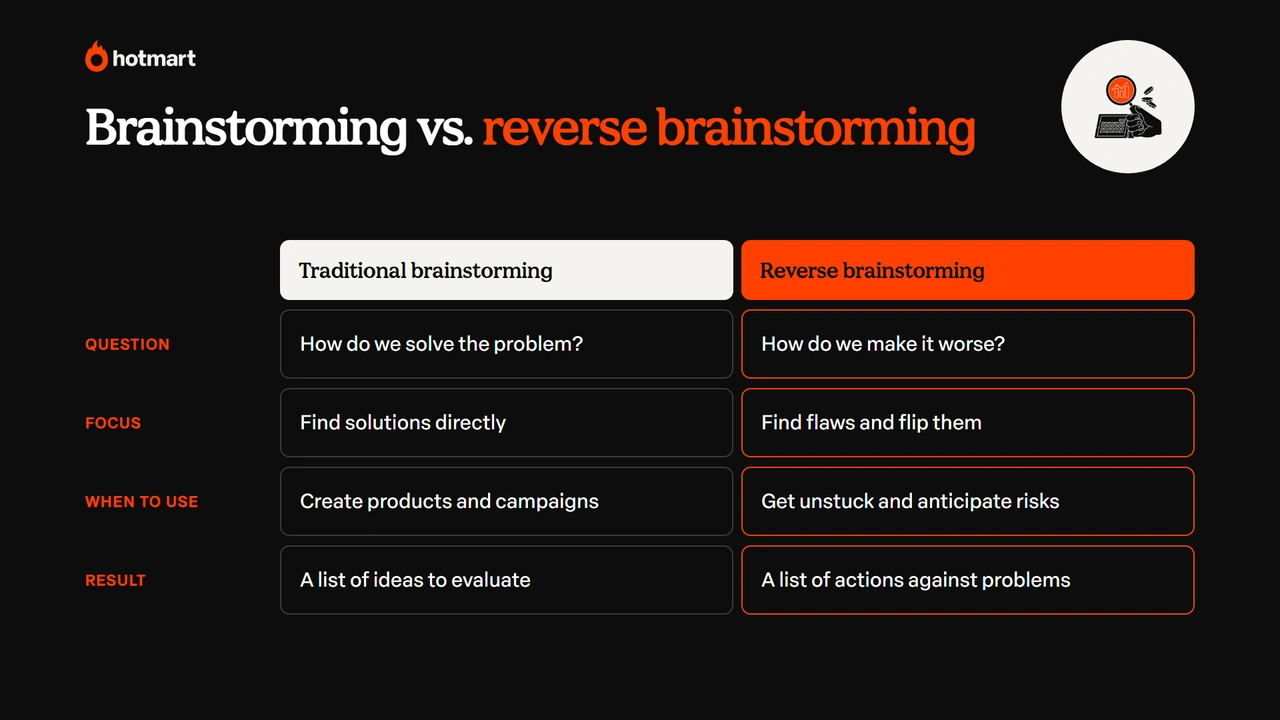
The main difference is the question used to generate ideas. Traditional brainstorming looks for solutions directly, while reverse brainstorming looks for ways to cause or worsen a problem and then flips those suggestions.
Traditional brainstorming was developed by advertising executive Alex Osborn and popularized in his book Applied Imagination, published in 1953. The idea is to generate lots of ideas without judging them during the creative stage.
Reverse brainstorming keeps that logic but changes the starting point.
| Traditional brainstorming | Reverse brainstorming |
|---|---|
| Question: how can we solve the problem? | Question: how can we make the problem worse? |
| Focus: find solutions directly | Focus: spot flaws and turn them into solutions |
| When to use: to create products, campaigns or new possibilities | When to use: to get past creative blocks and anticipate risks |
| Result: a list of ideas to evaluate | Result: a list of actions to prevent or fix problems |
You can use both approaches together, depending on the challenge.
Want to learn more about the original technique? Read our guide on what brainstorming is and how to do it.
How to do reverse brainstorming: step by step
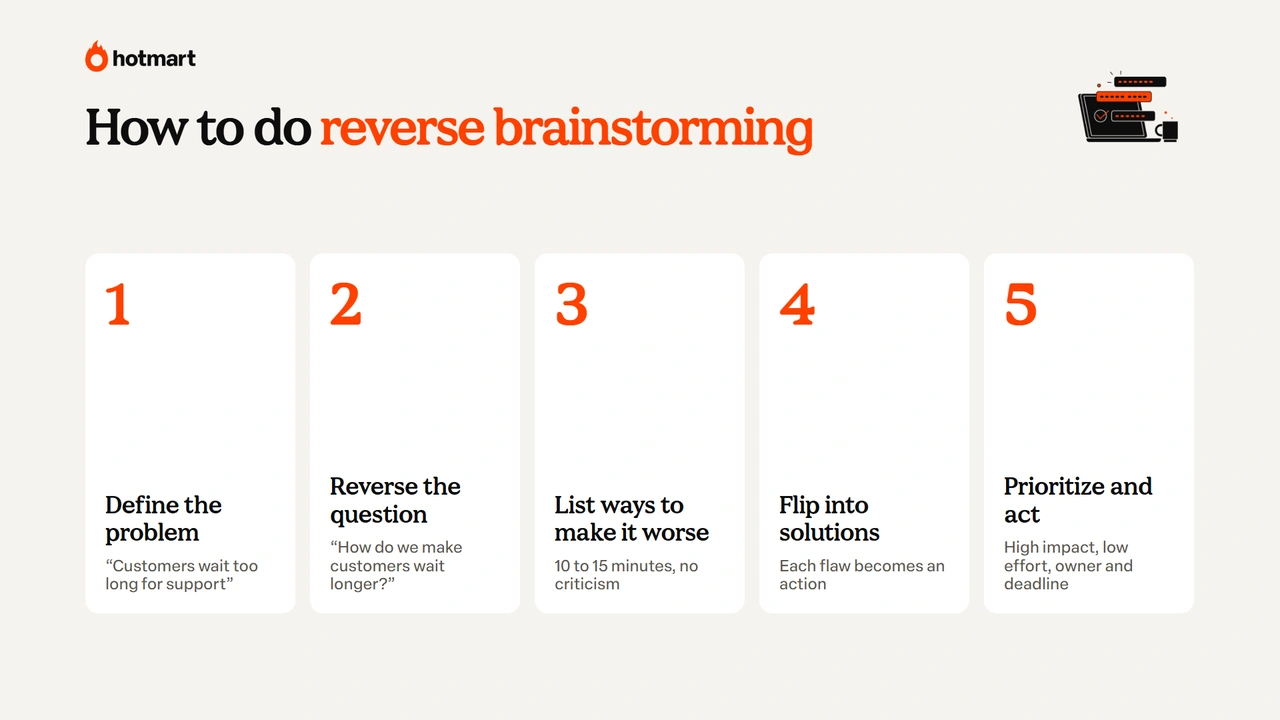
To do reverse brainstorming, you define a problem, reverse the question, imagine ways to make things worse and turn those answers into practical solutions.
The reverse brainstorming process has five steps:
- Define the problem.
- Reverse the question.
- List every way to make it worse.
- Group the ideas and turn each one into a solution.
- Prioritize the best ones and create an action plan.
Here’s how to put each step into practice.
1. Define the problem in one sentence
Start by identifying a clear, specific challenge so every participant understands what needs to be solved.
For example, instead of a vague goal like “improve customer service”, define the problem: “our customers wait too long for a reply from support”.
The clearer the situation, the more focused the ideas will be.
2. Reverse the brainstorming question
Now turn the goal into a question that invites problems.
In the example above, the question could be: “How can we make customers wait as long as possible for a reply?”
It may sound strange, but that reversal is exactly what helps you spot flaws that go unnoticed day to day.
3. List every way to make it worse
Set aside 10 to 15 minutes to gather as many suggestions as possible. At this stage, no idea is criticized or thrown out.
You can use sticky notes, a whiteboard or online tools, like Miro’s reverse brainstorming template.
Feel free to imagine extreme situations, like shutting down every contact channel or answering messages only once a week. What matters is exploring possibilities before evaluating them.
4. Group the ideas and flip each one into a solution
Once you’ve gathered the suggestions, sort them by similar themes, such as communication, deadlines and tools.
Then turn each problem into an action that prevents it.
For example, the idea of “leaving emails unanswered over the weekend” can become “set up an auto-reply with a response time and offer Saturday coverage”.
That way, negative situations become opportunities to improve.
5. Prioritize and turn the reverse brainstorming into an action plan
With the solutions defined, evaluate which ones have the highest potential impact and the lowest effort.
Choose your priorities, assign owners and deadlines and decide how you’ll track results. A Kanban board helps you follow each action.
A support team, for example, could test a new way of organizing messages for two weeks and compare response times before and after the change. Response time is one of the key indicators of customer experience. The goal is to leave the session with concrete actions, not just a list of problems.
Reverse brainstorming example: how to reduce online course drop-off
Picture a creator who sells an online course on baking. She notices that many students buy the product, watch the first lessons and then stop following the content.
Instead of asking “how do I get students to finish the course?”, she decides to apply the reverse brainstorming technique and starts with this question:
“How can we get students to quit the course before they finish?”
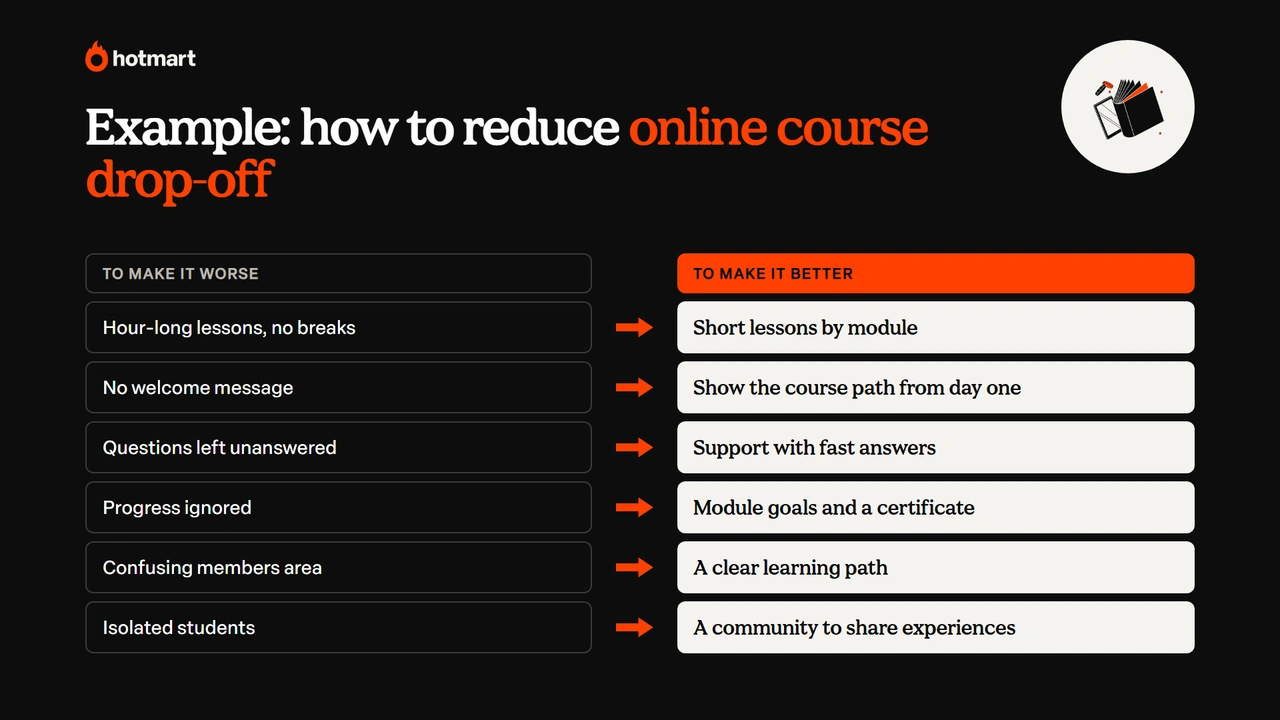
During the session, a few ideas to make the experience worse come up:
- Create hour-long lessons with no breaks.
- Send no welcome message.
- Leave questions unanswered for days.
- Offer no certificates or progress milestones.
- Organize the content in a confusing members area.
- Block any interaction between students.
After listing the suggestions, it’s time to flip each one.
| Idea to make the experience worse | Action to improve retention |
|---|---|
| Long lessons with no breaks | Short lessons organized by module |
| No welcome message | Show the learning path from the start |
| Questions left unanswered | Support channels and fast answers |
| Ignoring student progress | Module goals and certificates |
| A confusing members area | A clear learning path |
| No interaction between students | A community to share experiences |
With this exercise, the creator identifies changes that can improve the experience for people who bought the course.
Several of these actions depend on where the lessons live. When a course feels disorganized and students can’t see their progress, they’re more likely to lose interest.
In this scenario, the Hotmart members area can help. It’s free and lets you organize the course by module, issue automatic certificates, add gamification with points and rankings, and bring students together in communities.
That way, the solutions from the reverse brainstorming session can be put into practice with the help of technology, helping students keep learning.
Keep in mind that improving the platform alone doesn’t guarantee lower drop-off. Track the results and review other parts of the experience as well.
Ready to flip the problem?
Reverse brainstorming shows that finding solutions doesn’t always start with the right answers. Sometimes, imagining everything that could go wrong is exactly how you find out what needs to improve.
The technique is especially useful when ideas won’t come or when you want to spot risks before they become real problems.
The secret is not to stop at the list of negative situations. Every suggestion needs to become a concrete action, with priorities and clear next steps.
And that applies to many situations, from improving a company’s customer service to reducing student drop-off in an online course. Next time you face a tough challenge, try changing the question. The solution might be on the opposite path.
Frequently asked questions about reverse brainstorming
Still have questions? Below, we answer the most common questions about reverse brainstorming.
Can you do reverse brainstorming alone?
Yes. Reverse brainstorming works on your own. Just define a problem, ask yourself how you could make it worse and list the answers without judging them. Then turn each suggestion into an action to prevent or fix the situation. The technique is useful for personal projects, studying and improving your own business.
How long does a reverse brainstorming session take?
A simple session can take 30 to 45 minutes, depending on how complex the problem is and how many people take part. One option is to spend 10 to 15 minutes generating ideas and use the rest of the time to organize, flip and prioritize the solutions. What matters is setting a time limit and ending with clear next steps.
What’s the difference between reverse brainstorming and a premortem?
Reverse brainstorming looks for ways to cause or worsen a problem and then turns those ideas into solutions. A premortem is a preventive analysis technique in which the team imagines a project has already failed and tries to identify why. It was introduced by psychologist Gary Klein in a 2007 Harvard Business Review article. Both techniques help anticipate problems, but reverse brainstorming is broader and also works for challenges that already exist.
Can you do reverse brainstorming with AI?
Yes. Tools like ChatGPT, Claude and Gemini can help generate negative scenarios, organize the suggestions and turn them into possible solutions. Try this prompt: "Act as a reverse brainstorming facilitator. List 15 ways to make students in my online course on [YOUR TOPIC] quit before the halfway point. Then turn each one into a practical action to prevent the problem, in a two-column table: How to make it worse and How to make it better. Finally, highlight the five actions with the highest impact and lowest effort, and explain your criteria."