
What Is Brainstorming? Rules, Steps and Techniques for Better Ideas
Learn what brainstorming is, where the technique comes from, Osborn’s 4 rules, a step-by-step guide to running your own session and techniques and AI prompts for ideas.

What will we see in this post

Every good idea can start with a list full of possibilities, including the ones that seem to make no sense at first. The secret is to let creativity flow before deciding what actually works.
That’s the idea behind brainstorming, a technique that helps you find solutions to all kinds of challenges. In this article, you’ll learn how it works, its main rules and how to run a session alone, with a group or online, with techniques, practical examples and help from artificial intelligence. First, here’s a quick summary:
| Question | Answer |
|---|---|
| What is brainstorming? | It’s an idea generation technique that gathers as many suggestions as possible on a topic, without judging them while they’re created. |
| Who created brainstorming? | American advertising executive Alex F. Osborn, of the BBDO agency, who began using the method in 1939 and made it popular in his book Applied Imagination (1953). |
| What are the 4 rules of brainstorming? | Quantity over quality, no criticism while generating ideas, wild ideas are welcome, and combine other people’s ideas. |
| How do you brainstorm? | Turn the problem into a question, generate ideas alone and then as a group, cluster them, evaluate them and turn the best ones into actions. |
| What are the main brainstorming techniques? | Brainwriting, reverse brainstorming, round robin, mind mapping, starbursting and SCAMPER. |
What is brainstorming?
Brainstorming is an idea generation technique that aims to gather as many suggestions as possible about a topic or problem, without judging them during the creative process.
The principle is simple: first you explore possibilities, then you evaluate which ones make sense. Criticizing a suggestion as soon as it comes up can stop other ideas from being shared.
Brainstorming works in many situations, such as naming a product, developing a marketing campaign, planning social media content, choosing a thesis topic or improving a process. It’s also a great starting point for new business ideas.
A common question is whether to say brainstorm or brainstorming. Brainstorm can be a noun or a verb, while brainstorming refers to the activity or the idea generation session itself.
The origin and the 4 rules of brainstorming
Brainstorming was developed by American advertising executive Alex F. Osborn (1888 to 1966), cofounder of the BBDO agency, who started using the method in 1939.
First called organized ideation, the process was introduced in his book How to “Think Up”, published in 1942, and became popular with Applied Imagination, from 1953.
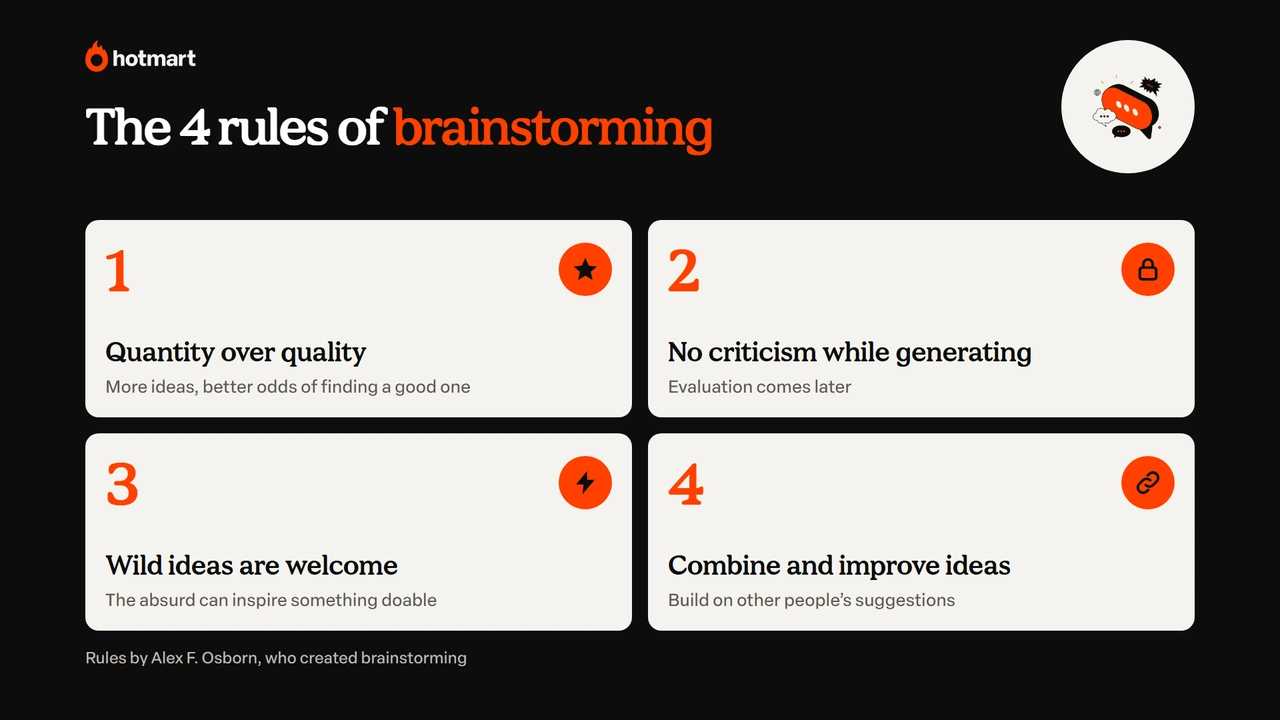
The 4 rules of brainstorming, defined by Osborn, are: quantity over quality, no criticism, wild ideas welcome and combining ideas. They encourage creativity and keep people from discarding suggestions before exploring them:
- Quantity over quality: the more ideas you come up with, the better your chances of finding a good solution. For example, list 30 product names before picking your favorite.
- No criticism while generating ideas: avoid comments like “that won’t work” while ideas are being shared. Evaluation comes later.
- Wild ideas are welcome: a seemingly absurd suggestion can inspire a workable alternative. A campaign that’s impossible to pull off, for example, can lead to a simpler action.
- Combine and improve other people’s ideas: instead of only offering new ideas, build on existing suggestions to create better options.
These rules are still the foundation of a good brainstorming meeting, in person or online.
How to brainstorm step by step
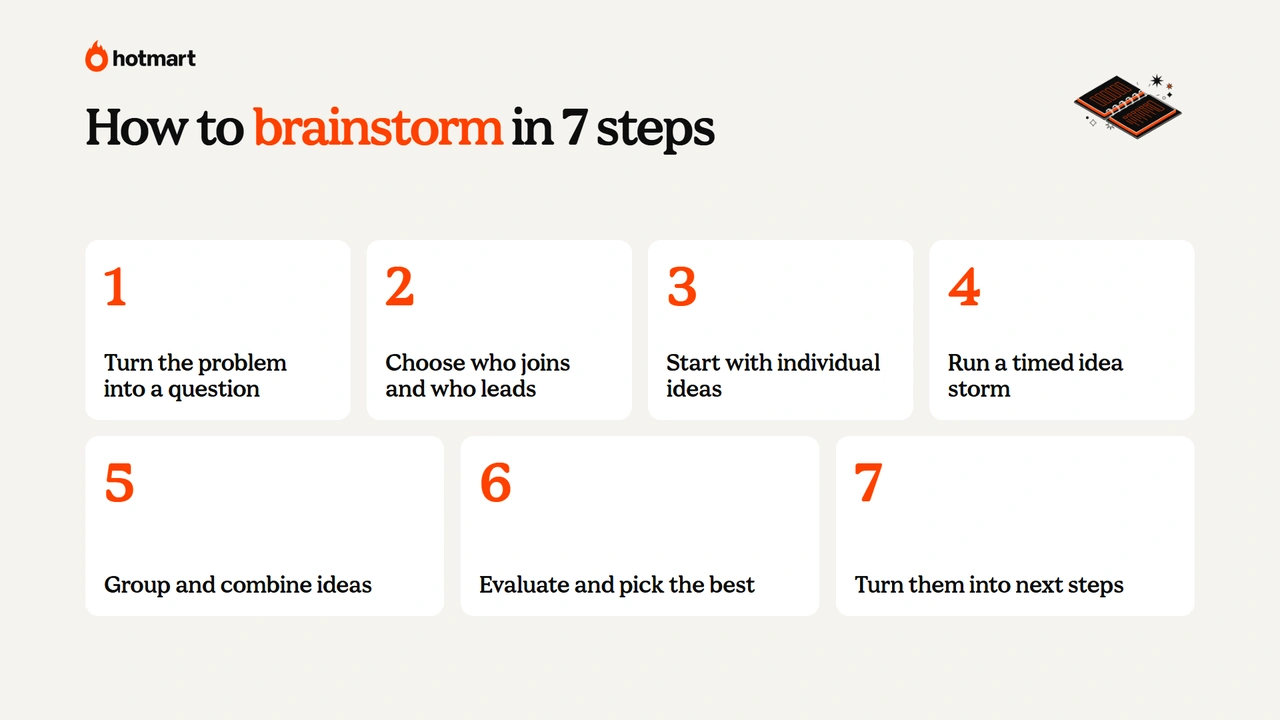
To run a brainstorming session, you need to prepare the challenge, generate ideas without judgment and evaluate the best options. These three big stages can be organized into seven steps:
- Turn the problem into a question.
- Choose who joins and who leads.
- Start with a few minutes of individual ideas.
- Run a timed idea storm.
- Group and combine ideas.
- Evaluate and pick the best ones.
- Turn the chosen ideas into next steps.
To see how the process works, let’s follow a language school that wants to reduce the number of students who quit after the first month.
1. Turn the problem into a question
Start by defining the challenge you want to solve. The more specific the question, the more focused the suggestions will be.
At the language school, instead of just presenting the topic “student dropout”, the team can work with this question:
“How can we keep students studying after their first month?”
This wording invites solutions and keeps the group focused on the same goal.
2. Choose who joins and who leads the brainstorming
Bring together a small group of people with different experiences and perspectives on the challenge.
At the language school, for example, teachers, customer service staff and sales team members can take part.
It’s also important to choose someone to lead the session. This person presents the question, explains the rules, keeps time and makes sure everyone has room to contribute.
3. Start with a few minutes of individual ideas
Before opening the discussion, give each participant a few minutes to write down their own suggestions.
This step keeps the first ideas shared from influencing the whole group.
A 1987 study by Michael Diehl and Wolfgang Stroebe identified what’s called production blocking: in group discussions, people have to wait their turn to speak and may forget or drop ideas while they wait.
That’s why starting individually helps preserve suggestions that might otherwise get lost.
4. Run a timed idea storm
After the individual round, gather the suggestions and encourage the group to come up with new options. Set a time limit and capture everything on a whiteboard, sticky notes or an online brainstorming tool.
The language school could, for example, set a goal of collecting 50 ideas.
Suggestions might include conversation classes, one-on-one follow-ups, weekly challenges and student meetups. At this stage, nothing gets thrown out.
5. Group and combine ideas
With the list ready, sort the suggestions by similarity. This practice is known as an affinity diagram.
In the school example, ideas about student follow-up can go in one group, while activities and events go in another.
Then look for interesting combinations. Weekly challenges, for example, can be paired with conversation groups so students practice the language between classes.
6. Evaluate and pick the best brainstorming ideas
Now it’s time to analyze which ideas can really work.
One option is dot voting: each participant gets three votes to pick their favorite ideas.
Then the team can place the top-voted ideas on an impact and effort matrix, comparing the potential result with the work needed to carry out each one.
In the example, the school might conclude that a weekly conversation group is more feasible than building its own app.
7. Turn the chosen ideas into next steps
A brainstorming session only pays off when the chosen ideas turn into actions.
So decide who owns each initiative, what the deadline is and how the idea will be tested. A Kanban board helps you track each action.
The school could start by offering conversation meetups for a month and track student attendance and retention.
Also avoid two common mistakes: letting the leader share their opinion first, which sways the group, and letting only the most outspoken people participate. The goal isn’t to end the meeting with lots of ideas, but to leave knowing which ones you’ll put into practice.
Types of brainstorming and brainstorming techniques
The types of brainstorming are in-person group sessions, solo brainstorming and online brainstorming, and the most used brainstorming techniques are brainwriting, reverse brainstorming, round robin, mind mapping, starbursting and SCAMPER. The main difference is how ideas are shared.
In the classic format, people take part in a group discussion. In the solo format, one person uses the technique to study, plan a project or solve a personal challenge.
Online brainstorming can happen in a shared document or on a virtual whiteboard, where everyone adds suggestions at the same time.
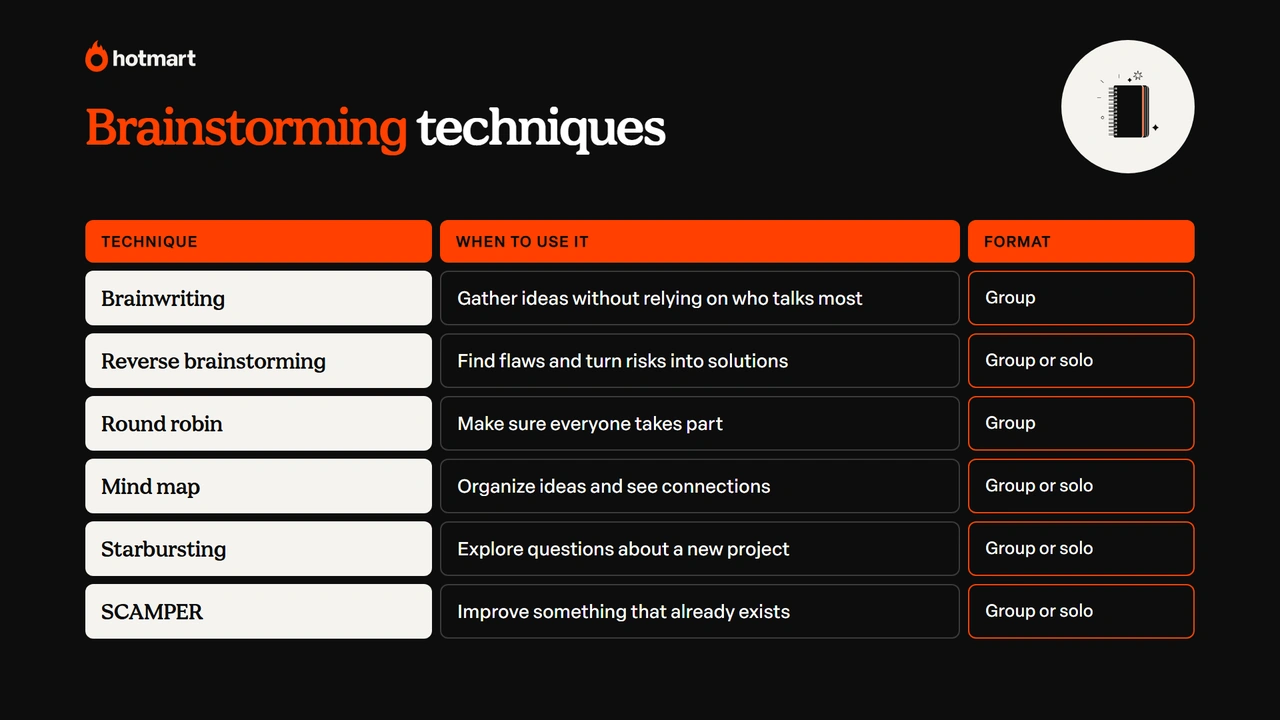
Beyond these formats, there are brainstorming techniques that help organize idea generation:
- Brainwriting: participants write their suggestions instead of saying them out loud. In the 6-3-5 method, created by German author Bernd Rohrbach in 1968, six people write three ideas in five minutes per round and pass them on to be developed.
- Reverse brainstorming: the group thinks of ways to cause or worsen a problem, then turns the answers into solutions. Read our article on reverse brainstorming.
- Round robin: each person shares one idea at a time, in rounds, so everyone gets a turn.
Here’s a summary to help you choose the best approach:
| Technique | When to use it | Format |
|---|---|---|
| Brainwriting | To gather ideas without relying on whoever talks most | Group |
| Reverse brainstorming | To find problems and turn risks into solutions | Group or solo |
| Round robin | To make sure everyone takes part | Group |
| Mind map | To organize ideas and see connections | Group or solo |
| Starbursting | To explore questions about a new project | Group or solo |
| SCAMPER | To improve or transform something that already exists | Group or solo |
Three other techniques help you explore options in a more structured way.
Mind mapping for brainstorming
A mind map organizes ideas visually, with the main topic in the center and related subjects branching out.
To use it, write the challenge in the center of a page or digital board. Then create branches for the main themes and add related suggestions to each one.
For example, when planning a trip, you can create branches for destinations, transportation, lodging and activities.
It’s a useful technique for organizing lots of information and spotting connections between ideas, alone or in a group. It was popularized by British psychologist Tony Buzan in the 1970s.
Starbursting: brainstorming with questions
Starbursting is a technique that uses questions to explore a topic before looking for solutions.
It’s built on a six-pointed star, with one question on each point: who, what, where, when, why and how.
If you want to launch a product, for example, you can ask:
- Who is the audience?
- What problem does the product solve?
- Where will it be sold?
- When will it launch?
- Why would someone buy it?
- How will it be promoted?
Starbursting is especially useful at the start of a project, when important questions still need answers.
SCAMPER: brainstorming to improve what already exists
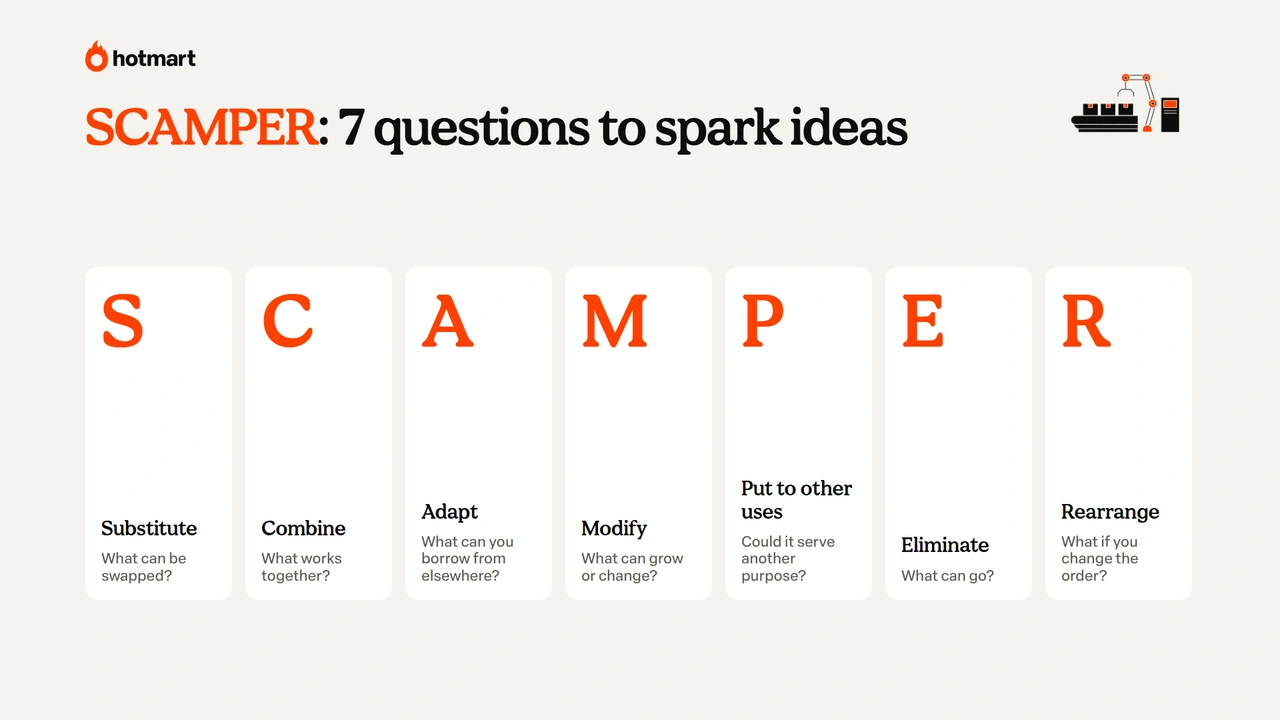
SCAMPER is a creativity technique that uses seven actions to find new possibilities based on something that already exists. The acronym was organized by American educator Bob Eberle in 1971, based on Alex Osborn’s questions.
The acronym stands for these verbs:
- Substitute: what can be swapped?
- Combine: which elements can work together?
- Adapt: what can you borrow from another situation?
- Modify: what can be expanded or changed?
- Put to other uses: is there another way to use this?
- Eliminate: what can be removed or simplified?
- Rearrange: what happens if you change the order or reverse the process?
Picture a coffee shop that wants to refresh its menu. With SCAMPER, it can combine flavors, adapt recipes or create new ways to present its products.
The technique is great for improving existing products, services and processes.
How to brainstorm with AI
Artificial intelligence tools such as ChatGPT, Claude and Gemini can help you generate ideas, explore different angles and organize suggestions during a brainstorming session.
You can use them to expand your initial list, apply techniques like SCAMPER or group the most promising ideas. See other AI tools for your work.
The study Ideas Are Dimes a Dozen, published in 2023 by Karan Girotra (Cornell) and Lennart Meincke, Christian Terwiesch and Karl Ulrich (Wharton), compared product ideas created by MBA students with suggestions generated by ChatGPT.
Of the 40 top-rated ideas in the experiment, 35 came from artificial intelligence. The researchers noted, however, that this doesn’t mean AI is more creative than the best professionals.
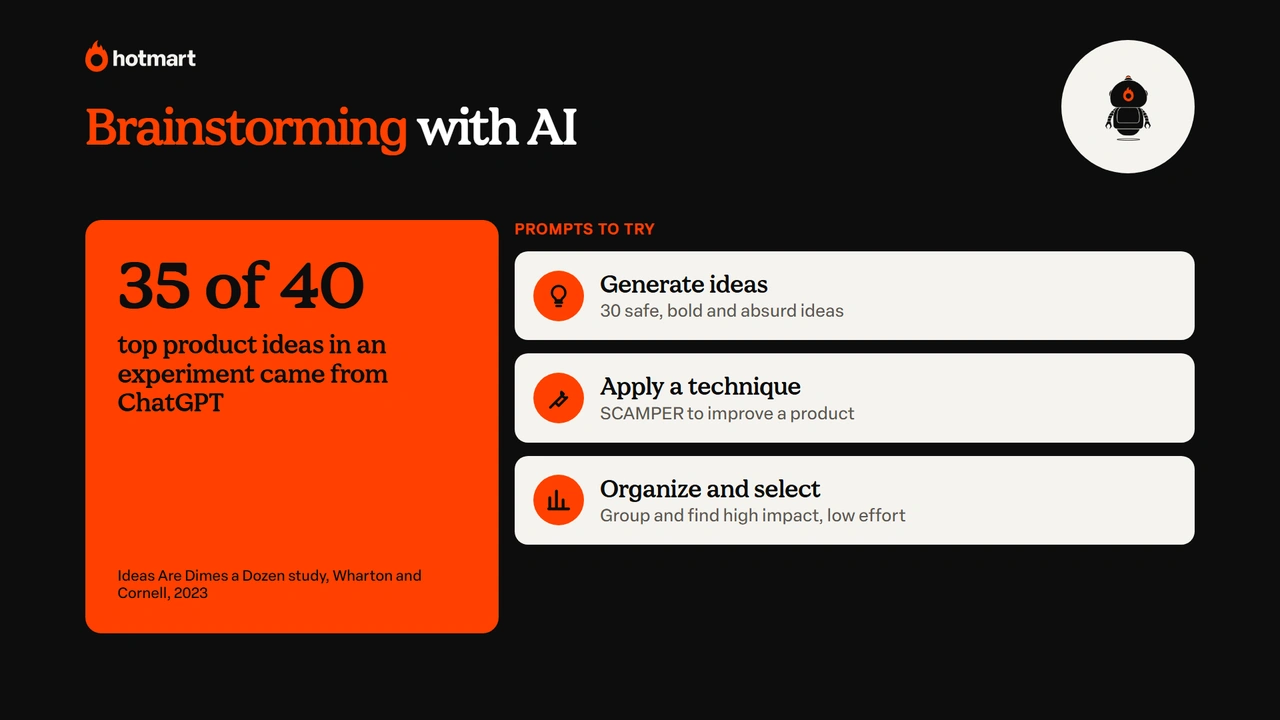
In practice, it’s best to use the technology as a partner. Start with your own round of ideas, ask for varied suggestions and review the answers, since AI can get facts wrong or suggest unrealistic ideas. To write your own requests, see what a prompt is and how to structure one.
To get started, try these three prompts:
Prompt 1: generate ideas
Act as a brainstorming facilitator. List 30 ideas to answer this question: [YOUR QUESTION]. Mix safe, bold and seemingly absurd suggestions. Don’t evaluate or discard any idea at this stage. Avoid repeats and explore different angles.
Prompt 2: apply a technique
Use the SCAMPER technique to suggest improvements for [YOUR PRODUCT OR SERVICE]. Give suggestions for each of the seven steps: substitute, combine, adapt, modify, put to other uses, eliminate and rearrange. Include practical examples.
Prompt 3: organize and select
Group the ideas below by similar themes and identify the five with the highest potential impact and lowest effort. Briefly explain your criteria and suggest a first test for each idea. Don’t make up data to justify your choices. Ideas: [PASTE YOUR LIST].
Brainstorming examples
To see how the technique works in real situations, check out three brainstorming examples in different contexts. Each one shows the challenge, the technique used, some suggestions and a possible choice to put into practice.
Example 1: a bakery naming a new line of cakes
Question: how can we create an appealing name for our new line of homemade cakes?
Technique: classic brainstorming.
Ideas generated:
- Slice of Love
- Sweet Memories
- Taste of Home
- Grandma’s Cakes
- Special Batch
- Piece of Kindness
Chosen idea: Slice of Love.
The name was chosen because it feels warm and fits the bakery’s homemade style. Before using it commercially, the bakery would need to check that it’s available and doesn’t conflict with registered trademarks.
Example 2: a marketing team planning Mother’s Day
Question: how can we create a Mother’s Day campaign that encourages audience participation?
Technique: brainwriting.
Ideas generated:
- Real stories of mothers and their children.
- Videos with thank-you messages.
- A campaign with old family photos.
- A series on lessons passed down through generations.
- Testimonials from entrepreneurial moms.
- A digital wall of tributes.
Chosen idea: a campaign with stories and lessons passed between generations.
The choice merged two ideas from the list, real stories and lessons between generations, applying the rule of combining and improving other people’s suggestions.
Example 3: a student choosing a thesis topic
Question: which business thesis topic combines my interest in technology and the job market?
Technique: mind map.
Ideas generated:
- AI in customer service for small businesses.
- Remote work and productivity.
- Online learning in short courses.
- Influencer marketing for local businesses.
- The creator economy.
Chosen idea: AI in customer service for small businesses.
The topic was chosen because it combines both of the student’s interests, has recent research to draw on and allows field research with local companies.
How to use brainstorming to create a digital product
Brainstorming can also help you turn your knowledge into an online course, an ebook or a mentoring program. The technique is useful for four key decisions: choosing the topic, naming it, structuring the content and planning promotion.
Picture a nutritionist who wants to create a course on healthy meal prep.
She can start by listing the questions she hears most often, like how to plan meals, store food and vary the menu during the week.
With that information, brainstorming can help define:
- Topic: healthy meal prep for a busy routine.
- Name: Meal Prep Made Simple.
- Modules: weekly planning, choosing ingredients, cooking and storage.
- Promotional content: storage tips, common mistakes and recipe demos.
Artificial intelligence can also help at this stage. Here’s an example prompt:
I want to turn my knowledge of [YOUR FIELD] into a digital product. My audience is [DESCRIBE THE AUDIENCE] and the questions I get most are [LIST THE QUESTIONS]. Brainstorm 15 digital product ideas, including courses, ebooks and mentoring programs. For each one, suggest a name, the problem it solves and the main content. Then sort the options by how easy they are to produce and point out which assumptions need to be validated with the audience before launch.
Once you’ve chosen the idea, it’s time to give it structure. If you’re not sure how to organize modules, set a price or plan the launch, Hotmart AI can help.
Available for free when you create courses and ebooks on Hotmart, the tool generates a strategic guide with suggestions to structure, price and launch your digital product, including a proposed module outline.
That way, you use brainstorming to explore possibilities and Hotmart AI to start turning the chosen idea into a more structured project.
Ready to start brainstorming?
Now that you know what brainstorming is and how to do it, it’s easier to see that good ideas don’t depend on waiting for inspiration.
The process starts with a clear question, moves through generating lots of possibilities and ends with choosing solutions you can put into practice.
Alex Osborn’s four rules are still a great starting point: value quantity, hold back criticism, welcome bold ideas and combine ideas. Starting individually and ending with owners, deadlines and tests makes the session more productive.
And if you want to expand your options, artificial intelligence can be a great partner. What matters is thinking first, exploring different paths and evaluating what really makes sense for your goal.
Frequently asked questions about brainstorming
Still have questions? Below, we answer the most common questions about brainstorming.
What tools can you use to brainstorm online?
Tools like Miro, Mural and FigJam let you brainstorm online with collaborative whiteboards, where participants add sticky notes, organize suggestions and work at the same time. You can also use shared documents, like Google Docs, to capture group ideas.
Does brainstorming work better in a group or alone?
Both formats work, depending on your goal. Solo brainstorming lets you develop ideas without interruptions, while a group brings different perspectives. A good option is to combine them: each participant starts by generating ideas alone, then everyone shares and builds on them together.
How long should a brainstorming session last?
There’s no required length. For simple challenges, a 20 to 30 minute session may be enough. More complex projects may need more time or several meetings. Ideally, set a time limit for generating ideas and save a few minutes to organize, evaluate and define next steps.
What’s the difference between brainstorming and mind mapping?
Brainstorming is a technique for generating lots of ideas about a problem or topic. A mind map is a visual tool that organizes information and shows connections between subjects. They work well together: first you brainstorm to gather suggestions, then you use a mind map to group them.