
Revenue Architecture: What It Is, the 6 Models and How to Apply It
Learn what revenue architecture is, the 6 models from Winning by Design, the difference between a sales funnel and the Bowtie, and how to apply it to an online business.

What will we see in this post

Picture a company where marketing generates more and more opportunities, the sales team hits its targets and the customer success team keeps up with every request. Even so, revenue isn’t growing the way it should. What could be going on?
That’s exactly the kind of problem revenue architecture sets out to solve. In this article, you’ll learn how the concept works, get to know the six models behind it, find out what the Bowtie is and see how to apply this strategy to your business.
What is revenue architecture?
Revenue architecture is a way of designing a company’s revenue as a single system that connects customer acquisition, retention and expansion, instead of treating marketing, sales and customer success as separate departments.
In short, it’s the structural blueprint for how a company generates, keeps and grows revenue.
In practice, it means planning not only how to win customers, but also how to keep them satisfied, encourage repeat purchases and build long-term relationships.
The concept was systematized by Winning by Design, a consultancy focused on recurring revenue growth, founded by Jacco van der Kooij. The methodology is also laid out in the book Revenue Architecture, which offers a structured way to analyze and improve the processes that drive company growth.
Why revenue architecture matters
Revenue architecture matters because it helps companies spot problems that stay hidden when each team only looks at its own targets. After all, winning new customers doesn’t necessarily mean growing revenue sustainably.
Imagine a creator who spends heavily on paid ads for a $97 course. Marketing brings in thousands of students, but the support team wasn’t sized for onboarding and the content doesn’t deliver on its initial promise. The result is a high refund rate and negative reviews. The failure wasn’t in the ad, but in the connection between the sale and the delivery.
With a clear architecture, you can see where money is “leaking”. Whether it’s friction at checkout or a missing upsell after a student finishes a module, a systemic design allows precise adjustments that increase Net Revenue Retention (NRR).
NRR shows how much recurring revenue from a period a company keeps and grows with its existing customers: NRR = (starting recurring revenue + expansion − churn − downgrades) ÷ starting recurring revenue. Above 100%, the current customer base grows on its own, even without new customers.
The 6 models of revenue architecture
According to Winning by Design, revenue architecture is made up of six complementary models that help organize everything from how a company charges for its products to the strategies it uses to grow.
They are:
- Revenue model;
- Data model;
- Mathematical model;
- Operating model;
- Go-to-market model;
- Growth model.
Here’s how each one works.
1. Revenue model
The revenue model defines how the company gets paid for the products or services it offers and how risk is shared between the business and its customers. Options include one-time sales, subscriptions and usage-based or outcome-based pricing.
For example, video editing software can be sold as a lifetime license (one-time sale) or as a monthly subscription. With a subscription, the seller takes on more risk, since it has to keep the customer happy month after month to make a profit.
2. Data model
The data model standardizes the stages a customer goes through, so marketing and sales use the same names for the same processes. It keeps a lead from being counted twice and stops vanity metrics from hiding real problems.
In practice, this means defining exactly what an “active student” or a “qualified opportunity” is. This is where the Bowtie comes in: for Winning by Design, the data model is the Bowtie itself, which organizes the process from first contact to account expansion.
3. Mathematical model
The mathematical model applies formulas that show how each stage of the customer journey contributes to total revenue. It reveals that small gains in retention tend to have a big impact on results: according to Frederick Reichheld of Bain & Company, increasing customer retention by 5% can raise profits by 25% to 95%.
Think of a subscription community with 1,000 students paying $100 a month. With a monthly cancellation rate (churn) of 10%, 282 subscribers remain after 12 months. With 8% churn, 368 remain: that’s 86 more subscribers and $8,600 more per month, without spending more on ads.
4. Operating model
The operating model is the design of the organizational structure, defining who owns each handoff along the customer’s path. It makes sure communication isn’t lost when a prospect becomes a buyer.
In an online mentoring program, the operating model might state that the support team must reach out to each student within 24 hours of purchase to confirm access, preventing refund requests caused by technical issues.
5. Go-to-market model
The go-to-market model is the distribution strategy that defines how the product reaches the end customer, whether through direct sales, affiliate partnerships or self-service models such as product-led growth (PLG). It matches the sales effort to the product’s average order value.
If you sell a $29 ebook, the ideal model is driving traffic straight to the sales page (self-service). A $50,000 mastermind, on the other hand, calls for a consultative model with one-on-one closing calls.
The go-to-market model helps you figure out which channels and approaches make the most sense for each customer profile.
6. Growth model
The growth model is the plan for the business’s next phases, identifying when the current product will hit its market ceiling. It signals when to launch a new feature or explore a new niche to keep the curve going up.
A creator who has saturated the audience for “baking for beginners” can use this model to plan an advanced “professional baking” course, creating a new revenue stream from the same customer base.
This way, instead of relying only on the initial offer, the business builds new revenue opportunities based on what customers need.
What is the Bowtie model?
The Bowtie model is a representation of the customer journey used in revenue architecture. It extends the traditional sales funnel by adding the stages that happen after the purchase, such as onboarding, adoption and expansion.
Developed by Winning by Design, the recurring revenue Bowtie shows that the business relationship doesn’t end when the customer signs a contract.
In Winning by Design’s version, the Bowtie has seven stages: Awareness, Education, Selection, Commit, Onboarding, Impact and Growth. These stages fall into three moments:
- Left side, acquisition: covers lead generation, opportunity development and the sales process.
- Center, commit and close: the moment when the company and the customer reach a commercial agreement.
- Right side, retention and expansion: follows customer onboarding, product usage and opportunities to grow the relationship.
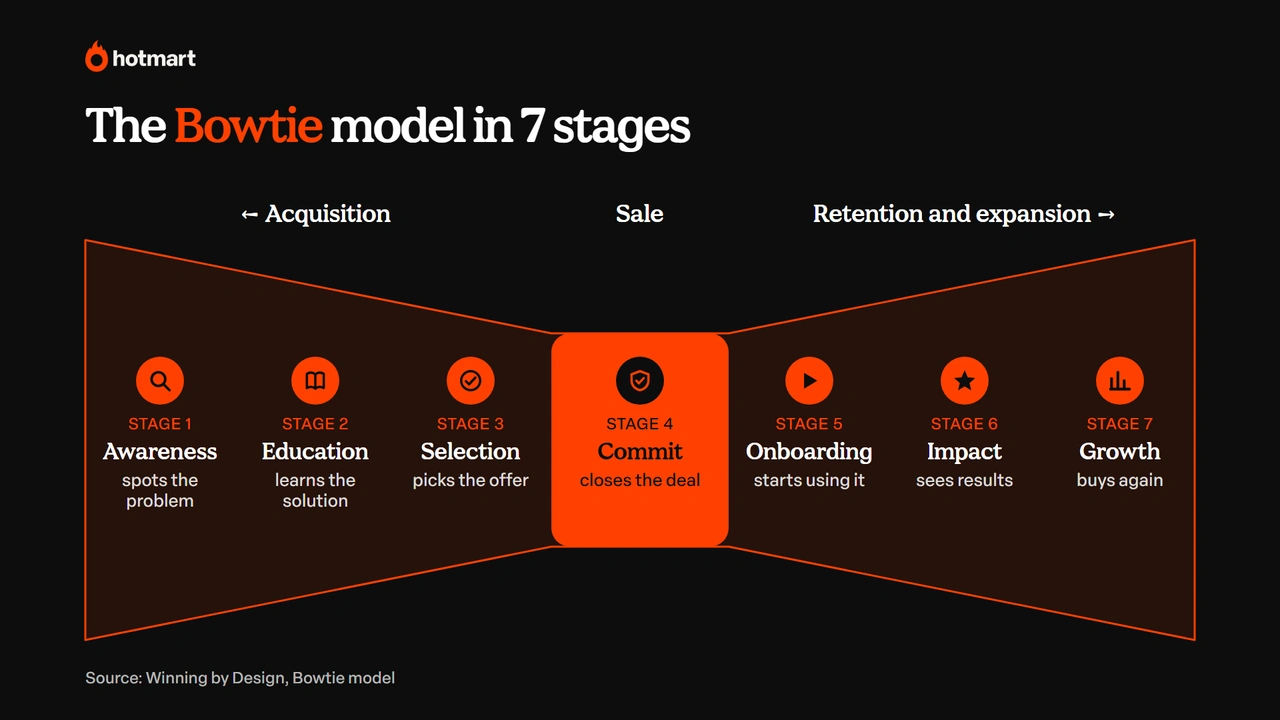
Picture a company that sells management software. In a traditional funnel, the process ends when the customer signs up. With the Bowtie, the company keeps tracking whether the customer managed to set up the tool, uses its features and finds reasons to upgrade the plan.
That’s the main difference between a sales funnel and the Bowtie:
| Criteria | Sales funnel | Bowtie model |
|---|---|---|
| Where it ends | Usually at conversion or close | Continues after the sale |
| What it tracks | Attraction, conversion and qualification | Acquisition, onboarding, adoption, retention and expansion |
| Key metrics | Leads, opportunities and conversion rate | Conversion, retention, churn and revenue expansion |
| Teams involved | Mainly marketing and sales | Marketing, sales and customer success |
This way, the company sees not only how many people buy, but also how many stay, use the products and keep generating revenue.
Revenue architecture vs. RevOps vs. growth model: what’s the difference?
Revenue architecture is the complete design of the revenue-generating system. RevOps runs that system day to day, while the growth model is one part of the structure.
RevOps is short for Revenue Operations. This approach integrates the processes, data and tools of the teams responsible for business growth.
Here are the differences:
| Concept | What it means | Main role |
|---|---|---|
| Revenue architecture | Structure that connects acquisition, retention and expansion | Define how the company generates and grows revenue |
| RevOps | Revenue operations | Integrate teams, data, processes and tools |
| Growth model | One of the six models in the architecture | Identify opportunities to support new stages of expansion |
In practice, revenue architecture defines how the system should work. RevOps helps put that design into operation, while the growth model guides decisions about the business’s next moves.
These concepts complement each other, but they aren’t the same thing.
Signs your company’s revenue architecture needs adjusting
Some everyday problems can signal that a company needs to rethink how it organizes its revenue processes.
Here are the main warning signs:
- Inconsistent data: the same customer shows up with different information across the systems teams use.
- Misalignment between marketing and sales: the teams disagree on what makes a lead qualified.
- Broken handoffs: expectations set during the sale don’t reach the team responsible for onboarding.
- Targets hit, but revenue flat: individual metrics improve, but financial results don’t follow.
- Early cancellations: customers stop using the product before they see its value.
If these problems come up often, it’s worth analyzing the entire customer journey and pinpointing the stages where you’re losing customers.
How to apply revenue architecture to an online business
Revenue architecture also works for online businesses, such as online courses, mentoring programs and subscription communities. Although the concept grew mainly out of software and B2B companies, its principles help creators organize the different stages of the buying journey.
Imagine a creator who sells a digital marketing course. Using the Bowtie model, they can structure the business around three moments.
In acquisition, the goal is to attract people interested in the topic and turn them into students. To do that, the creator can publish content on social media, offer free resources and present the course to anyone who wants to go deeper.
In retention, the focus shifts to the buyer’s experience. That includes making lessons easy to access, guiding the first steps and encouraging students to keep learning.
In expansion, the creator can offer new experiences to students who want to go further, such as mentoring, an advanced program or a subscription community.
Hotmart offers tools for several stages of the Bowtie. For onboarding, the members area, which is free, organizes your content and tracks student progress.
For retention, you can sell subscriptions, such as a paid membership or community, and Hotmart automatically retries the charge when a subscription payment is declined. This reduces involuntary churn, the revenue that “leaks” even though the student never decided to leave.
For expansion, Order Bump offers a complementary product right at checkout. And Hotmart’s dashboards show churn, MRR and lifetime value for your subscriptions, the metrics that feed the mathematical model.
This way, the creator stops looking only at the number of sales and starts considering the entire student experience, from first contact to new learning opportunities.
Ready to design your business’s revenue architecture?
Revenue architecture is a way of seeing marketing, sales and customer success as one system that generates, keeps and grows revenue. Winning by Design’s six models help you design that system, and the Bowtie shows at which stage customers move forward, stall or leave.
For an online business, this means looking beyond the sale: tracking whether students start using the product, whether they stay active and which offers make sense for them next.
With Hotmart’s tools, you get the members area, subscriptions, checkout with Order Bump and retention reports in one place to put this architecture into practice.
Revenue architecture FAQ
Still have questions about revenue architecture? Here are answers to the most common ones.
Is revenue architecture only for SaaS companies?
No, revenue architecture can be applied to any business that wants predictable growth, especially online creators and recurring services. Although it was born in the software (SaaS) world, its systemic design principles help any company connect marketing and post-sale.
Who is responsible for revenue architecture in a company?
In larger companies, responsibility usually falls on the CRO (Chief Revenue Officer) or RevOps leaders. In smaller online businesses, the creator or operations manager should take on the architect role so teams don't work in silos.
Who wrote the book Revenue Architecture?
Revenue Architecture was written by Jacco van der Kooij, founder of Winning by Design. The book explains the six models and the Bowtie, and the concepts also appear in Winning by Design's articles and training on sales and RevOps.