
Lead generation: what it is, types and strategies to attract customers
Learn what lead generation is, the main types of leads and how to attract qualified contacts with organic and paid strategies and lead magnets that help you sell more.

What will we see in this post

Before you can sell, you need someone to sell to. After all, even if you have a great product or service, you still need to find people who are interested in it and have the potential to become customers. That is where lead generation comes in: a process that helps turn people who do not know your business well yet into contacts you can build a relationship with.
But how do you generate leads that are actually a good fit for your offer?
In this article, you will understand what lead generation is, get to know the main types of leads and discover strategies to attract qualified contacts, both organically and with paid media.
What is lead generation?
Lead generation is the process of attracting people who are interested in a product or service and collecting information that allows you to start or continue a relationship with them, such as their name and email address. This usually happens in exchange for something valuable, like an ebook, a free class, a checklist or access to exclusive content.
Imagine you sell a photography course. Someone finds one of your articles about how to take better photos with a smartphone and, at the end, discovers they can download a free guide with composition tips. To get the material, they enter their email address. That’s it: you have just generated a lead.
From there, you can share other content related to the topic, present your teaching method and, when it makes sense, offer the full course. In other words, lead generation helps you create sales opportunities without relying only on people who are already ready to buy.
In digital marketing, this process matters because it allows you to build a contact list, better understand your audience’s interests and create more targeted communication. Instead of trying to sell to everyone at once, you get ways to connect with people who have shown interest in what you offer.
What are leads?
Leads are people or companies that have shown interest in a brand, product or service and shared some contact information that makes communication possible. They are not necessarily customers yet, but they have already taken a first step in the relationship with the business. To go deeper into the concept, read our guide on what leads are.
This interest can show up in different ways: filling out a form, downloading a free resource, subscribing to a newsletter or attending a webinar, for example. What defines a lead is an identifiable contact plus some sign of interest, not just a website visit or a like on social media.
It is important to remember that not every lead is ready to buy. Some people are just researching a topic, while others already know the problem they need to solve and are evaluating possible solutions. That is why generating contacts is only the beginning: you also need to understand each lead’s profile and timing to guide them to the next step.
What are the types of leads?
The types of leads can be classified by level of interest, proximity to purchase and the information available about each contact. This classification helps you decide which marketing and sales actions make the most sense in each situation.
The most common categories are:
- MQL (Marketing Qualified Lead): a lead who has shown interest by engaging with content or campaigns, but still needs to move further along the journey before a more direct sales approach.
- SQL (Sales Qualified Lead): a lead who meets the criteria defined for a sales opportunity and is ready to be contacted by the sales team.
- Leads classified by interest, source and data enrichment: contacts that can be segmented by the topic they showed interest in, the channel they came from or how much information is available about their profile.
These categories are not universal. Each business can set its own criteria to decide when a contact is qualified for marketing or sales, often with a lead scoring model. What matters is to avoid treating every contact the same way. A good strategy for generating qualified leads considers not only how many people you capture, but also how well they fit your offer and how likely they are to move toward a purchase.
What is the difference between lead generation and lead nurturing?
The difference between lead generation and lead nurturing lies in the timing and goal of each stage. Generation means attracting interested people and collecting their contact details. Nurturing comes next, with actions that help develop the relationship and prepare those contacts for a possible purchase.
If you want to go deeper into this stage, also check out our content on lead nurturing, which explains how to develop the relationship with the contacts you capture.
How does lead generation fit into the sales funnel?
Lead generation is mainly concentrated at the top of the sales funnel, the stage where a brand attracts people who may be interested in its products or services. After they are captured, these contacts can move through the middle and bottom of the funnel as they discover their needs, evaluate solutions and get closer to a buying decision.
The sales funnel is usually divided into three stages:
- Top of the funnel: the discovery and awareness stage. People come into contact with the brand through content, ads, social media or other channels. Lead generation happens mostly here, when the visitor shares their details.
- Middle of the funnel: the consideration stage. The lead is already interested in the topic and wants to better understand the problem and the available alternatives. Educational content and nurturing actions help in this process.
- Bottom of the funnel: the decision stage. The potential customer evaluates the offer, compares options, clears up doubts and considers buying. This is the moment to present what makes your solution different and help the person decide whether it meets their needs.
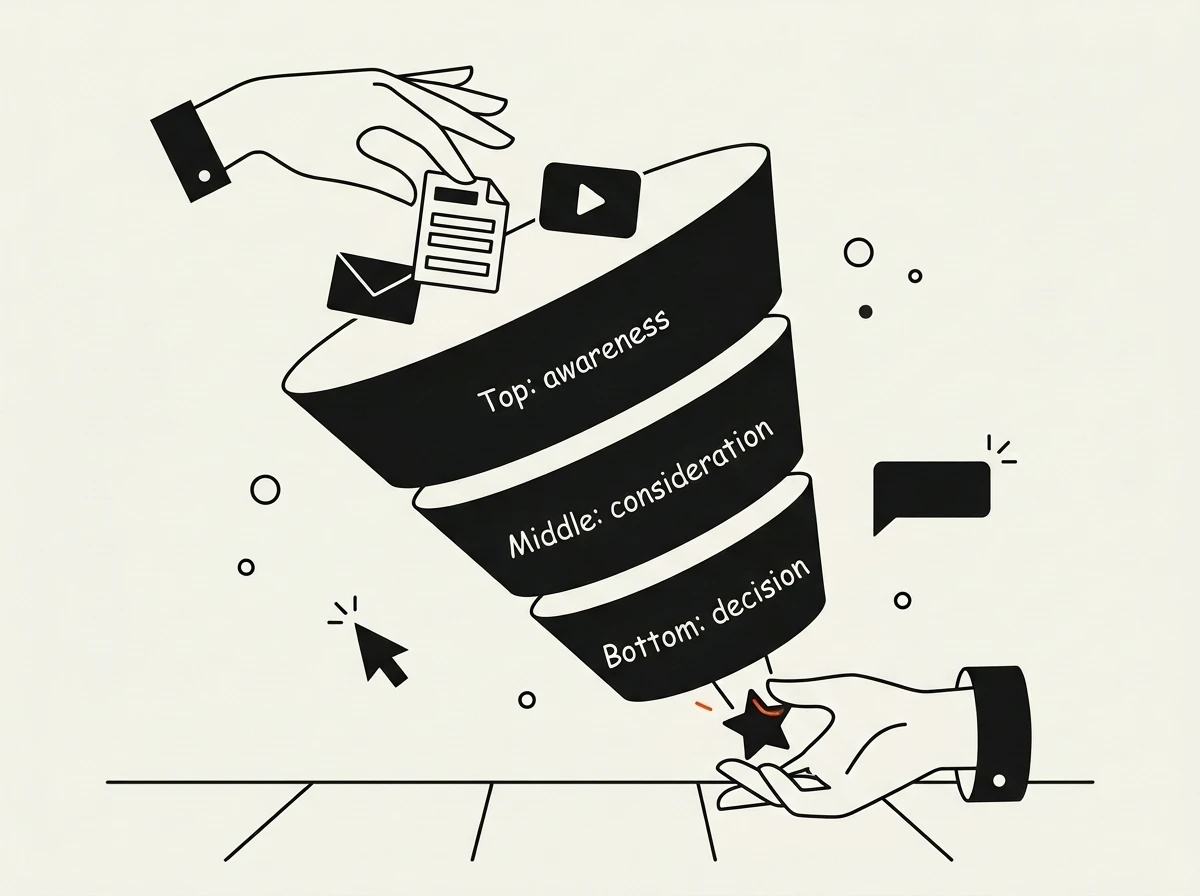
These stages are not necessarily linear. A lead may move quickly, spend more time researching or come back to a need that seemed solved. That is why the funnel should work as a reference for planning your communication, not as a rigid sequence everyone has to follow.
What are the main lead generation strategies?
There are different lead generation strategies, and the right choice depends on your audience, the type of offer, the resources available and your business goals. Some help you attract people organically; others use paid media or automation to expand your reach and make capturing leads easier.
The main lead generation strategies include:
- Content marketing, with articles, videos and posts that answer your audience’s questions.
- Landing pages and forms, which turn visitors into contacts through a clear offer.
- Webinars and free classes, which attract people who want to learn about a specific topic.
- Email marketing, used to share content, promote offers and keep the relationship with your list going.
- Social media, which expands the reach of your content and drives people to lead capture pages.
- Chatbots, which can collect information during a conversation and guide users to the next step.
Next, see how each of these strategies can be applied in practice.
1. Content marketing
Content marketing is one of the most widely used organic lead generation strategies. The idea is to produce relevant materials for your audience, answer their questions and attract people interested in topics related to your business.
Blog posts, videos, podcasts, newsletters and social media posts are some examples of formats that can be part of this strategy.
Content helps you show expertise and build trust even before a sales conversation. To turn that interest into leads, include calls to action that invite people to download a resource, join a list or visit a page with a free offer.
2. Landing pages and forms
Landing pages are pages created with one specific goal, such as promoting an offer, presenting a free resource or collecting contact information. Forms, in turn, let visitors share the details needed to access what is being offered, and tools like Google Forms make it simple to create them.
Avoid asking for more information than you need. The more effort it takes to access a resource, the more resistance visitors may feel. The ideal is to find a balance between the data you need and how easy it is to complete the sign-up.
3. Webinars and free classes
Webinars, workshops and free classes let you share knowledge in more depth and capture contacts from people interested in a specific topic. Since attending usually requires signing up, these formats can also signal a higher level of interest than a quick interaction on social media.
The key is to deliver real value in the free class. If the experience helps participants solve a question, they have more reasons to keep following your brand and consider other solutions you offer.
4. Email marketing
Email marketing can contribute to both lead generation and lead nurturing. It helps you promote free resources, invite people to events, share content and present offers to contacts who agreed to receive this kind of communication.
For the strategy to work, segment your contacts whenever possible and avoid sending the same message to your whole list. Also, respect communication preferences and offer a clear way to unsubscribe.
5. Social media
Social media platforms are important channels for lead generation in digital marketing because they help you introduce your brand to new people, share knowledge and drive your audience to lead capture offers.
On Instagram, for example, you can publish a carousel with practical tips and invite people to access a free resource through the link in your bio. On YouTube, you can share a tutorial and point to a complementary class for those who want to go further. And on LinkedIn, a B2B company can share specialized content and direct interested people to a webinar.
It is worth testing different formats and tracking which ones generate more page visits, sign-ups and qualified contacts, and social media tools can make this tracking easier. This way, you better understand your audience’s interests and can adjust your strategy over time.
6. Chatbots
Chatbots are tools that automate conversations with website visitors, social media users or people who reach out through messaging channels. Depending on how they are set up, they can answer frequently asked questions, recommend content and collect contact information.
This approach can make the experience smoother and reduce the time needed to answer initial questions. However, it does not replace human support in every situation. When a question is specific or requires a more careful analysis, it is important to offer a way to talk to a real person.
Organic vs. paid lead generation: what is the difference?
The main difference between organic and paid lead generation is how the audience reaches your offer. In organic generation, contacts are attracted through channels such as content, SEO and social media, without paying directly for each visit or lead. In paid generation, the company invests in paid advertising to expand its reach and drive people to a page or offer.
Organic lead generation can happen when someone finds an article on Google, discovers a recommended video or shares a post on social media.
Paid lead generation, on the other hand, uses ads on platforms such as Google Ads, Instagram, Facebook or LinkedIn to reach selected audiences, and advertising on Instagram is a common starting point for creators. It can speed up the arrival of visitors and make it easier to test campaigns. It requires investment, and results depend on factors such as targeting, offer, competition and landing page quality.
Outbound vs. inbound prospecting: what is the difference?
In inbound prospecting, the potential customer comes to the brand through content, search engines, social media, referrals or other attraction channels. In outbound prospecting, the company takes the initiative to reach out to people or organizations that may be interested in its solution.
Both approaches can be part of a sales strategy. Inbound prospecting helps attract people who show interest spontaneously, while outbound lets you look for opportunities in specific audiences, including people who do not know your brand yet. If you want ideas for the inbound side, see these marketing strategies to attract customers.
Regardless of the method, it is important to be clear about who you want to reach and why your offer may be relevant to them. In outbound, this means avoiding generic messages and following the rules that apply to communication and the use of personal data. In inbound, it means creating content and offers that attract people with real potential to become customers.
Which tools help with lead generation?
Lead generation tools help you capture, organize and follow up with contacts throughout the buying journey. They can simplify tasks, centralize information and make it easier to communicate with your list, but the right choice depends on your business needs and stage.
The main categories are:
- CRM: organizes contact data, records interactions and helps track sales opportunities. Examples: HubSpot, Salesforce and Pipedrive.
- Marketing automation: lets you segment contacts, schedule campaigns and create automated communication flows. Examples: ActiveCampaign, Mailchimp and Brevo.
- Landing pages and forms: help you present offers and collect visitor information. There are tools specialized in this function and platforms that offer built-in page creation and contact capture features.
These tools have different functions and can work together. A landing page captures the contact; a marketing automation platform can send the content planned for that stage; and a CRM helps track the history and spot sales opportunities.
If you are just starting out, you do not need to sign up for several solutions at once. Map out what your business really needs, choose tools that fit your operation and set up a simple capture and follow-up process before expanding your structure.
How much does it cost to generate a lead?
There is no fixed price to generate a lead. The cost depends on the channel used, the market segment, the competition, the offer, the audience and the marketing strategy.
Track your cost per lead alongside other metrics, such as conversion rate, number of qualified leads, customer acquisition cost and revenue generated. This way, you can evaluate not only how much it costs to capture a contact, but also the return it can bring to your business.
How to use lead generation to sell online courses and digital products?
If you sell courses, ebooks, mentoring programs or other digital products, you can use lead generation to attract people interested in a topic and build a relationship before presenting your main offer. One of the most common ways to do this is to offer a lead magnet: a free resource or experience that delivers value in exchange for contact information.

The lead magnet needs to be related to the product you sell. If you offer a healthy cooking course, for example, you could provide an ebook with practical recipes for the week. People who download it show interest in the topic and may want to learn more with the full course.
Here are some lead magnet ideas for different types of digital products:
- Ebook: an introductory guide, practical manual or collection of tips on a topic.
- Free class: a learning experience that introduces a concept or teaches a specific skill.
- Checklist: a list of steps to complete a task, avoid mistakes or organize a process.
- Test or quiz: an interactive experience that helps people identify their knowledge level, profile or main challenges.
The ideal format depends on your audience and what you want to offer. A checklist can work well for people looking for a quick solution, while a free class may make more sense to showcase your teaching method.
Ready to start generating leads?
Lead generation is an important step for anyone who wants to turn audience interest into sales opportunities. Throughout this guide, we saw that there are different types of leads, that capturing contacts is only the beginning of the relationship and that strategies such as content marketing, landing pages, free classes and social media can help attract new contacts.
The secret is to align these actions with your business goals. Instead of chasing volume alone, prioritize generating qualified leads: people who show real interest in the topic and have the potential to benefit from what you offer.
If you sell courses, ebooks or mentoring programs, you can start with a simple free offer and a page to capture interested contacts. Hotmart can be a great ally in this process, as it offers features that support selling digital products, including tools to create sales pages and resources to communicate with your audience.
Frequently asked questions about lead generation
What is the difference between a lead and a customer?
A lead is a person or company that has shown interest in a brand and shared contact information, but has not necessarily made a purchase yet. A customer is someone who has already bought the product or hired the service. Marketing and sales work helps turn leads with potential into customers.
What are the main lead generation strategies?
The main strategies include content marketing, landing pages and forms, webinars and free classes, email marketing, social media and chatbots. The choice depends on your audience, product, available resources and business goals. Combining different channels can help expand your reach and improve the quality of the contacts you capture.
What does lead generation mean?
Lead generation means attracting people interested in a product or service and collecting information that allows you to start or maintain a relationship with them. This usually happens through forms, sign-ups, free resource downloads and other actions that encourage visitors to share their contact details.
How do you generate leads for digital products?
To generate leads for digital products, start by identifying the audience that can benefit from your knowledge and create a free offer related to your main product, such as an ebook, checklist, quiz or class. Promote this offer on relevant channels, use a clear capture page and plan content to keep the relationship going. Your lead magnet should attract people with real interest in the topic of your course, ebook or mentoring program.