Outbound marketing: what it is, how it differs from inbound and how to apply it
Learn what outbound marketing is, how active prospecting works, the main examples and how to combine it with inbound to sell online courses and digital products.

What will we see in this post

While inbound marketing works so that customers find your brand, outbound marketing takes the opposite path: it goes to the potential customer to present a solution. Both strategies have similar goals but start from different approaches, and understanding the difference helps you choose the best actions for your business.
In this article, you will learn what outbound marketing is, how the prospecting process works, what the main examples are and when it is worth investing in this strategy. You will also see how to apply it to sell online courses, mentoring programs and other digital products.
What is outbound marketing?
Outbound marketing is the set of strategies in which a company actively starts the conversation with potential customers, instead of waiting for them to find the brand on their own. The goal is to present an offer, spark interest and open sales opportunities.
This model shows up in traditional formats, such as TV and radio ads and direct mail, but also in digital actions, such as prospecting emails, sales calls, LinkedIn messages and paid ads.
In practice, outbound lets a company choose who it wants to reach and contact that audience directly. A consulting firm specialized in small businesses, for example, can identify entrepreneurs in a specific industry and pitch a mentoring program focused on the challenges they face.
That is why outbound marketing can be especially useful when a business has a well-defined audience, needs to reach people who do not know its solution yet or wants to speed up the generation of sales opportunities.
What is the difference between inbound and outbound marketing?
The main difference between inbound and outbound marketing is how the company starts the relationship with the potential customer. In inbound marketing, the strategy is to attract people through relevant content and experiences. In outbound, the company takes the initiative to present its solution directly to the audience.
See the comparison below.
| Inbound marketing | Outbound marketing |
|---|---|
| The customer finds the brand | The company reaches out to the potential customer |
| Attraction and relationship | Active prospecting and promotion |
| Tends to build results in the medium and long term | Can generate opportunities faster |
| Blog, SEO, social media and educational resources | Cold email, cold calls, ads and prospecting at events |
| Attract, educate and nurture potential customers | Reach specific audiences and open sales opportunities |
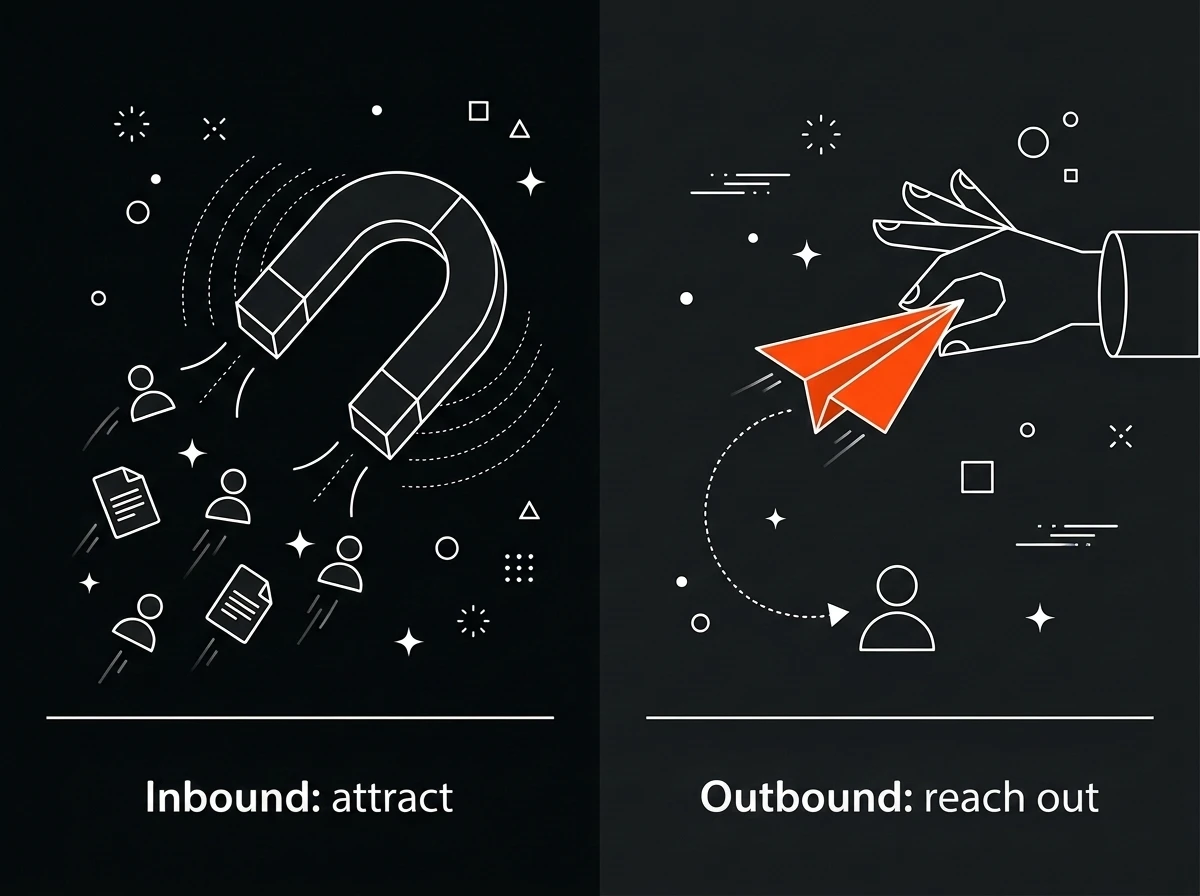
Now imagine someone who sells photography courses. By writing articles about lighting and photo editing, they use inbound to attract people interested in the topic. When they reach out to photography schools or companies that need to train their teams, they apply outbound to present an offer directly to potential buyers.
Neither approach is always better. The choice depends on your audience, budget, buying cycle and business goals. In many cases, combining both strategies is the most efficient path.
How does the outbound process work?
The outbound process starts by defining who has the greatest potential to become a customer. Instead of sending messages to a broad, poorly qualified list, the company identifies characteristics that indicate a good fit between the offer and the audience’s needs.
This work usually follows four stages:
- Define the ideal customer profile: identify the type of person or company that benefits most from the solution. In B2B, this can include industry, company size, job title and business challenges.
- Map potential customers: build a contact list that matches that profile, using research, professional networks, events and other appropriate sources.
- Reach out: contact them by email, phone, message or another relevant channel, presenting a value proposition tied to that potential customer’s needs.
- Lead the sales conversation: understand their interest, answer questions, qualify the opportunity and, when there is a fit, move on to a meeting, demo or proposal.
The process does not end with the first contact. Logging interactions, tracking replies and analyzing results helps you understand which approaches work best and where adjustments are needed.
That is what separates a structured strategy from a sequence of messages sent at random: each contact has a reason, a hypothesis about a need and a defined next step.
Where does modern outbound marketing come from?
Outbound marketing has its roots in traditional advertising and direct sales prospecting. For a long time, many companies relied on broad campaigns and mass calls to reach as many people as possible, even without knowing whether they were interested in the offer.
An important shift came with the rise of so-called Outbound 2.0, associated with Aaron Ross’s work at Salesforce and presented in the book Predictable Revenue, co-written with Marylou Tyler.
The approach helped consolidate a more organized sales model, based on specialized sales roles, a defined ideal customer profile and sales prospecting processes that could be tracked and improved.
Instead of depending only on contact volume, modern outbound aims to make outreach more predictable and targeted. This means researching the potential customer, personalizing communication and measuring what happens at each stage of prospecting.
Technology has also expanded what this model can do, with tools to organize contacts, log interactions and track opportunities. Even so, no tool replaces understanding who is on the other side of the conversation.
What are the main outbound marketing strategies and examples?
Outbound marketing strategies can take different forms, from a one-on-one conversation with a potential customer to an advertising campaign for a broad audience. The most common examples include:
- Cold call: a phone call to a potential customer who has no prior business relationship with the company.
- Cold email: a prospecting email sent to someone who does not know the offer yet.
- Traditional ads: TV, radio and direct mail campaigns to reach specific or broad audiences.
- Digital and display ads: paid advertising that presents a brand or offer while people browse online.
- Partnerships and events: initiatives to actively connect with potential buyers through meetings, referrals and business relationships.
Next, see how each of these examples works in practice.
1. Cold call
A cold call is a phone call to a potential customer with whom the company has no established business relationship. The goal is to start a conversation, understand whether there is a need and assess whether it is worth moving forward with a proposal.
Imagine a company that offers financial management software for small businesses. The sales team can call managers at companies that match the ideal profile and explain how the solution helps organize cash flow.
To work, the call needs context. Very generic approaches that ignore the other person’s reality or try to close a sale right away tend to create resistance. A conversation that is objective, respectful and focused on a concrete need is more likely to spark interest.
2. Cold email
A cold email is a prospecting message sent by email to a potential customer who has had no business contact with the company. Outreach can also happen on professional networks such as LinkedIn, as long as the channel suits the audience and follows the applicable rules.
One advantage of this format is that the company can research the contact before writing and present its proposal in an organized way. It is also possible to track replies and send follow-ups when there is a good reason to.
For example, a professional who sells brand positioning consulting can contact companies in a specific industry, mention a challenge relevant to that market and explain how their work can help.
Ideally, the message should be short, personalized and transparent about why you are reaching out. Sending large volumes of identical messages without considering the relevance of the offer can hurt your brand’s reputation and reduce the effectiveness of your prospecting.
3. Traditional ads (TV, radio, direct mail)
Traditional ads are classic examples of outbound marketing. They deliver a commercial message to the audience through channels such as television, radio, newspapers, magazines and printed materials mailed directly to specific addresses.
A gym chain that promotes a new location on a local radio station, for example, is using advertising to reach people in a region before they even search for the brand.
These formats can make sense when the goal is to build awareness, promote a launch or reach a geographically defined audience. However, the investment and the ability to measure results vary by channel and campaign.
4. Digital and display ads
Outbound is also present in the digital environment. Banners, website ads, video ads and other forms of paid advertising can present an offer to people who were not actively looking for it at that moment.
A company launching a professional training program, for example, can advertise the product to an audience segmented by interests or characteristics relevant to the offer.
Targeting helps direct the message, while campaign data helps track impressions, clicks and conversions. Still, it is important to distinguish the ad format from the overall strategy: a paid campaign can have outbound characteristics, while other digital campaigns are designed to capture people who have already shown interest.
To get good results, the ad needs a clear proposition, a call to action consistent with the offer and a simple path for people to learn more or take the next step.
5. Partnerships and events
Attending events, building partnerships and seeking referrals are other ways to actively find potential customers. These initiatives create connections with people or companies that share interests, audiences or needs.
Think of someone who sells a management mentoring program for freelancers. They can attend entrepreneurship meetups, talk to industry associations or propose a partnership with a company that serves the same audience but offers a complementary service.
In these cases, prospecting does not need to start with a direct offer. A relevant conversation, a presentation or a collaboration can open the door to a future business relationship.
What matters most is that the partnership makes sense for both sides and also adds value for the audience involved. This way, the contact is no longer just an attempt to sell and becomes a chance to build a relationship.
When should you use outbound instead of inbound?
Outbound is usually a good choice when a business knows exactly who it wants to reach and needs to start conversations with that audience. This is common in niche markets, consultative sales, B2B solutions and higher-ticket products, where a personalized approach can help explain the value of the offer.
Imagine a professional who sells a mentoring program for beauty clinic owners. Instead of waiting for those people to find her content, she can map clinics that fit the desired profile and present the program to their managers, connecting the proposal to the challenges of that industry.
Outbound can also help when a company needs to test a market, promote a new solution or generate opportunities faster than it would take to build a consistent organic audience.
This does not mean the strategy guarantees immediate sales. How fast you see results depends on the quality of your contact list, the relevance of the offer, the channel you choose and how long your audience takes to decide.
Before investing, consider whether the potential value of each sale justifies the prospecting effort and whether the company has the resources to make the contacts and follow up on opportunities.
What are the advantages and challenges of outbound marketing?
Outbound marketing lets you reach potential customers actively and in a targeted way, but it requires planning so that the contact is relevant and the investment makes sense.
| Advantages | Challenges |
|---|---|
| Can generate opportunities in less time, depending on the sales cycle | Can feel intrusive when it ignores the audience’s context or interest |
| Lets you choose the profiles the company wants to reach | Requires research and targeting to avoid poorly qualified contacts |
| Helps test offers and new markets | May require more resources to personalize and follow up on outreach |
| Makes it easier to build a sales process with stages and metrics | Results depend on the quality of contacts, the offer and execution |
One of the main advantages is being able to choose who to approach. Instead of depending only on the people who come to the brand, the business can actively look for opportunities that match its ideal customer profile.
On the other hand, prospecting takes time, consistency and care. The cost per contact can be higher in some operations, especially when individual research, a sales team and tools are involved.
To assess whether the strategy works, track metrics such as reply rate, meetings booked, qualified opportunities, conversions and acquisition cost. Scoring opportunities with a lead scoring model also makes it easier to see whether the problem is the audience, the approach or the offer.
How can inbound and outbound work together?
Inbound and outbound marketing do not have to work separately. When integrated, the two strategies can expand the brand’s reach and help turn initial interest into sales opportunities.
Inbound helps build presence, educate the audience and demonstrate expertise on a topic. Outbound, in turn, lets you take an offer directly to people or companies that could benefit from it.
For example, a company can publish articles about financial management and share educational resources to attract interested people. At the same time, it can prospect companies in a specific industry that face challenges related to the topic, applying strategies to attract customers on both fronts.
You can also use the signals of interest generated by inbound, such as the leads captured through lead generation efforts, to guide prospecting. Someone who downloaded a resource, attended an event or showed interest in a solution can receive a more contextualized sales approach, as long as there is an appropriate basis for that contact.
The combination works best when marketing and sales share information, define qualification criteria and keep their communication consistent. This way, outbound does not replace the work of attraction: it complements the relationship and helps open new opportunities.
Does B2B outbound marketing have any specific features?
Yes. B2B outbound marketing (focused on selling products and services to other companies) usually requires more research and personalization because the buying decision may involve different people and stages.
In a deal between companies, for example, the person who uses the solution may not be the one who approves the budget or signs the contract. In addition, the organization may need to evaluate costs, security, integration with other systems and expected return before making a decision.
That is why B2B outbound prospecting should start by understanding the target company: its industry, size, business moment and possible challenges. Then, it is important to identify the most relevant people for the conversation and adapt the message to each context.
The approach also needs to respect the decision timeline. Instead of pushing for a meeting or proposal without understanding the potential customer’s needs, lead the conversation in a consultative way, offer useful information and follow up on the opportunity thoughtfully.
How to use outbound marketing to sell online courses and digital products?
If you sell courses, mentoring, consulting or other digital products, you can use outbound marketing to reach people who are more likely to be interested in your offer. The strategy tends to be especially useful when the product requires a more careful decision or has a higher price point.
The first step is to define your ideal student or customer profile. Instead of trying to sell a management mentoring program to any entrepreneur, for example, a creator can focus on small business owners in a specific industry who face a challenge the program helps solve.

With that profile in mind, you can map potential customers and choose the right channels to start the conversation. An email or DM can present the problem your product helps solve, briefly explain the proposal and invite the person to learn more about the solution.
A few practices help make the strategy more efficient:
- Choose a specific audience: the clearer your ideal customer profile, the easier it is to identify relevant contacts.
- Personalize your outreach: show why the offer may make sense for that person, without relying on generic messages.
- Prioritize the conversation: for higher-value products, understanding the potential customer’s situation can matter more than trying to close the sale on the first contact.
- Track your results: log replies, meetings, proposals and sales to find out which approaches work best.
- Respect contact boundaries: avoid excessive follow-ups, honor requests to stop receiving messages and follow the rules that apply to communication and the use of personal data.
Another option is to build partnerships with affiliates. In this model, other people help promote your product and reach potential buyers in exchange for a commission on the sales they generate, according to the agreed terms, as in affiliate marketing. This can support active customer acquisition, although affiliate partnerships are not necessarily an outbound strategy on their own: it depends on how each partner promotes the offer.
If you already create content, outbound can complement your inbound work by opening conversations with audiences that do not know your brand yet. And when the sale happens, a platform like Hotmart helps you structure the sale and delivery of digital products.
Ready to go after your next customer?
Outbound marketing is a strategy for anyone who wants to take the initiative to find potential customers, present a solution and open new sales opportunities. It can happen through calls, emails, ads, partnerships and events, as long as there is a clear goal behind each action.
Throughout this article, we saw that prospecting works best when it starts from a well-defined ideal customer profile, uses relevant approaches and tracks results to improve the process. We also saw that outbound and inbound are not competing strategies: together, they can strengthen customer acquisition and expand your growth opportunities.
If you sell courses, mentoring or other digital products, consider outbound as a complement to your content strategy, especially when you need to reach a specific audience or present a higher-value offer.
With Hotmart, you can structure the sale of your digital products and count on a platform to support your operation.
Create your account and take the next step to turn your knowledge into a digital business.
Frequently asked questions about outbound marketing
What is outbound marketing?
Outbound marketing is a strategy in which a company starts the contact with potential customers to present products or services. It can use channels such as calls, prospecting emails, ads, events and partnerships to generate interest and open sales opportunities.
Does outbound marketing still work?
Yes. Outbound marketing can work when it targets the right audience, presents a relevant offer and uses an approach suited to the channel. Today, prospecting tends to be more efficient when it combines research, personalization and result tracking, instead of relying only on mass outreach.
Is outbound marketing only for large companies?
No. Small businesses, freelancers and content creators can also apply outbound marketing on a smaller scale. Someone who sells a mentoring program, for example, can map potential customers in a niche and start personalized conversations by email or on professional networks, without needing a large sales team.