
SPIN Selling: What It Is, When to Use It and Question Examples
Learn what SPIN Selling is, how its four types of questions work and see practical examples and a sales script to apply this consultative selling method.

What will we see in this post

SPIN Selling is a consultative sales methodology built on four types of questions: Situation, Problem, Implication and Need-payoff. The technique helps salespeople understand a prospect’s context and needs before presenting an offer, making the sales conversation more personalized and strategic.
Instead of opening a negotiation by listing product features and benefits, SPIN Selling suggests investigating the customer’s reality first, identifying their main challenges and exploring the impact of those problems. With that information, it’s much easier to present a solution tied to what that person or company actually needs.
In this guide, you’ll learn how SPIN Selling works and see practical examples of how to apply it at different stages of a sales conversation.
What is SPIN Selling?
SPIN Selling is a consultative sales methodology based on four types of questions: Situation, Problem, Implication and Need-payoff. Its goal is to help salespeople understand a prospect’s context, challenges and needs before presenting a product or service.
In practice, instead of starting the conversation by trying to persuade the customer or walking through a list of features, the salesperson uses strategic questions to guide the conversation. These questions help to:
- Understand the customer’s current situation;
- Identify problems and needs;
- Explore the consequences of those problems;
- Help the customer see the value of finding a solution.
This is one of SPIN Selling’s defining traits: the sale is no longer centered on the salesperson’s pitch, but built around the needs uncovered during the conversation.
The methodology was developed by British researcher Neil Rackham, whose team at Huthwaite analyzed more than 35,000 sales calls to understand which behaviors were linked to success in complex sales.
The findings became the book SPIN Selling, published in 1988, which turned into a reference for consultative selling and still shows up on most lists of the best sales books.
One of the key lessons from that research was that, in complex sales, top performers didn’t rely only on persuasive arguments or detailed presentations. They asked relevant questions in a logical sequence and used the customer’s answers to take the conversation deeper.
That’s where the name SPIN comes from: each letter stands for a category of question used during the sale. Next, you’ll see what the acronym means and the role each question plays.
What does SPIN stand for?
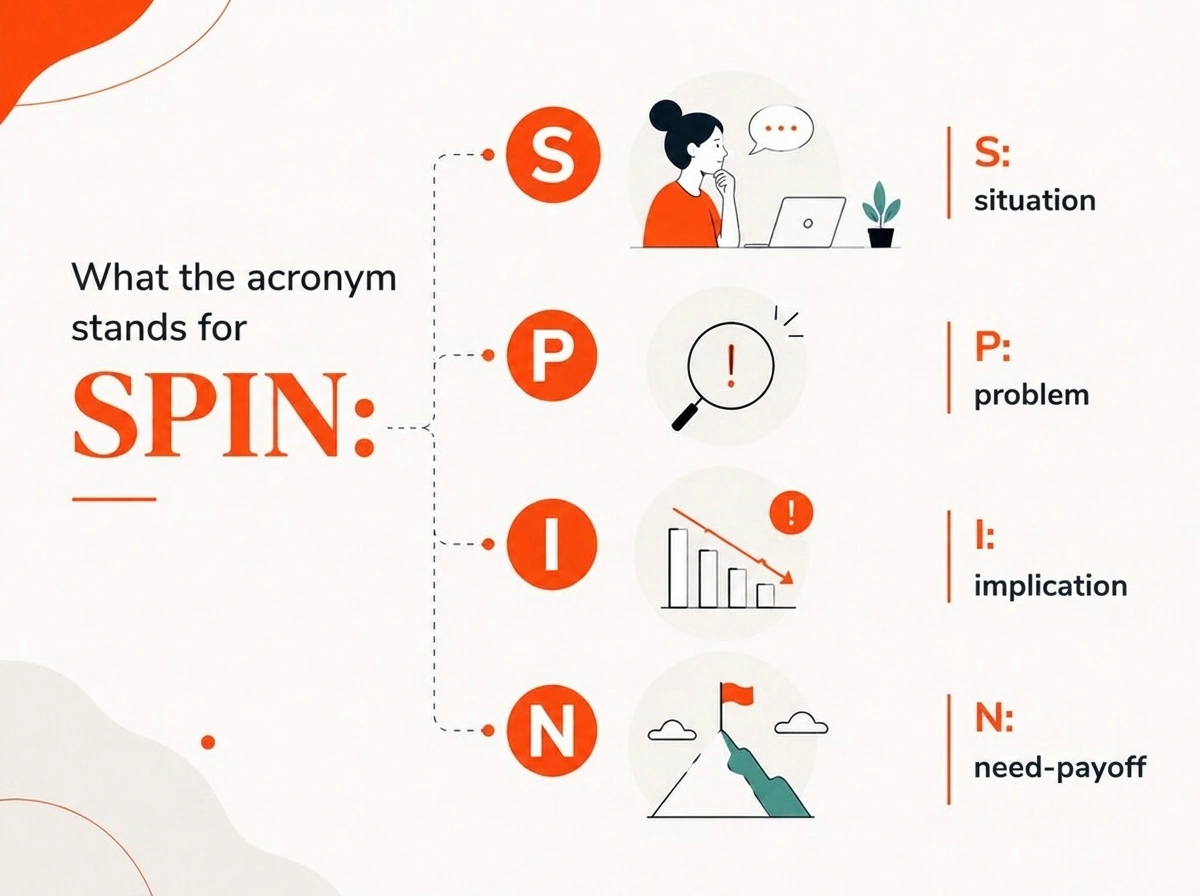
SPIN stands for Situation, Problem, Implication and Need-payoff. These are the four types of questions that structure the SPIN Selling method and help salespeople understand the customer’s context, identify their pain points, explore the impact of those problems and show the value of a possible solution.
What the SPIN acronym stands for:
- S: situation
- P: problem
- I: implication
- N: need-payoff
Each stage has a different goal. Situation questions help you understand the customer’s context. Problem questions uncover difficulties or pain points.
Implication questions dig into the consequences of those problems, increasing the sense of urgency. Finally, need-payoff questions get the customer to put into words the benefits they expect from a solution.
What are the four SPIN Selling questions?
The four SPIN Selling questions are Situation, Problem, Implication and Need-payoff questions.
Each type of question has a specific job in the sales conversation and helps move the prospect from understanding their current situation to seeing the value of a solution.
In short, the four stages of SPIN Selling work like this:
- Situation questions: help you understand the customer’s current context.
- Problem questions: uncover difficulties, needs and obstacles.
- Implication questions: explore the consequences and impact of those problems.
- Need-payoff questions: help the customer see the benefits of solving the problem.
Let’s look at each type of question, with practical examples of how to use them in a sales conversation.
1. Situation questions (S)
Every good sale starts with context.
Situation questions help you understand who the customer is, how they work today and which processes are already part of their routine.
This is a discovery stage. The salesperson isn’t trying to convince anyone yet: the job is to gather enough information to understand the scenario before going deeper.
Some examples:
- How do you bring in new customers today?
- How many people are involved in your sales process?
- What’s your main customer acquisition channel?
- How long have you been working this way?
Imagine a salesperson offering a coaching program on customer acquisition for small business owners. The conversation could start like this:
Salesperson: “How does your business usually bring in new customers today?”
Customer: “Most of them come from referrals.”
Then the salesperson can explore further:
Salesperson: “Do you invest in ads or content marketing?”
Notice that, at this point, there’s no attempt to sell yet. A common mistake is turning this stage into an endless questionnaire.
When that happens, the conversation loses momentum and starts to feel bureaucratic. Ask only the questions you really need to understand the context.
2. Problem questions (P)
Once you know the scenario, it’s time to find out what’s keeping the customer from getting better results. This is where many opportunities show up.
Customers don’t always come to the meeting knowing exactly what their main challenge is. Often, they only notice the symptoms. Problem questions help turn symptoms into concrete challenges.
Here are a few examples:
- What’s making it hardest to grow sales right now?
- Do you struggle to follow up with your leads?
- Does your team have enough time to handle every opportunity?
Back to the example, the business owner answers:
“When referrals come in, we sell well. The problem is we never know how many customers we’ll have next month.”
That answer completely changes the direction of the conversation. The problem isn’t selling more: the real challenge is the lack of predictability. Spotting that difference is essential in consultative selling.
From there, the salesperson stops pitching a generic solution and starts building a proposal for that specific scenario. An important tip is to avoid yes-or-no questions: the more room the customer has to explain their reality, the more information you’ll have for the next stages.
3. Implication questions (I)
By now, the customer has acknowledged that there’s a problem. But that alone isn’t always enough to motivate change. That’s where implication questions come in.
The goal of this stage is to help the customer think about the consequences of the problem if it stays unsolved. It’s one of the most important stages of SPIN Selling because it turns an annoyance into a priority.
Instead of immediately pitching a coaching program on customer acquisition, the salesperson can go deeper with questions like:
- What happens when referrals slow down?
- How does this lack of predictability affect your financial planning?
- Have you ever held off on hiring or investing because you didn’t know how much you’d bring in?
- How much time does your team spend looking for new customers manually?
Picture this exchange:
Salesperson: “You rely a lot on referrals. What happens when they slow down?”
Customer: “We usually have to scramble to find new customers.”
Salesperson: “And does that tend to affect your cash flow?”
Customer: “Yes. We’ve had months when we postponed investments because we didn’t know what revenue would look like.”
Notice that the salesperson still hasn’t presented a solution. The customer is the one realizing the impact of the problem.
This is one of the big differences between traditional and consultative selling. Instead of convincing someone they have a pain point, you create space for them to reach that conclusion on their own.
4. Need-payoff questions (N)
After exploring the consequences of the problem, it’s time to steer the conversation toward the future. Need-payoff questions get the customer to picture how things could be different if the challenge were solved.
Some examples:
- What would it mean for your business to have a more consistent sales forecast?
- What would change in your team’s routine if your sales processes were more organized?
- How much time could you save with a structured customer acquisition strategy?
- How would that affect your results over the year?
Back to our example:
Salesperson: “If you could bring in customers predictably every month, what would that allow you to do?”
Customer: “We could plan hiring better and invest with more confidence.”
At this point, something important happens: the benefit stops being the salesperson’s argument and becomes the customer’s own conclusion. That’s why SPIN Selling tends to reduce objections throughout the sale.
When people see the value of change on their own, the conversation is no longer about persuading them, but about finding the best way to solve their problem.
How to use SPIN Selling in a sales meeting
To use SPIN Selling in practice, prepare for the meeting, understand the customer’s context, identify their problems, explore the impact of those challenges and only then present a solution that fits the needs you uncovered.
The method should work as a guide for the conversation, not as a rigid script of questions.
In practice, the process can be organized into five steps:
- Prepare before the meeting: research the customer and the context of the deal.
- Understand the context: ask questions to learn about the customer’s current reality.
- Uncover the problems: identify the challenges standing in the way of their goals.
- Show the impact: explore the consequences of leaving those problems unsolved.
- Present your solution: connect your offer to the needs uncovered during the conversation.
Here’s how to put each of these steps into practice.
1. Prepare before the meeting
The more you know about the customer before the meeting, the better. Research their:
- Industry;
- Team size;
- Business model;
- Online presence;
- Main market challenges.
This preparation saves you from basic questions that a quick search could answer and leaves more time for strategic ones.
2. Understand the context
Understanding the context is the first step in applying SPIN Selling during the conversation. Find out how the customer works today, which processes they use, what their goals are and how they got to where they are.
Start by exploring the customer’s reality. The goal here is to listen far more than you talk. Resist the urge to pitch your solution in the first few minutes.
It’s not about turning the meeting into an interrogation, but about gathering enough context to understand the customer and decide which topics deserve a deeper look.
3. Uncover the problems
Once you understand the scenario, use problem questions to identify obstacles, difficulties and unmet needs.
A good question would be: “What’s the main challenge you face in this process today?”. But don’t stop at the first problem mentioned.
If the customer says they need to sell more, for example, try to find out what’s behind it: not enough leads, low conversion, trouble retaining customers or no structured sales process?
The better you understand the root of the problem, the easier it is to connect your solution to a real need, much like exploring questions and pain points to define a buyer persona.
4. Show the impact
After identifying a relevant problem, the next step is exploring its consequences. Implication questions help the customer see what could happen if that difficulty stays unsolved.
If the customer mentions low sales predictability, for example, you could ask: “How does this lack of predictability affect your financial planning?” or “Have you ever held off on hiring or investing because you didn’t know what you’d sell in the coming months?”.
The goal isn’t to pressure or scare the customer, but to help them understand the real impact of the problem. Once that consequence is clear, the need for a solution naturally becomes more important.
5. Present your solution
Present your solution only after you understand the context, the problem and its consequences. By then, you’ll have enough information to explain in a personalized way how your product or service can help.
Instead of listing every feature or benefit, tie your presentation to what the customer told you. If they said the lack of predictability makes financial planning hard, show specifically how your solution can help them build a more predictable sales process.
That way, your offer no longer feels like a generic pitch and directly answers the needs uncovered throughout the SPIN Selling process.
SPIN Selling script example for a sale
A SPIN Selling script should work as a reference to guide the conversation, not something to follow word for word.
In the example below, each question has a job within the method: understanding the situation, uncovering the problem, exploring its implications and helping the customer picture the benefit of a solution.
Imagine an expert selling a coaching program for content creators who want to launch their first online course:
| Stage | Speaker | Example |
|---|---|---|
| Situation | Salesperson | How do you sell your expertise today? |
| Situation | Customer | Mostly through one-on-one consulting. |
| Situation | Salesperson | On average, how many clients can you take on per month? |
| Situation | Customer | About ten to twelve. |
| Problem | Salesperson | Has that been limiting your growth? |
| Problem | Customer | A lot. My calendar is always full. |
| Implication | Salesperson | If you keep working this way, what might happen a year from now? |
| Implication | Customer | I’ll probably still be earning the same amount. |
| Need-payoff | Salesperson | What would change if you turned part of that knowledge into an online course and kept consulting only for key clients? |
| Need-payoff | Customer | I could help more people without depending only on my time. |
Notice that the solution doesn’t show up at the start of the script. First, the salesperson understands the current model, identifies a limitation, explores its impact and gets the customer to picture a better situation. Only then is it the right time to present the offer.
What is the most common SPIN Selling mistake?
The most common SPIN Selling mistake is turning the conversation into an interrogation, running through a memorized list of questions without really listening to the customer’s answers. People who are new to the method often believe that memorizing that list is enough.
In practice, it doesn’t work that way. When the salesperson turns the conversation into an interview, the customer quickly notices they’re following a script. The questions lose spontaneity and the connection weakens.
SPIN Selling isn’t about the number of questions, but about asking the right questions at the right time. Often, a single answer opens the door to a topic that wasn’t in the original plan. That’s why listening is just as important as asking.
When should you use SPIN Selling?
SPIN Selling works best for consultative and complex sales, especially when the buying decision requires analysis, involves higher prices or has a longer sales cycle.
In these scenarios, understanding the customer’s needs in depth before presenting the offer can make the conversation more relevant and personalized.
That’s why SPIN Selling is especially useful for:
- B2B sales: especially when the decision involves managers, directors or several departments.
- Consulting, coaching and specialized services: situations where the solution has to be tailored to the customer.
- Software and enterprise solutions: especially when there are different features, plans or implementation options.
- Mid- to high-ticket products: when the purchase requires more thought and comparison.
- Longer sales cycles: deals that take several conversations before a final decision.
For simple, quick, low-involvement sales, on the other hand, going through every SPIN Selling stage may be unnecessary.
SPIN Selling pros and cons
The main advantages of SPIN Selling are a more personalized approach, a deeper understanding of the customer’s needs and the chance to reduce objections. The disadvantages include the preparation it requires and the fact that it isn’t a fit for every type of sale.
In short:
- Pros: puts the customer at the center of the conversation, helps uncover real needs, lets you tailor the offer and can reduce objections.
- Cons: requires preparation and skill and can make simple or transactional sales unnecessarily long.
Here’s a closer look at the main strengths and limitations of SPIN Selling.
Pros:
It puts the customer at the center of the conversation. Instead of turning the meeting into a sales presentation, the salesperson spends more time understanding the customer’s reality, which leads to more relevant conversations and increases the perceived value of the solution.
It reduces objections, because throughout the conversation the customer acknowledges their challenges and voices the benefits they expect. By the time the proposal comes, many objections have already been addressed.
It helps you tailor the offer. The more information you gather, the easier it is to adapt the proposal to that customer. That avoids generic pitches and improves your chances of closing.
Cons:
It requires preparation. It works best when the salesperson knows the market, the customer profile and the context of the deal. Without that preparation, the questions can feel shallow.
It isn’t always the best choice. In quick, highly transactional sales, going through every stage can make the process unnecessarily long. In those cases, more direct sales techniques tend to work better.
How to handle objections with SPIN Selling
To handle objections with SPIN Selling, find out what’s behind the resistance before trying to counter the customer’s argument. Instead of immediately answering an objection about price, timing or priority, ask questions that reveal what’s really holding the decision back and bring back the problems and impacts you identified earlier.
In practice, the process can follow three moves:
- Investigate the objection: find out what concern is behind the resistance.
- Revisit the impact: remind the customer of the consequences they acknowledged during the conversation.
- Connect the solution: show how the offer helps specifically in that scenario.
Here’s how it works with a price objection:
Customer: “The investment feels high right now.”
Salesperson: “I understand. When you say high, what are you comparing it to?”
Customer: “What I currently earn from consulting.”
Salesperson: “That makes sense. You mentioned your calendar is full and that, with this model, your revenue would stay the same a year from now. How much is it worth to you to help more people without depending only on your hours?”
Notice that the salesperson doesn’t argue about price: they investigate where the objection comes from and bring back the implication the customer had already acknowledged. That steers the conversation back to the value of the solution. To complement this approach, check out some ethical persuasion techniques for sales.
How to use SPIN Selling to sell digital products on Hotmart
To use SPIN Selling to sell digital products, ask strategic questions to understand where the prospect is, identify their challenges and explore the impact of those problems before presenting your offer. This approach is especially useful for consultative sales of coaching programs, consulting, mentorship and higher-ticket online courses.
For example, imagine an expert who sells a coaching program for professionals who want to launch their first online course. The conversation can be structured around the four types of SPIN Selling questions:
Situation: understand the current scenario
Situation questions help you understand the prospect’s starting point and how they currently monetize their knowledge. For example:
- How do you sell your expertise today?
- Have you already defined your target audience, or are you still building one?
Problem: identify the main challenge
Once you understand the scenario, use problem questions to find out what’s making it hard to create or sell one of the many types of digital products:
- What’s your biggest challenge in turning your knowledge into a digital product?
- What has kept you from getting this project off the ground?
Implication: explore the consequences of the problem
Implication questions help the prospect see how this challenge affects their results and what could happen if it stays unsolved:
- How does this challenge affect your income today?
- What could happen if you keep putting off launching your digital product?
Need-payoff: help the customer picture the transformation
Finally, need-payoff questions encourage the prospect to think about the benefits of solving the problem:
- What would it be like to have a digital product that generates sales without depending only on your working hours?
- What would change in your routine and your business if you could make this project happen?
When the offer comes after these four stages, it no longer feels like a generic solution and is directly tied to the needs the prospect identified during the conversation.
This makes the approach more consultative and helps creators present their coaching program, online course or other digital product in context. If you’re just getting started, see how to sell online courses step by step.
After the sale, a platform like Hotmart can support the rest of your digital business, with a custom checkout, payments in multiple currencies, content delivery, student management and sales tracking in a single ecosystem.
Frequently asked questions about SPIN Selling
Still have questions about using SPIN Selling? Below, we answer the most common questions about the method.
Does SPIN Selling only work for complex sales?
No. The method can be used in different sales contexts, but it usually delivers the best results in deals that involve a bigger investment, longer sales cycles or more strategic decisions. In simple sales, some stages can be adapted to keep the conversation more direct.
Can SPIN Selling be combined with other sales methodologies?
Yes. SPIN Selling complements other well-known approaches, such as the Challenger Sale, Solution Selling and different lead qualification frameworks like BANT. Whatever method you choose, understanding the customer's reality remains an essential step in consultative selling.
Do I need to read the original book to use SPIN Selling?
It's not required. The concepts in this article already give you a solid foundation to start using the method in your sales conversations. Still, reading SPIN Selling by Neil Rackham is a great way to dig into the research behind the method and see practical examples.
Who created SPIN Selling?
SPIN Selling was created by British researcher Neil Rackham, based on studies of how salespeople behave in complex sales. The method was introduced in the book SPIN Selling, published in 1988, and became a reference in consultative selling.
What is the difference between SPIN Selling and traditional selling?
The main difference is that SPIN Selling prioritizes uncovering the customer's needs before presenting the offer. In more traditional approaches, the salesperson tends to focus on product features and benefits; in SPIN Selling, they use questions to understand the scenario and tailor the solution.
Does SPIN Selling work for B2B sales?
Yes. SPIN Selling works well in B2B sales, especially when the deal involves complex solutions, longer sales cycles or multiple decision-makers. The questions help you understand the company's context, identify problems and explore their impact on the business.
What are the best examples of SPIN Selling questions?
Good SPIN Selling questions help the customer reflect on their situation, their problems, the consequences of those challenges and the benefits of solving them. Some examples: "How does this process work today?", "What's the main challenge?", "How does this problem affect your results?" and "What would change if you could solve it?".
Can SPIN Selling be used to sell online courses and digital products?
Yes. SPIN Selling can be used to sell online courses, coaching and other digital products, especially when the purchase involves a consultative sale. The method helps creators understand the prospect's goals and challenges before presenting their digital product as a possible solution.