
Goals for 2027: Ideas for Every Area of Life and How to Make Your New Year’s List
Discover 40+ ideas for your goals for 2027 by area of life, how to make your list in 5 steps and a free template to fill out.

What will we see in this post

A new year usually brings that urge to change habits, make plans happen and finally get projects off the ground. But among so many New Year’s resolutions, some end up forgotten before February even arrives.
To help you turn intentions into action, we’ve gathered more than 40 goal ideas for 2027 across seven areas of life, a step-by-step guide to making your list, a template to fill out and tips to keep moving forward all year long. First, here’s a quick summary:
| Question | Answer |
|---|---|
| What are the most common New Year’s resolutions? | Saving money (44%), spending more time with family and friends (37%), eating healthier and starting to exercise (25% each), according to a Datafolha survey of Brazilians (December 2025). |
| How many goals should you set for 2027? | Three to five main goals, so you can stay focused throughout the year. |
| How do you write a good goal? | With a number, a deadline and a first step: “save $300 a month until December,” not just “save money.” |
| How do you make a list of goals? | Look back on the year, choose your priorities, write clear goals, break them into steps and put your reviews on the calendar. |
| How do you avoid giving up halfway through the year? | Start small, use the “if X happens, then I’ll do Y” format, keep your progress visible and review your list every month. |
What are the most common goals for 2027?
The most common goals for 2027, like most New Year’s resolutions, involve money, health, relationships and work. Saving money, spending more time with loved ones, eating better, exercising and growing professionally are some of the goals that tend to show up in personal planning.
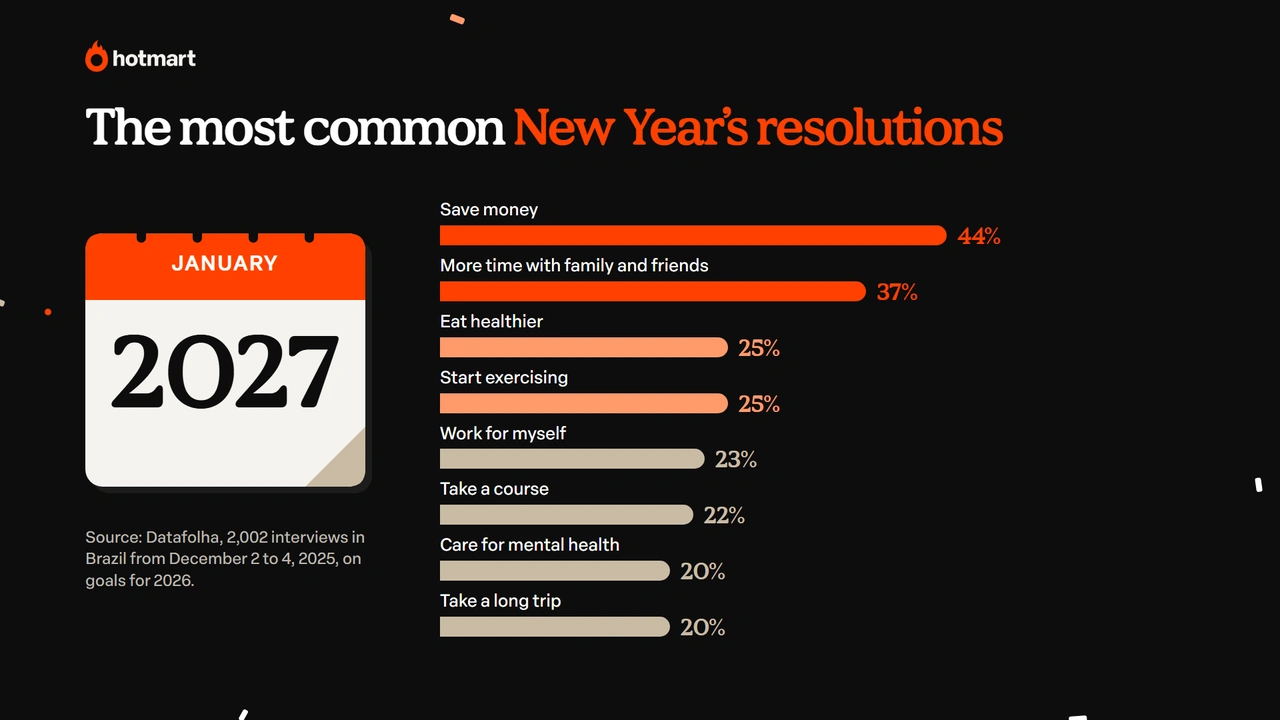
A Datafolha survey of Brazilians about their expectations for 2026 helps illustrate these priorities. Conducted from December 2 to 4, 2025, the survey interviewed 2,002 people and found that saving money was the most cited goal.
Here are the eight goals that topped the survey:
| Most cited goals for 2026 (Brazil) | Percentage |
|---|---|
| Save money | 44% |
| Spend more time with family and friends | 37% |
| Eat healthier | 25% |
| Start exercising | 25% |
| Become self-employed or start a business | 23% |
| Take a course to learn a new professional skill | 22% |
| Take care of mental and emotional health | 20% |
| Take a long trip | 20% |
Source: Datafolha, survey conducted December 2 to 4, 2025 and released on December 27, 2025, with a margin of error of two percentage points.
These numbers show that goals go far beyond career achievements. To build a list that truly makes sense for you, it’s worth also thinking about what you’d like to improve in your routine, your relationships and your free time.
And there’s a reason so many people plan right at the turn of the year. Researchers at the Wharton School of the University of Pennsylvania coined the term fresh start effect to describe our tendency to work harder on our goals after milestones on the calendar, such as New Year’s Day, a birthday or the start of a month. The study, by Hengchen Dai, Katherine Milkman and Jason Riis, was published in the journal Management Science in 2014. In other words: using the energy of 2027 to put your plans on paper makes perfect sense.
Goal ideas for 2027 by area of life
A good list of goals for 2027 covers different areas of life, not just financial or professional ones. Looking at the year as a whole is what turns a wish list into a more balanced life plan.
After all, growing in your career may matter a lot, but finding time to rest, take care of your health and be with the people you love is also part of a balanced plan.
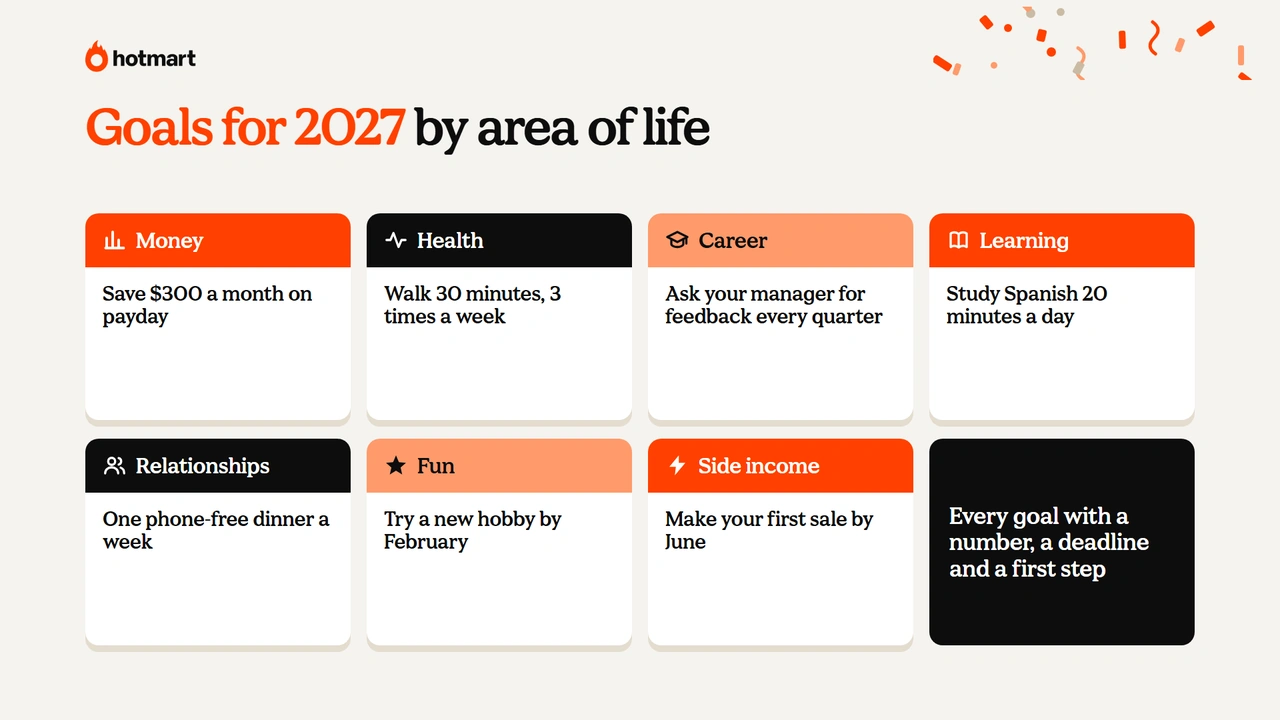
To help, we’ve organized examples of 2027 goals into seven categories, all written with a number and a deadline, so you can copy and adapt them:
- Financial goals.
- Health and wellness goals.
- Career and work goals.
- Learning and education goals.
- Relationship and family goals.
- Leisure and hobby goals.
- Goals for starting a business or earning extra income.
The following examples of goals for 2027 are just illustrations. Adjust the amounts, deadlines and frequency to fit your own reality.
Financial goals for 2027
Getting your money in order can ease your worries and make room for your other plans. The best approach is to start with goals that fit your income.
Here are some ideas:
- Save $300 a month, on payday, to start an emergency fund.
- Pay off credit card debt by June 2027.
- Track every expense during the first 90 days of the year.
- Cut food delivery spending by 20% by April.
- Set aside $150 a month for a trip at the end of the year.
- Review your personal budget on the last Sunday of every month.
What matters is knowing exactly how much you want to save, how long it will take and what your first step will be.
Health and wellness goals
Taking care of your health means caring for both body and mind. Small changes to your routine can be a starting point for building healthier habits.
Some examples of personal goals for 2027 include:
- Walk for 30 minutes, three times a week.
- Pack lunch for work four days a week.
- Plan your routine so you sleep seven to nine hours a night, the range the National Sleep Foundation recommends for adults.
- Set aside two blocks of free time with no commitments each week.
- Schedule a routine checkup by March, following your doctor’s guidance.
- Seek therapy if you need it, and set a session schedule that works for you.
Keep in mind that health goals should respect your individual situation and, when needed, include guidance from a professional.
Career and work goals
Professional goals for 2027 can involve growing within your company, switching fields or building new skills.
If you want to move forward in your career, here are some possibilities:
- Update your resume and LinkedIn profile by March.
- Ask your manager for feedback every quarter.
- Attend two events or meetups in your field by September.
- Complete a training program relevant to your profession by July.
- Apply to at least three jobs a month, if you’re looking for a new opportunity.
- Create a development plan to go after a promotion or a role change by December.
Remember that outcomes like promotions and job offers don’t depend only on you. That’s why it helps to pair these goals with actions that are within your control.
Learning and education goals
Learning something new can open professional doors, broaden your interests and give you more confidence to take on challenges.
Check out a few examples:
- Finish an online course by April 2027.
- Study Spanish for 20 minutes a day, five days a week.
- Read one book a month throughout the year.
- Learn how to use a new digital tool by June.
- Take a workshop or trial class every quarter.
- Block out two hours a week to study a topic you’re personally curious about.
You don’t have to stick to work-related topics. Learning photography, cooking or a musical instrument can also be part of your plans and your personal development.
Relationship and family goals
With so many responsibilities, staying in touch with the people you love can easily slip down the list.
If you want to strengthen those bonds, consider these relationship goals for 2027:
- Have a phone-free family dinner once a week.
- Call a friend or family member every two weeks.
- Plan a trip for two by the second half of the year.
- Save one night a month for a special date night.
- Meet up with friends in person at least once a month.
- Set aside a weekly moment to talk with your partner about plans and priorities.
For couples’ goals, it’s best to set them together, taking into account both people’s availability and interests.
Leisure and hobby goals
Not every goal needs to be about productivity. Making time for activities you enjoy can also be part of a more balanced year.
Here are some ideas:
- Try a new hobby by February.
- Set aside one hour a week for a leisure activity.
- Cut screen time outside of work to an average of two hours a day, if that makes sense for your routine.
- Visit a new city by December.
- See a play or visit an exhibit every quarter.
- Plan one outdoor outing a month.
The idea is to make room for experiences you enjoy, without turning your free time into one more obligation.
Goals for starting a business or earning extra income
If you want to start a business from scratch or boost your budget, setting goals can help you turn an idea into a real project.
Here are a few possibilities:
- Set aside five hours a week to develop a business idea.
- Research your audience and validate an offer by March.
- Make your first sale of a product or service by June 2027.
- Land your first five clients by September.
- Aim to save $500 a month from a way to make extra money, adjusting the goal to your actual results.
- Create and launch a digital product by November.
If you’re just getting started, focus on small actions you can actually carry out. Making your first sale, for example, can be more useful than setting a very high revenue goal without knowing whether there’s demand.
How to make your list of goals for 2027 in 5 steps
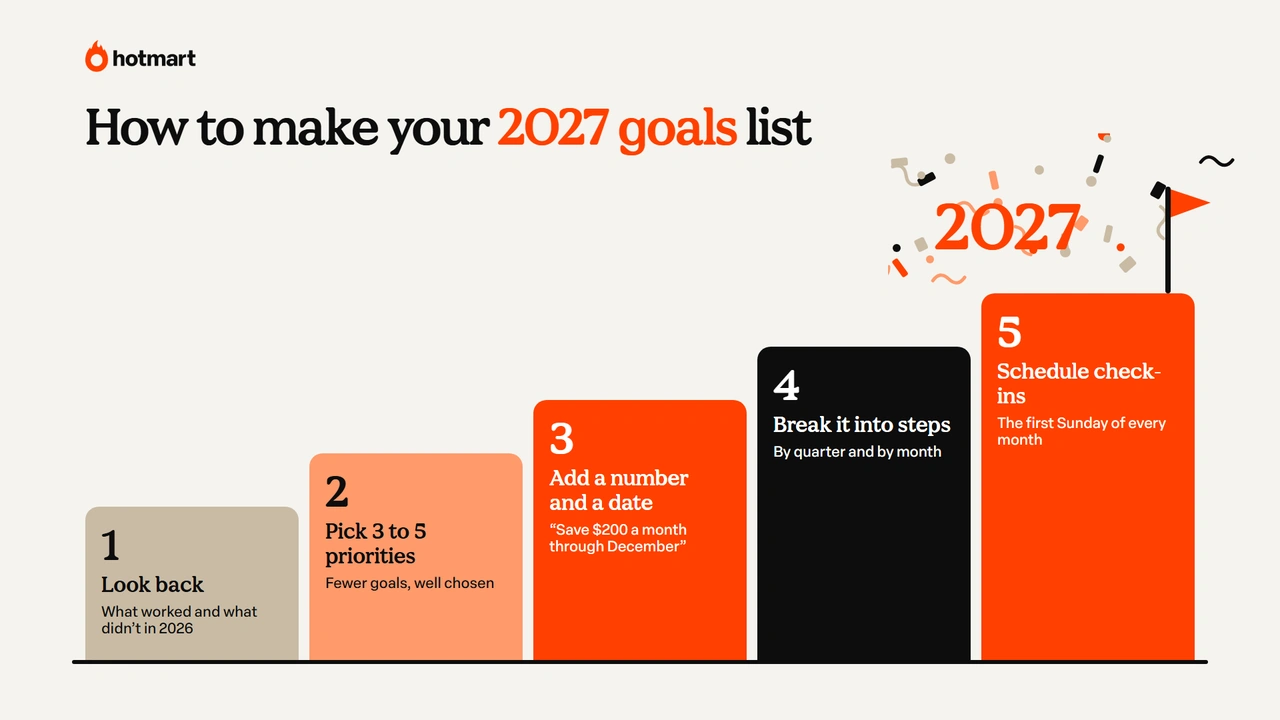
To make your list of goals for 2027, start by looking back on the past year, pick a few priorities, set clear goals, break each one into steps and track your progress regularly.
This process helps turn broad wishes into actions that actually fit into your routine.
Here’s how to organize your plan:
- Look back on 2026. Think about what worked, what fell by the wayside and why. The wheel of life helps you see, with scores from 0 to 10, how the different areas of your life are doing.
- Choose three to five priorities. Instead of writing a huge list, pick the goals that make the most sense for the season of life you’re in.
- Write goals with numbers and deadlines. Swap “I want to save money” for “I want to save $200 a month until December.” To make each goal even clearer, use the SMART goals method.
- Break each goal into smaller steps. If you want to finish a course by June, for example, decide how many lessons you’ll watch each month and each week.
- Put your reviews on the calendar. Pick a fixed date, like the first Sunday of every month, to check your progress and adjust your plan.
You don’t need to have every answer at the start of the year. What matters is creating a plan you can revise as your reality changes.
2027 goals template
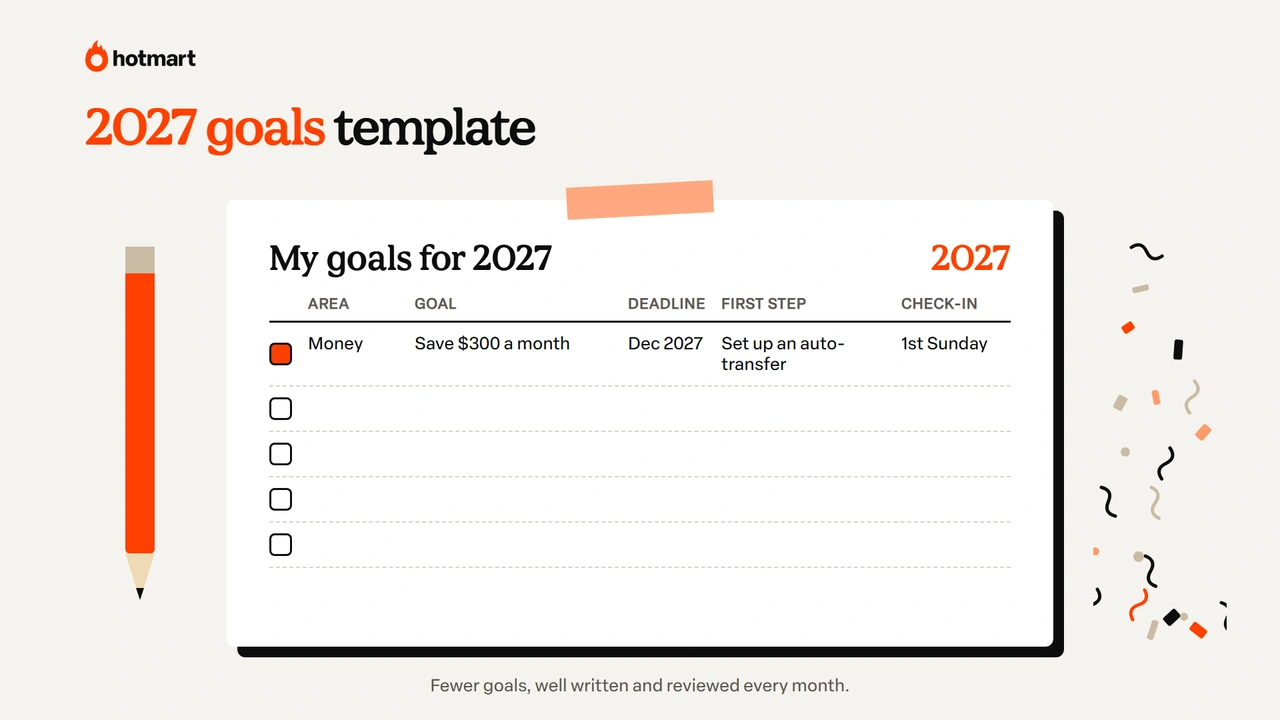
A 2027 goals template brings together, in one place, the area, the goal, the deadline, the first step and the review date. That makes it easier to see your priorities and keep track of what you’ve already accomplished.
You can use a spreadsheet, an organization app or even a notebook.
Here’s a simple template to copy and fill out:
| Area | Goal | Deadline | First step | Review date |
|---|---|---|---|---|
| Finances | Save $300 a month for an emergency fund | December 2027 | Set up an automatic monthly transfer on payday | First Sunday of every month |
| Learning | Finish an online course | April 2027 | Choose the course and block out two hours a week | First Sunday of every month |
Then just add the other goals you’ve chosen and update your progress throughout the year. If you prefer pen and paper, download the 2027 goals template as a PDF and print it out.
How to stick to your New Year’s resolutions
Many New Year’s resolutions fall by the wayside because there are too many of them, they’re too vague or they’re hard to track. When a goal feels too big, it can be hard to know where to start.
The good news is that a few adjustments can make your plan much more doable:
- Start with small habits. If your goal is to read more, try starting with ten pages a day instead of trying to finish several books at once.
- Use the “if, then” format. Instead of “I want to exercise more,” make a deal with yourself: “if it’s Monday, Wednesday or Friday, then I’ll walk for 30 minutes after lunch.” Psychologist Peter Gollwitzer calls this kind of plan an implementation intention, and a meta-analysis of 94 tests with more than 8,000 participants, published by him and Paschal Sheeran in 2006, showed that it significantly increases the chances of following through on what you planned.
- Keep your progress visible. Use a planner, an app, a spreadsheet or a Kanban board to record what you’ve already done.
- Share your goals with someone. Setting up walks with a friend, for example, can help you stay consistent.
- Celebrate small wins. If you managed to save money three months in a row, acknowledge that progress, even if you still have a way to go to reach the final amount.
- Adjust the goal when needed. If your routine or financial situation changes, revise deadlines and amounts without guilt.
Remember that consistency doesn’t mean doing everything perfectly. A goal can still make sense even after breaks, changes or fresh starts.
Goals for 2027: learn something new or earn extra income
Learning a new skill and working for yourself were among the most cited goals in the Datafolha survey of Brazilians about their goals for 2026, and they’re common resolutions in many other countries, too.
If these are also priorities for you, there are different ways to get started.
If you want to learn something new in 2027, Hotmart brings together online courses in many different areas, such as languages, personal finance, career, cooking and hobbies.
You can pick a topic that interests you and learn at your own pace, fitting the lessons into the time you have available.
If you’d like to turn what you know into income, one option is to create an online course or an ebook about something you already know how to do.
On Hotmart, listing and publishing an online course or an ebook is free. Hotmart only charges when you make a sale: as of November 2026, the fee is 9.9% + US$1.00 per approved sale.
And if you have an idea but don’t know how to build a page to promote it, Hotmart Launchpad can help. You describe your idea in your own words, and artificial intelligence builds the sales page, which goes live with a domain, hosting and Hotmart checkout already set up.
Hotmart Launchpad has a free plan to create and publish your first project.
That way, a goal like “share what I know” can turn into concrete steps: choosing the topic, organizing the content, creating the product and planning how to promote it.
Ready to turn your goals for 2027 into action?
Making a list of New Year’s goals can be a great start, but it’s not the number of goals that determines the outcome.
In practice, choosing a few priorities, setting deadlines and breaking your plans into small steps can make more of a difference than trying to change everything at once.
It’s also worth looking at different areas of life. After all, your goals can involve money and career, but also health, relationships, learning and time for fun.
And remember to review your list throughout the year. Not everything will happen exactly as you imagined, and adjusting your course is part of the process.
What matters is starting with goals that make sense for you and finding ways to put them into practice, one step at a time.
Frequently asked questions about goals for 2027
Still have questions? Below, we answer some of the most common questions about New Year’s goals.
How many goals should you set for 2027?
A good strategy is to choose three to five main goals for the year. That number helps you stay focused and keeps you from trying to change too many things at once. If you have several goals, rank them by priority and consider starting the less urgent ones later on.
When should you start planning your New Year’s goals?
You can start planning your goals in the last weeks of December or the first days of January. But there’s no required date. The most important thing is to set aside time to assess your priorities, define clear goals and plan your first steps. You can also create new goals throughout the year.
How do you set goals for 2027 as a couple?
Start by talking about the goals you want to reach together, such as saving for a trip, getting your finances in order or making more time for your relationship. Then agree on amounts, deadlines and who’s responsible for what. It’s important to build these goals together and to respect each person’s individual goals as well.
What should you do with the 2026 goals you didn’t reach?
Before carrying a goal over to the next year, think about why you didn’t reach it. Maybe the deadline was too short, your priorities changed or the goal no longer makes sense. If it still matters to you, adapt it and break it into smaller steps. If not, you can let it go without guilt and make room for new plans.