
Wheel of Life: What It Is, How to Do It and a Free Printable Template
Learn what the wheel of life is, how to fill out its 12 areas step by step and download a free printable template.

What will we see in this post

Work, health, family, money, personal plans… Sometimes it feels like everything needs your attention at the same time, and it’s hard to know where to start making changes.
The wheel of life is a tool that helps you see how the different areas of your life are doing and spot what deserves more attention. In this article, you’ll learn how it works, get to know its 12 areas and fill it out step by step, with a completed wheel of life example and a printable PDF template. First, here’s a quick summary:
| Question | Answer |
|---|---|
| What is the wheel of life? | A self-reflection tool that rates, on a scale of 0 to 10, how satisfied you are with 12 areas of life. |
| Who created the wheel of life? | It’s credited to American Paul J. Meyer, founder of the Success Motivation Institute, in the 1960s. |
| What are the areas? | 12 areas grouped into four dimensions: personal, professional, relationships and quality of life. |
| How do you fill out the wheel of life? | Give each area a score from 0 to 10, shade in the slices, choose your leverage area and build an action plan. |
| How often should you redo it? | Every three months, using the same areas, so you can compare your progress. |
What is the wheel of life?
The wheel of life is a self-reflection tool that lets you assess how satisfied you are with different areas of your life by giving each one a score from 0 to 10.
It’s drawn as a circle divided into sections, like a pizza. Each slice stands for one aspect of life, such as health, work, relationships and finances.
When you fill out the wheel, you create a visual snapshot of how you feel about these areas right now. That helps you spot imbalances, recognize what’s working and choose priorities to improve your day-to-day life.
The tool is credited to Paul J. Meyer, an American pioneer of personal development who founded the Success Motivation Institute in Waco, Texas, in 1960 and is said to have created the model during that decade for the institute’s goal-setting programs.
Widely used in coaching and mentoring, the wheel of life can also be filled out on your own, as an exercise in reflection and personal planning.
Keep in mind that the wheel of life is not a psychological test or a diagnosis. Your scores reflect your personal perceptions and serve as a starting point for thinking about change.
What are the areas of the wheel of life?
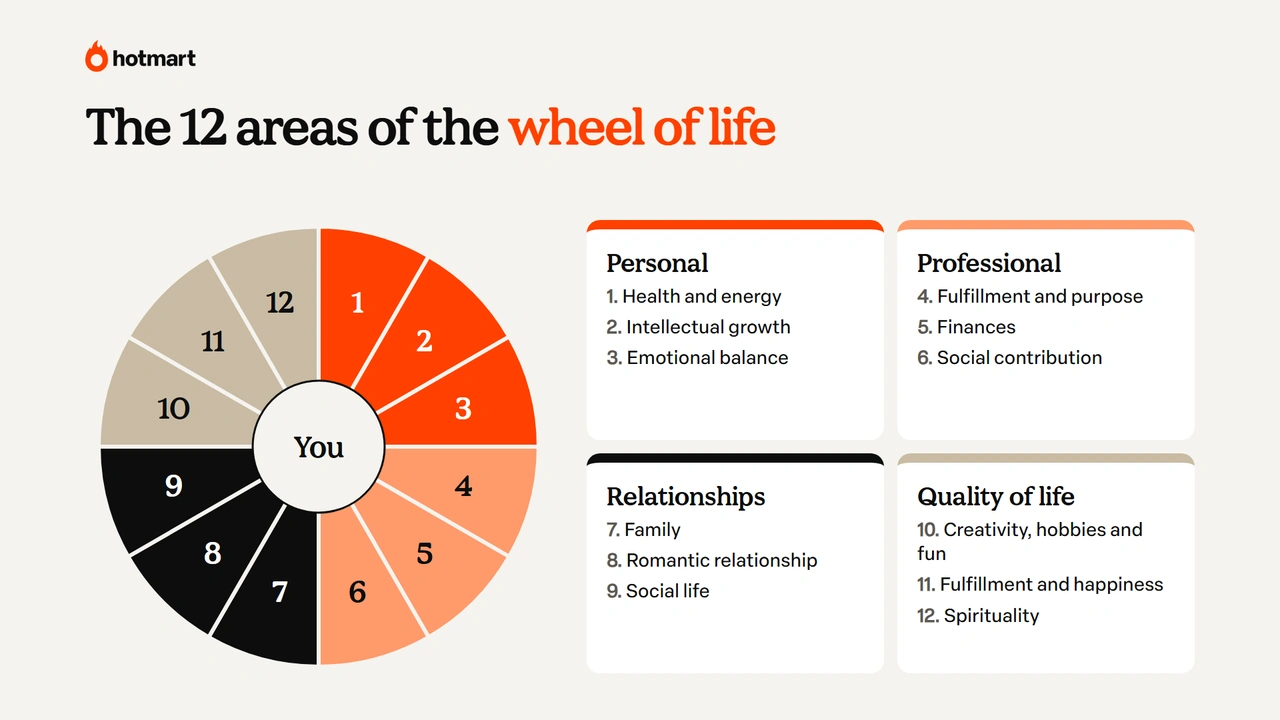
The best-known version of the wheel of life has 12 areas, organized into four dimensions: personal, professional, relationships and quality of life.
Each area represents an important part of your life and gets a satisfaction score from 0 to 10.
To make it easier to fill out, here are the dimensions and some questions that can guide your assessment:
| Dimension | Area | Question to reflect on |
|---|---|---|
| Personal | Health and energy | Am I satisfied with my health and my energy level day to day? |
| Personal | Intellectual growth | Do I have opportunities to learn and build new knowledge? |
| Personal | Emotional balance | How do I feel about my emotions and the way I handle challenges? |
| Professional | Fulfillment and purpose | Am I satisfied with my work and the meaning I find in what I do? |
| Professional | Finances | Does my financial situation meet my needs and goals? |
| Professional | Social contribution | Do I feel I make a positive contribution to other people or to society? |
| Relationships | Family | Am I satisfied with the quality of my family relationships? |
| Relationships | Romantic relationship | How do I feel about my love life and my romantic relationships? |
| Relationships | Social life | Do I get to spend time with friends and people who matter to me? |
| Quality of life | Creativity, hobbies and fun | Do I have time to do the things I enjoy? |
| Quality of life | Fulfillment and happiness | Am I satisfied with the life I’m building? |
| Quality of life | Spirituality | Do I make room for my beliefs, my values or my sense of connection and purpose? |
These are the areas used in this template, but there are versions of the wheel of life with eight areas, as well as adaptations for career, school and other goals.
The most important thing is to use the same categories every time you redo the exercise, so you can compare your progress.
How to do the wheel of life step by step
To do the wheel of life, you divide a circle into areas, give each one a satisfaction score and look at which parts of your life need more attention.
Filling out the wheel of life only takes a few minutes. What really makes a difference is using the result to plan small changes.
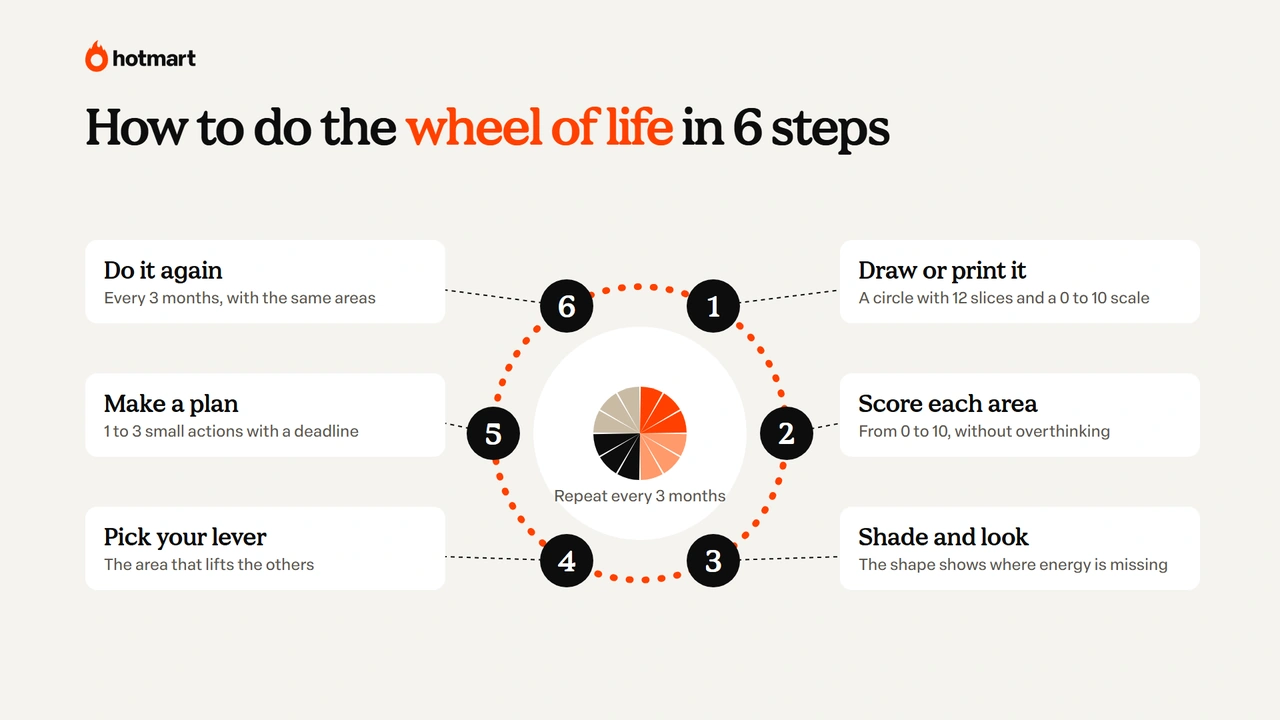
Here are the six steps:
- Draw or print the wheel.
- Give each area a score from 0 to 10.
- Shade in the slices and look at the shape.
- Choose your leverage area.
- Turn your analysis into an action plan.
- Redo the wheel every three months.
1. Draw or print the wheel
Start by drawing a circle divided into 12 equal slices, one for each area of life.
Each slice should have a scale from 0 to 10, running from the center out to the edge. The center represents the lowest satisfaction, while the outer edge is the highest score. If you prefer, use our blank wheel of life template, which you’ll find below in the section about the PDF.
2. Give each area a score from 0 to 10
Now, rate how satisfied you currently feel with each area of your life.
Use the questions from the table above and try to answer spontaneously, without overthinking. This exercise works best when you’re completely honest with yourself.
For example, if you’re happy with your friendships, you might give Social life an 8. But if you feel you never find time to rest and have fun, you might give creativity, hobbies and fun a 3.
There’s no right or wrong answer. Your score reflects how you feel today, not what other people expect of you.
3. Shade in the slices and look at the shape
Once you’ve chosen your scores, shade in each slice from the center out to the matching mark. You can also connect the dots to see the shape of your wheel.
The more filled in an area is, the more satisfied you are with that part of your life.
To see how to read the result, imagine a fictional person named Marina, who filled out her wheel of life with the following scores:
| Area of life | Score |
|---|---|
| Health and energy | 4 |
| Intellectual growth | 8 |
| Emotional balance | 5 |
| Fulfillment and purpose | 8 |
| Finances | 6 |
| Social contribution | 7 |
| Family | 8 |
| Romantic relationship | 7 |
| Social life | 5 |
| Creativity, hobbies and fun | 3 |
| Fulfillment and happiness | 6 |
| Spirituality | 7 |
Looking at her completed wheel of life, Marina notices that she’s satisfied with her work and her family, but misses having time for fun and for taking care of her own health.
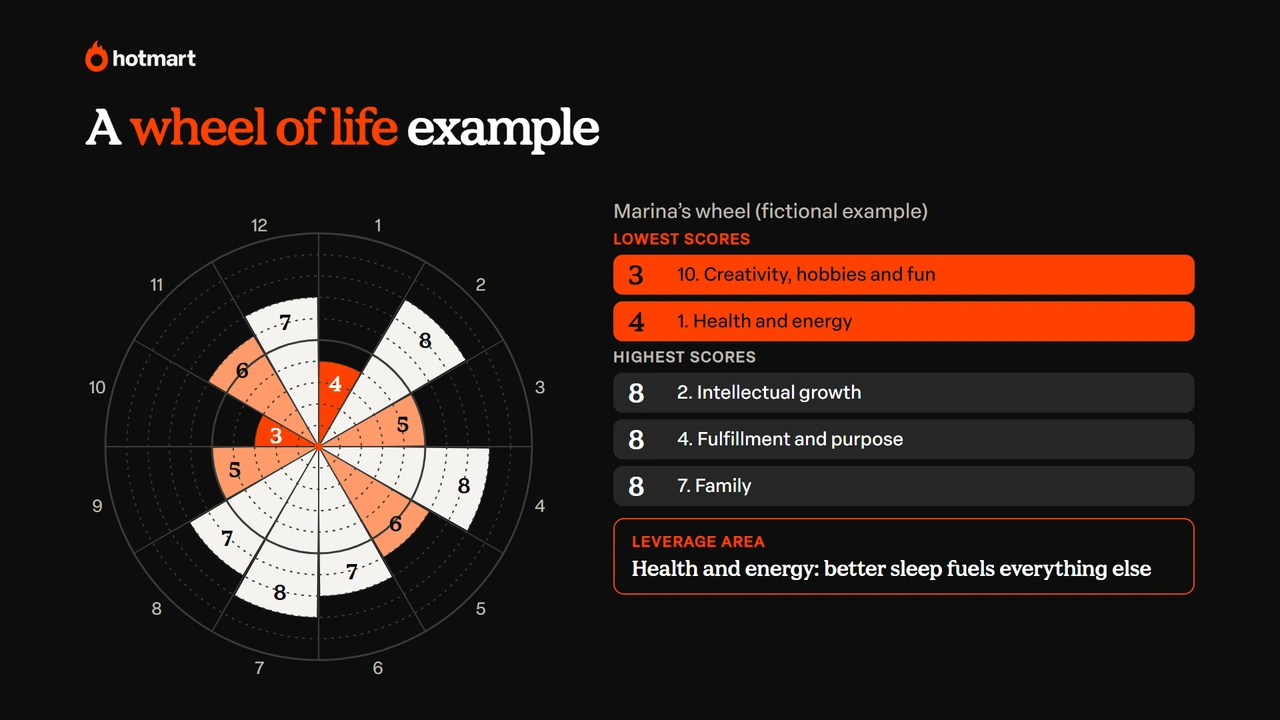
A wheel with high scores in some areas and low scores in others has an uneven shape. A more even wheel, on the other hand, shows similar levels of satisfaction across the categories.
But here’s the catch: a round wheel doesn’t always mean a balanced or satisfying life. If every score is low, the shape may look even, but there’s still plenty of room for improvement.
That’s why you should look at both the shape and the scores themselves.
4. Choose your leverage area
After analyzing the result, choose one area that could bring improvements to other parts of your life.
This is what’s called your leverage area.
For example, sleeping better can boost your energy, your concentration at work and your mood throughout the day.
In Marina’s case, improving her health and energy could be a good starting point. By getting her rest schedule in order, she may also find more energy to enjoy her free time.
Remember that the area with the lowest score doesn’t always have to be your top priority. It’s best to think about what bothers you most and which changes are realistic right now.
5. Turn your analysis into an action plan
Now that you’ve identified a priority, it’s time to decide what you can do to improve that area.
Start by choosing one to three small actions, with clear deadlines that fit your routine.
Here’s how Marina could organize her plan:
| Chosen area | Current score | Target score | First action | Deadline |
|---|---|---|---|---|
| Health and energy | 4 | 7 | Walk for 20 minutes, three times a week | Next 30 days |
| Creativity, hobbies and fun | 3 | 6 | Try one leisure activity a week | Next 30 days |
The target scores are personal goals, not guaranteed results. What matters is tracking whether the actions are helping Marina feel better about these areas.
Avoid trying to change everything at once. Small steps can make your plan much more doable.
6. Redo the wheel every three months
The wheel of life reflects how you feel at a specific moment. That’s why your scores may change as new experiences, priorities and challenges come along.
A good strategy is to redo the exercise every three months, using the same areas and the same scale.
Keep your previous versions so you can compare the results and notice changes.
If a score went up, think about what helped. If it went down, try to understand what changed in your routine.
The goal isn’t to reach a perfect score in everything, but to track your progress and adjust your priorities when needed.
Wheel of life printable: free PDF template
The printable wheel of life template features the blank circle with all 12 areas and the 0 to 10 scale, ready for you to fill out by hand. Download the free wheel of life PDF, print it on letter-size paper and use colored pencils or markers to shade in the slices.
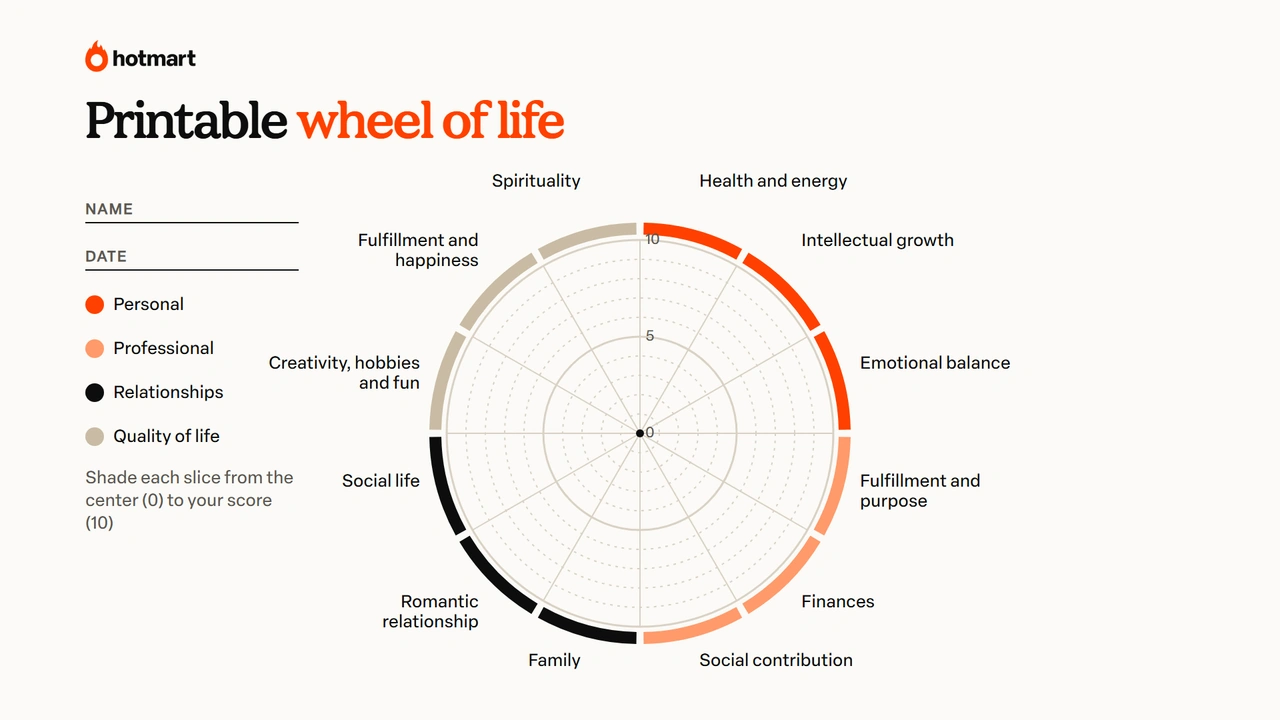
To get the most out of your blank wheel of life, follow these tips:
- Write the date at the top of the page: that way you can compare versions when you redo the exercise.
- Use one color for each dimension: personal, professional, relationships and quality of life become easier to see.
- Print more than one copy: one for now and others for your next reviews, every three months.
- Keep the pages together: in a folder or your planner, so you can track your progress throughout the year.
Prefer to fill it out on your computer or phone? You can also copy the 12 areas into a spreadsheet and create a radar chart, which draws the wheel automatically from your scores.
Using the wheel of life to plan the new year
The wheel of life can be used in your New Year planning to look back on the past year and choose goals for the months ahead.
One option is to fill it out in December, noticing which areas got the lowest scores and which deserve more attention.
Imagine you ended the year with a 4 for Finances and a 3 for leisure. Instead of writing a huge list of resolutions, you could choose two priorities: managing your budget better and setting aside more time for activities you enjoy.
From there, turn those priorities into specific goals using the SMART goals format, such as saving a set amount each month or trying a new hobby by February.
If you’re planning your next steps, check out our ideas for your goals for 2027 and the step-by-step guide to making your list.
Career wheel of life and wheel of life for teens
The wheel of life can also be adapted to different stages of life and specific goals. Just swap the traditional categories for the areas that matter most to the person filling it out.
In a career wheel of life, for example, the areas might include autonomy, expertise, salary and benefits, flexibility, growth opportunities and purpose. This version helps you reflect on how satisfied you are with your career and identify development priorities.
A wheel of life for teens, on the other hand, can cover school, friendships, family, health, free time and hopes for the future. It can be used as a classroom wheel of life activity, helping students reflect on their routines, interests and goals.
In any adaptation, it’s important to remember that the scores are personal and shouldn’t be used to compare or judge participants.
How to use the wheel of life in coaching, mentoring and courses
Wheel of life coaching is a common starting point for first coaching and mentoring sessions, because the tool shows how a person rates different parts of their life and what changes they want to make.
Beyond personal use, the wheel of life can fit into your business in two ways:
- as a reflection activity in mentoring programs and online courses;
- as an interactive quiz that people take and get their results instantly.
The wheel of life in mentoring programs and online courses
If you work as a coach, mentor or therapist, you can use the wheel of life as a reflection activity to help your clients or students identify their priorities.
On Hotmart, you can sell online courses, mentoring and coaching programs, with the wheel of life as an activity inside the Hotmart members area. Listing your product is free, and Hotmart charges 9.9% + US$1.00 per approved sale (fees as of November 2026).
Health professionals should use the tool within the limits of their scope of practice, without replacing assessments or validated clinical instruments.
Interactive wheel of life quiz
Another option is to turn the wheel of life into an online quiz, where people answer the questions and see their scores for each area.
With Hotmart Launchpad, you describe your idea in your own words, and artificial intelligence creates quizzes, calculators and other interactive tools, like a wheel of life quiz.
Hotmart Launchpad uses your brand’s logo, colors and tone of voice, and publishes your project with a domain, hosting and Hotmart checkout. There’s a free plan to create and publish your first project.
That way, the wheel of life can go from a paper-only activity to a complementary resource for your courses, mentoring programs or audience engagement strategy.
Ready to fill out your wheel of life?
The wheel of life is a simple way to see how you feel about different parts of your life.
By filling out the 12 areas, you can recognize what’s working, spot what needs attention and choose where to start.
But remember that a low score doesn’t mean failure. It just shows there’s room for change, based on your current needs and priorities.
What matters most is turning this reflection into realistic actions, tracking the results and redoing the exercise from time to time.
Why not set aside a few minutes to fill out your wheel of life and find out which area deserves the most attention right now?
Frequently asked questions about the wheel of life
Still have questions? Below, we answer some of the most common questions about the wheel of life.
Do I need a 10 in every area of the wheel of life?
No. The wheel of life doesn’t require you to be fully satisfied with every part of your life. The scores help you see how you feel about each area and what changes you’d like to make. The goal is to find a balance that makes sense for your reality, without turning the exercise into a demand for perfection.
Can you do the wheel of life online?
Yes. You can do the wheel of life online using websites with interactive quizzes, spreadsheets or design tools. Some platforms let you enter your scores and automatically see the result as a chart. You can also download a wheel of life PDF, print it and fill it out by hand.
Does the wheel of life work for companies and teams?
Yes, as long as it’s adapted to a professional context. A team can use the wheel of life to reflect on things like communication, collaboration, organization, autonomy and growth. In that case, the exercise should be a starting point for conversations and improvements, not a psychological assessment or an individual performance review.
Is the wheel of life related to Buddhism?
The wheel of life used in coaching and personal development is not the same as the one found in Buddhism. In the Buddhist tradition, the Bhavachakra, also known as the wheel of life, is a symbol that represents the cycle of existence and rebirth. The self-reflection tool, on the other hand, uses a circular chart to assess satisfaction with different areas of life. Despite the similar name, they have different origins and purposes.