
Content creation: the complete guide to planning, producing and turning content into a business
The complete guide to content creation: what it is, why it matters, formats by channel, quality content (E-E-A-T), the step-by-step process, tools including AI, routine, common mistakes and how to turn content into a business.

What will we see in this post

Every post, video, podcast or newsletter you consume was born from a content creation process. ✍️ Sometimes it looks spontaneous, but behind anyone who publishes consistently there is almost always a method: a clear goal, a well-defined audience, researched topics, a script, production and a review of what worked.
In this guide, you’ll learn what digital content creation is, why it matters (including in AI search), which formats to use on each channel, what Google considers quality content, a step-by-step process to create content consistently and how to turn all of it into a source of income. 🚀
| Question | Quick answer |
|---|---|
| What is content creation? | The process of planning, producing, publishing and analyzing useful or entertaining materials for an audience |
| What is it for? | Attracting an audience, building authority, driving sales and showing up on Google and in AI answers |
| What are the main formats? | Blog posts, long-form video, Reels/TikTok, podcasts, newsletters, carousels, live streams and lead magnets |
| What is quality content? | Helpful, original and trustworthy content made for people, backed by the creator’s real experience |
| Can you make a living from content creation? | Yes, with sponsorships, affiliate marketing, your own digital product and a community, but it takes time and method |
What is content creation?
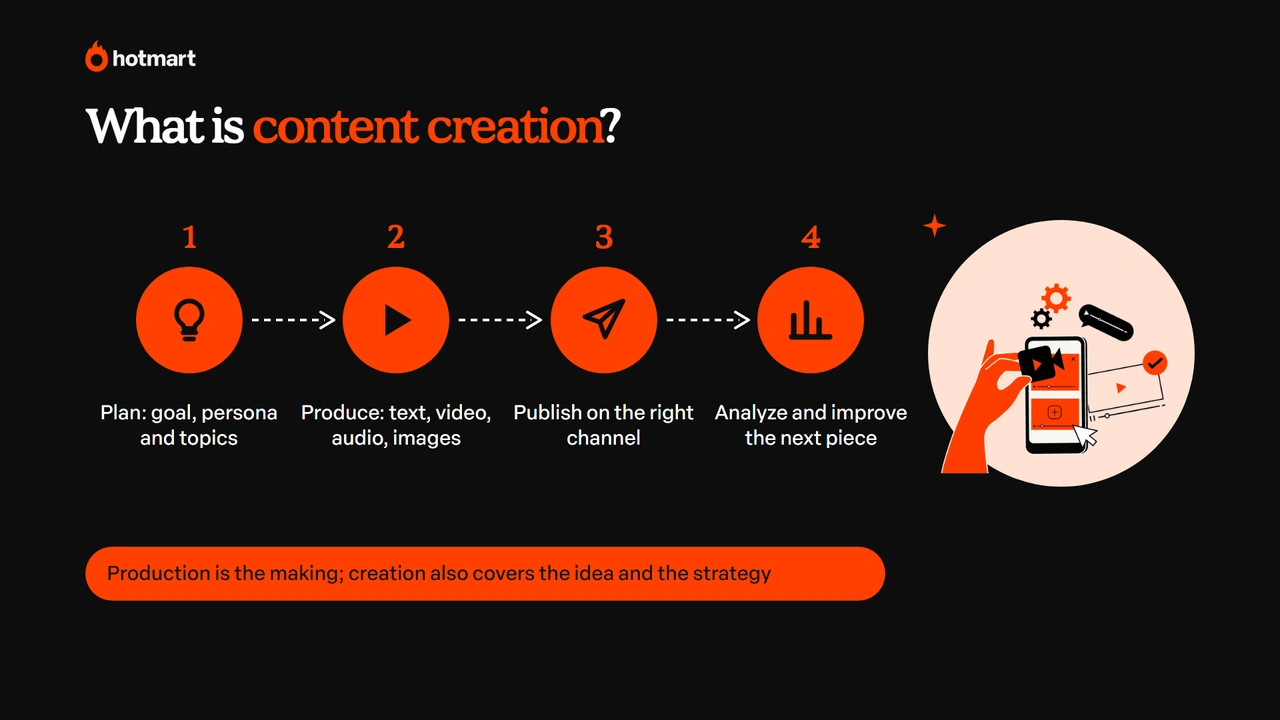
Content creation is the process of planning, producing, publishing and analyzing materials (text, video, audio, images and interactions) that deliver information, entertainment or a solution to a specific audience. When these materials are made for the internet, like blog posts, Reels, podcasts and newsletters, we call it digital content creation.
Content creation goes far beyond “posting”: it involves understanding who will consume the content, choosing the right format, delivering the message clearly and measuring the results to improve the next piece. That’s why terms like content production and how to create content are often used almost as synonyms. The difference is that production is the “making” stage, while creation also includes the idea and the strategy.
It’s also worth separating content creation from content marketing. Content marketing is the business strategy that uses content to attract and convert customers. Content creation is the hands-on work of turning that strategy into published pieces, and the person who does it on a regular basis is the content creator.
Why content creation matters for brands and creators
Content creation matters because it is the most sustainable way to be found, remembered and chosen online. Instead of interrupting people with ads, content answers their questions at the exact moment they are searching. In practice, creating content regularly helps you:
- build a brand and authority: whoever explains a subject well becomes a reference in it;
- grow your own audience: followers, subscribers and newsletter readers who keep coming back;
- sell more: content educates your audience, overcomes objections and prepares the purchase;
- show up on Google and in AI search: helpful, well-structured pages are the ones that appear most in search results and in answers from tools like Google’s AI Overviews, ChatGPT and Perplexity;
- earn direct income: through sponsorships, affiliate marketing, digital products and communities.
When it comes to AI search (often called GEO), there’s an important point: Google itself states, in its documentation on AI features in Search, that there is no special optimization required to appear in AI Overviews and AI Mode. The same best practices still apply: important content in text form, internal links, a good page experience and genuinely useful information.
The market also shows the size of the opportunity. According to the 2025 U.S. YouTube Impact Report, published in July 2026 based on research by Oxford Economics, YouTube’s creative ecosystem contributed over $60 billion to U.S. GDP in 2025 and supported more than 540,000 full-time equivalent jobs. And a global analysis by Goldman Sachs estimates that the creator economy could reach $480 billion by 2027. To understand how this market works, read this guide on what the creator economy is.
Types of digital content: which content creation format to use on each channel
The most common types of digital content today are text (blog posts and newsletters), video (long and short), audio (podcasts), images (carousels and infographics), live content (live streams) and lead magnets (ebooks, guides and spreadsheets). Each format works best with a specific channel and goal, and the table below sums up where each one shines:
| Format | Best channel | What it’s for | Production effort |
|---|---|---|---|
| Blog post | Your own website and Google | Answering searches, driving organic traffic and showing up in AI answers | Medium |
| Long-form video | YouTube | Teaching in depth and building authority | High |
| Short-form video | Reels, TikTok, Shorts | Fast reach and discovery by new followers | Low to medium |
| Podcast and video podcast | Spotify, YouTube | Building relationships and having in-depth conversations | Medium |
| Newsletter | Owning your audience without depending on algorithms | Low to medium | |
| Carousel | Instagram, LinkedIn | Explaining step by step and earning saves | Low |
| Live stream | Instagram, YouTube, TikTok | Real-time interaction, answering questions and selling | Medium |
| Lead magnet | Landing page, members area | Capturing contacts (ebook, checklist, spreadsheet, webinar) | Medium to high |
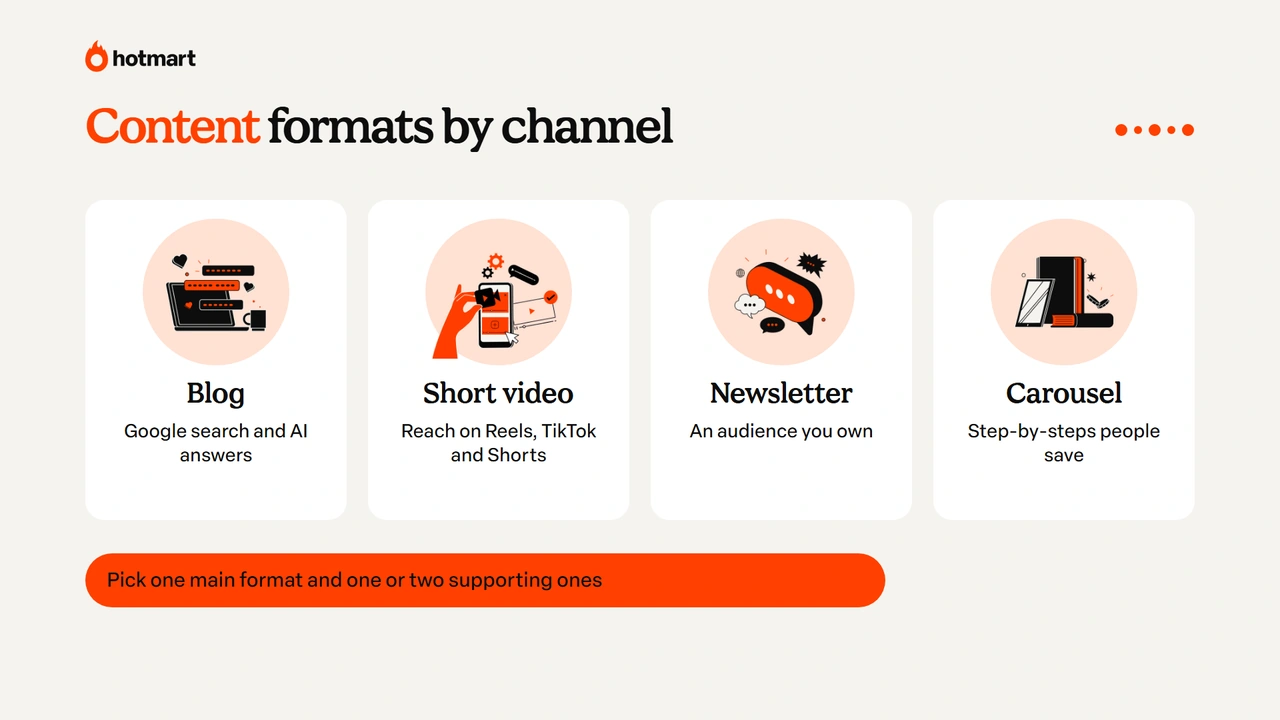
You don’t need to be on every channel. The best path is to choose one main format, the one you feel most comfortable with and where your audience is, plus one or two supporting formats to distribute the same topic. For more ideas tailored to each network, check out this guide to social media content.
What quality content means in content creation
Quality content is content that truly solves the needs of the people consuming it, with information that is accurate, original and easy to understand. Google sums up this idea as “people-first” content, rather than content made to manipulate search rankings, in its guide on creating helpful, reliable, people-first content.
In the same guide, Google explains the concept of E-E-A-T, a set of signals that help identify good content:
- Experience: you have lived or tested what you’re talking about;
- Expertise: you master the subject;
- Authoritativeness: other people and websites recognize you as a reference;
- Trustworthiness: the information is accurate, transparent and safe.
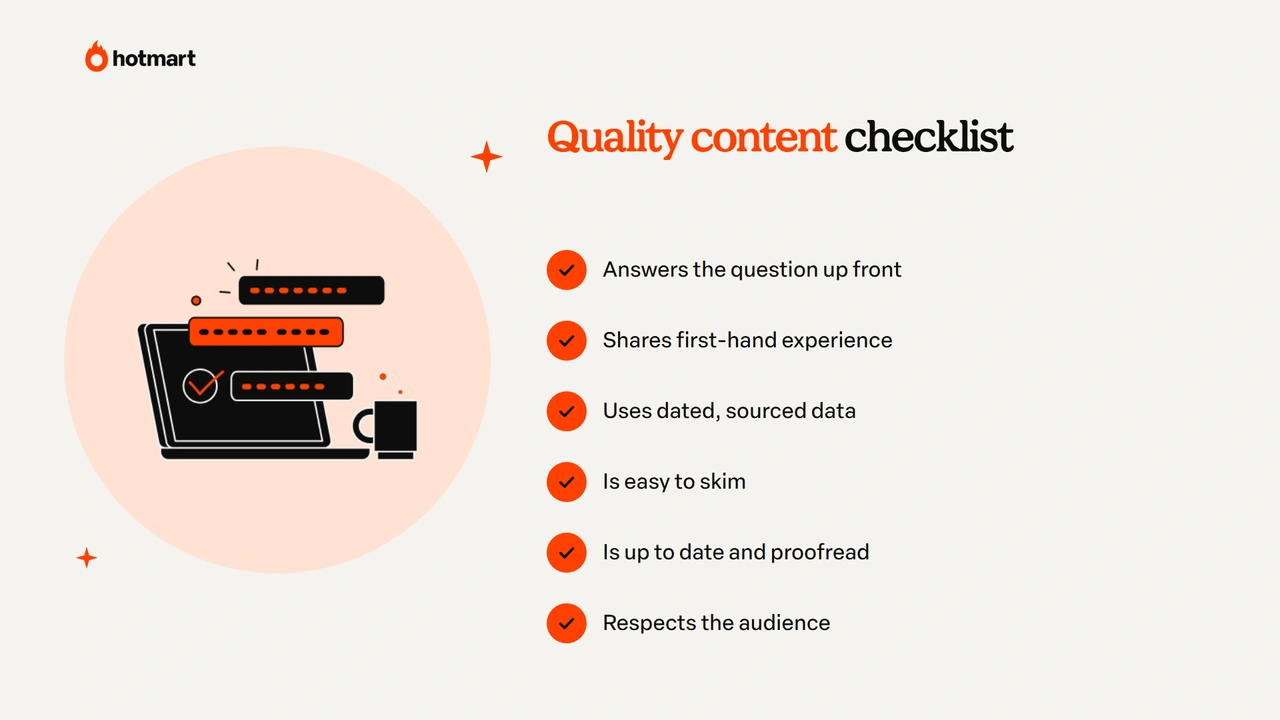
According to Google, trust is the most important of the four, and E-E-A-T isn’t a standalone ranking factor but a guide to what its systems try to reward. In everyday content creation, this becomes a simple checklist. Good content:
- answers the question right at the start, with no fluff;
- brings something of your own: an example, a test, an opinion or a behind-the-scenes look;
- uses data with a source and a date;
- is easy to skim (headings, lists, images);
- is up to date and corrected;
- respects the audience, with no exaggerated promises.
If your content checks these boxes, it has a better chance of being saved, shared and recommended by people, search engines and AI tools alike. If you write for your blog, this guide to SEO content writing shows how to apply these principles to search.
How to create content: the content creation process step by step
Creating content consistently depends less on inspiration and more on a process you can repeat. This is the content creation process we use and recommend, in 9 steps:
- set the goal;
- get to know your persona;
- choose your content pillars;
- research topics;
- build the calendar;
- write the script;
- produce;
- distribute and repurpose;
- track the metrics.
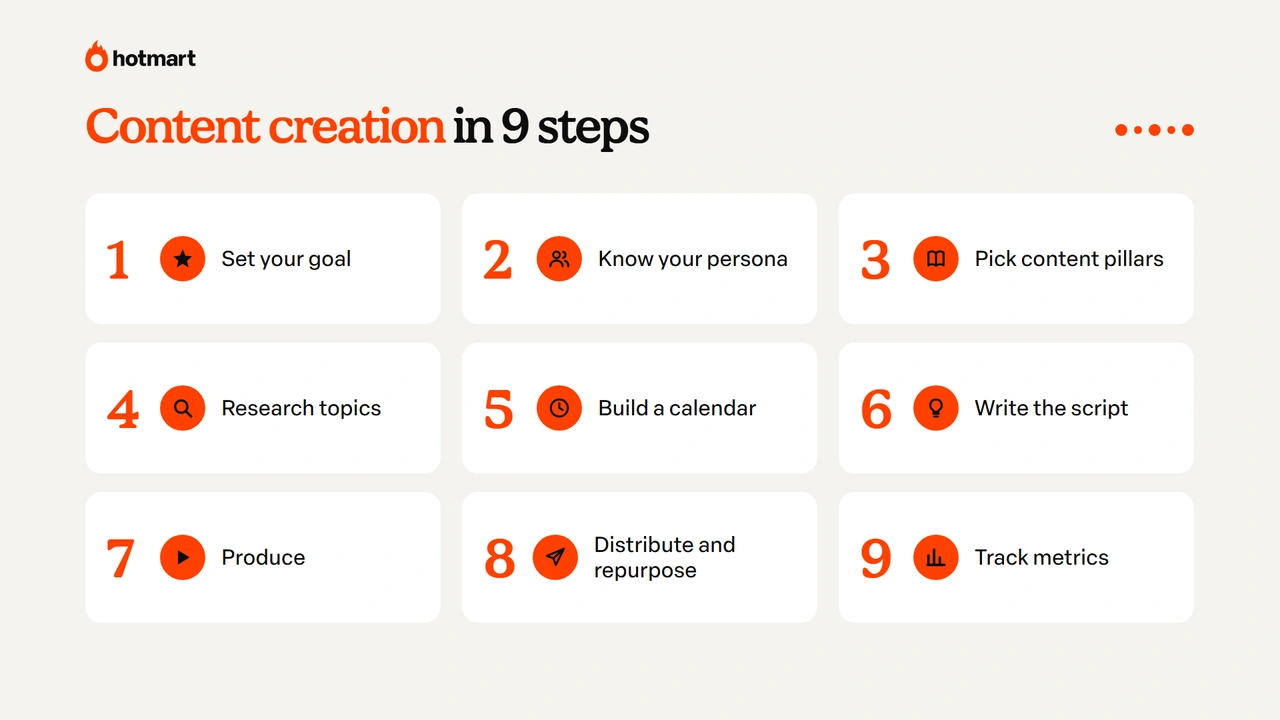
Below, we explain each stage of content creation.
1. Set the goal of your content creation
The goal of your content creation is the first decision to make: gain followers, generate leads, sell a product, strengthen your brand or monetize through sponsorships. The goal changes the format, the tone and the metric you’ll track. Content made to sell an online course, for example, needs a call to action, while reach-focused content needs a strong hook in the first few seconds.
2. Get to know the persona you create content for
The persona is a portrait of your ideal audience: age, routine, pain points, desires, where they spend time online and the words they use. The clearer your persona is, the easier it is to choose topics and language. If you haven’t built yours yet, this guide explains what a buyer persona is and how it differs from a target audience.
3. Choose your content pillars
Content pillars are 3 to 5 broad themes you’ll keep coming back to, such as “practical tips,” “behind the scenes,” “common mistakes” and “student results.” They organize your editorial line, keep you from talking about a little bit of everything and help your audience understand why they should follow you.
4. Research content topics your audience is searching for
Good content topics come from what people are already asking. Use Google and YouTube autocomplete, the “People also ask” section, the comments on your posts, the questions in your DMs and keyword research tools. Write everything down in an idea bank, because a topic that doesn’t fit today may work next week.
5. Build a content calendar
The content calendar defines what goes out, on which channel and on what day. It takes away the pressure of deciding “what to post today” and helps you keep a steady frequency, which has a big impact on reach. Start with a frequency you can maintain for months and learn how to create an editorial calendar step by step.
6. Write the content script
Every piece of content gets better with a script, even if it’s just one topic per line. The simplest structure works for almost any format: a hook (why people should pay attention), the body (what you deliver) and a call to action (the next step). If you’ve never written one, this guide on how to write a script walks you through the basics.
7. Produce content with what you have
In content production, doing the basics well matters more than expensive equipment: clean audio, natural light facing you, proofread text and images that are readable on a phone. Record or write in batches (several pieces at once) to save time and keep the same visual standard.
8. Distribute and repurpose each piece of content
Publishing is only half the job. Share each piece of content on your supporting channels, send it to your newsletter and turn one piece into several: a long video becomes short clips, an article becomes a carousel, a live stream becomes a podcast episode. Repurposing content multiplies your reach without multiplying your effort.
9. Track your content creation metrics
Content creation metrics show you what to repeat and what to adjust. Look at reach and views (discovery), saves, shares and comments (interest), watch time or reading time (quality) and clicks, sign-ups and sales (results). Once a month, pick the 3 pieces that performed best and create variations of them.
Content creation tools (including AI)
Content creation tools cover every stage, from planning to analysis, and most of them have a free version. To get started, this basic kit has you covered:
- planning: Notion, Trello or Google Sheets for your calendar and idea bank;
- topic research: Google Trends, Google and YouTube autocomplete, AnswerThePublic;
- writing and proofreading: Google Docs and checkers like Grammarly or LanguageTool;
- design: Canva for carousels, thumbnails and lead magnets;
- video and audio: CapCut, DaVinci Resolve and Audacity;
- scheduling and metrics: Meta Business Suite, YouTube Studio and each network’s analytics;
- artificial intelligence: ChatGPT, Claude and Gemini to help with ideas, structure and editing.
AI speeds up content creation a lot, as long as it works as an assistant and not as the author. Use it to generate topic ideas, draft outlines, summarize references and proofread. But the experience, the opinions and the fact-checking are still up to you.
This care is also technical: Google warns that using generative AI to produce many pages without adding value for users may violate its spam policy on scaled content abuse. Be transparent when AI plays a significant role in a piece and never use data it gives you without checking the source. To compare options, see this list of artificial intelligence tools.
For those who sell digital products, there are also AI tools focused on video. Hotmart Smart Studio, for example, creates videos with the creator’s own face and voice from an avatar, without turning on the camera, and suggests scripts based on the products and audience of people who sell on Hotmart. It’s useful for testing ads and Reels at scale without giving up your identity.
Content creation routine and common mistakes
A good content creation routine groups tasks by type instead of doing everything on the same day. Here’s a weekly model that works for people who create content on their own:
- Monday: topic research and weekly planning;
- Tuesday: scripts and copy;
- Wednesday: batch recording or design;
- Thursday: editing and scheduling;
- Friday: metrics review and audience engagement.
Adjust the days to the time you have available. What matters is having fixed time blocks to create, because waiting for inspiration is a recipe for disappearing and for creative block.
Even with a routine, some content creation mistakes show up often:
- posting without a goal: nice-looking content that leads nowhere;
- talking to everyone: without a persona, the message becomes generic;
- copying trends without adapting them: your audience notices when there’s nothing of you in it;
- disappearing and coming back: inconsistency hurts reach and trust;
- ignoring metrics: repeating what doesn’t work out of attachment;
- publishing without proofreading: factual mistakes cost credibility.
Fixing these points usually brings more results than switching social networks or buying new equipment.
How to turn content creation into a business
Turning content creation into a business means using the audience and authority you’ve built to generate recurring income. The path exists, but it takes time: Goldman Sachs estimates that there are about 50 million creators worldwide, yet only about 4% of them are professionals earning more than $100,000 a year.
That’s why people who make a living from content usually combine more than one income stream. The main ones are:
- sponsorships and brand deals: you promote products and get paid for it (in the U.S., the FTC requires you to disclose any relationship with the brand, including free products);
- affiliate marketing: you recommend other people’s products and earn a commission per sale;
- your own digital product: an online course, ebook, coaching program or AI agent built on your method;
- paid community: a subscription with exclusive content, meetups and networking.
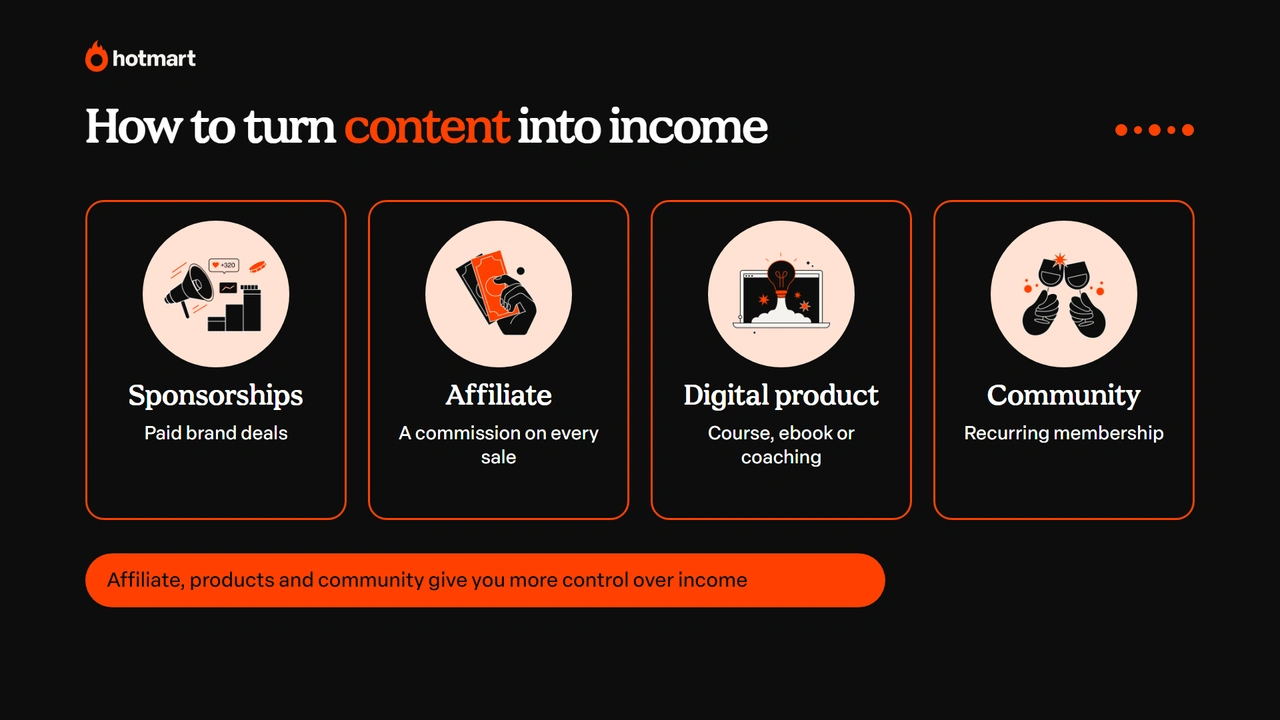
Sponsorships depend on brands’ interest. The last three models give you more control over your income, and that’s where Hotmart comes in.
If you don’t have a product yet, you can start with affiliate marketing: choose products aligned with your niche, promote them with your link and earn a commission on every approved sale. It’s a way to test what your audience buys before creating something of your own.
When your content keeps generating the same questions, it’s a sign that there’s a product there, and that you’re ready to grow from content creator to digital creator. On Hotmart, you can sign up and publish your course or ebook for free, host your lessons in the members area and only pay when you sell: 9.9% + US$1.00 per approved sale, with no monthly fee. This guide shows what you need to know to create a digital product from scratch.
For those who already have a loyal audience, an online community on Hotmart lets you charge a recurring subscription (weekly, monthly, quarterly or yearly), with posts, videos, audio and live streams in a space that’s all yours. That way, content creation stops depending only on the algorithm and starts supporting a business.
Ready to start your content creation journey?
Content creation is a process anyone can learn: set a goal and a persona, choose your pillars, research topics, plan, produce, distribute and measure. With quality and consistency, every piece you publish adds authority and brings you closer to your audience.
Start small: pick one format, build next month’s calendar and publish your first piece of content this week. When your audience starts asking for more, you’ll already know the path to turning that knowledge into a business. 💡
Frequently asked questions about content creation
Still have questions? Below, we answer some of the most frequently asked questions about content creation.
What does someone who works in content creation do?
Someone who works in content creation plans topics, writes scripts and copy, records, edits, publishes and analyzes the results of materials for social media, blogs, podcasts or email. They can work for their own brand as an independent creator or for companies and agencies.
What is the difference between content creation and content marketing?
Content marketing is the business strategy that uses content to attract, nurture and convert customers. Content creation is the hands-on part of that strategy: turning ideas into published posts, videos, audio and articles.
How do you start content creation from scratch?
Choose a topic you know well and an audience to talk to, then define one main format and a frequency you can keep up. After that, build a simple calendar, publish consistently for a few months and adjust your path based on the metrics.
Can you use artificial intelligence for content creation?
Yes, as support for ideas, structure and editing. Google doesn't penalize the use of AI itself, but rather mass-produced content without human review; so check the facts, add your own experience and be transparent when AI plays a significant role.
How much do people who make a living from content creation earn?
There's no fixed amount: income depends on the niche, the size and engagement of the audience and the revenue streams. According to Goldman Sachs, only about 4% of creators worldwide earn more than $100,000 a year, and combining sponsorships, affiliate marketing and your own product makes income more stable.