
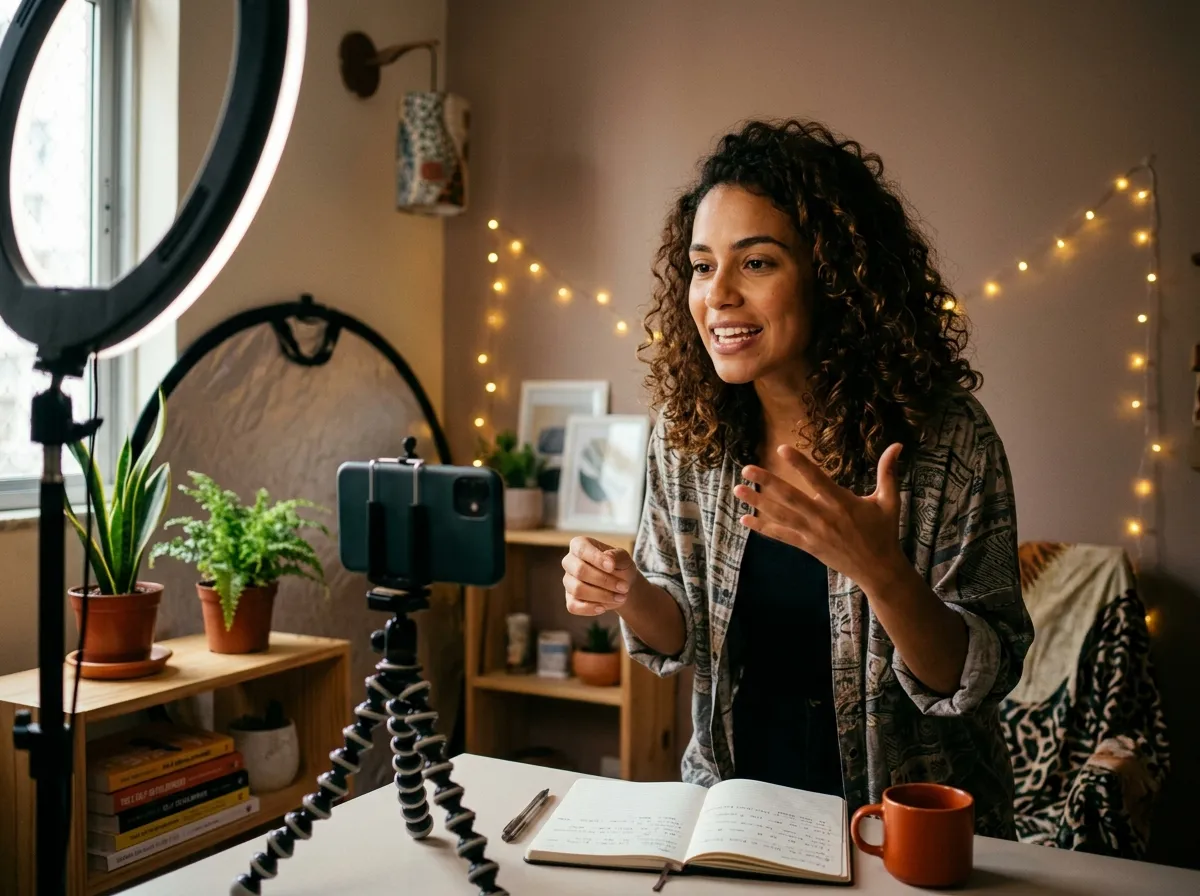
What Is a Content Creator and How to Become One
Understand what a content creator is, how it differs from an influencer, the skills required, and the real paths to turn content into income.

What will we see in this post

Content creator is the person who produces videos, text, audio and images for the internet and distributes that material across channels like social media, blogs and streaming platforms. It’s not just someone who appears on camera, and it’s not a synonym for influencer: the term covers everyone from a blog writer to a podcast host, a designer or a video editor, with or without their face on screen.
It’s one of the fastest-growing careers worldwide. An estimated 200 million-plus people produce some form of content globally — in Brazil, one of the largest markets, it’s already the second-largest creator ecosystem in the world, with around 110 million people producing some kind of content, according to research by Schwarzwald Capital reported by Report 360. Throughout this guide, we explain what a content creator actually does, how much they earn, and, most importantly, the real paths to turning this activity into income.
How did the content creator profession start?
The earliest signs of this profession showed up on blogs and photologs in the 2000s, when ordinary people started publishing their routines and attracting followers. With the arrival of YouTube, Instagram and, later, TikTok, the activity became a real profession with its own source of income.
How did this work become a real profession?
Over time, each new social platform brought its own defining creators: first the YouTube pioneers, then Instagram’s biggest names, and more recently TikTok’s creators. Each wave of platforms established new influential voices.
It’s nothing new for brands to team up with people with online relevance to reach more consumers. Still, the professionalization of this kind of work has reached levels never seen before.
What’s the difference between a content creator and an influencer?
The difference is in the main goal. A content creator focuses on producing valuable material in various formats, while an influencer uses their audience to shape purchasing decisions and behavior. Every influencer is, by definition, a content creator, but the reverse isn’t true: you can create relevant content without a huge following or brand deals.
In practice, what separates the two is purpose and reach:
| Aspect | Content creator | Influencer |
|---|---|---|
| Main focus | Producing valuable material (educate, inform, entertain) | Shaping audience opinion and consumption |
| Needs a large audience? | No. Can work freelance or behind the scenes | Yes. Reach is the core asset |
| Typical income source | Own product, services, freelance work, platform monetization | Advertising and brand partnerships |
| Appears on camera? | Not always | Almost always |
This distinction matters when planning income. An influencer depends on brands; a creator can build their own business that isn’t held hostage by sponsorships.
How do you become a content creator?
To become a content creator, the path is to pick a niche, define an audience, choose your channels, and produce consistently. There’s no degree or expensive equipment requirement: many people start with just a phone and level up as the content gains an audience. Here are the steps in the order that makes sense for beginners.
1. Pick a niche and become a reference in it
Start with an area you know and enjoy. A well-defined niche makes it easier to attract the right audience and build authority. A digital creator in a personal-growth niche, for example, can cover habits, productivity and emotional wellbeing for an audience actively looking for that kind of content. To narrow it down with intention, look into how to pick the right micro-niche for your profile.
2. Build a persona
A persona is the semi-fictional representation of your ideal audience. It helps define tone of voice, format, and which topics actually make sense.
3. Choose the platforms you’ll work on
The right channels depend on the type of content and where your audience already is. Short video calls for TikTok, Reels and YouTube Shorts; text calls for a blog and LinkedIn; audio calls for podcast platforms. Don’t try to be everywhere at once when you’re starting out.
4. Define the formats you’ll produce
Format follows the platform and the persona. Anyone leaning toward long-form video tends toward YouTube; anyone who prefers writing, toward a blog; anyone who enjoys conversation, toward a podcast. Start with one or two formats and keep up consistency, which matters more than volume.
5. Track trends and data
Keyword research, competitor analysis and trend-tracking tools help you understand what your audience is actually searching for. This keeps you from producing blindly and increases the odds your content gets discovered.
6. Produce consistently and adjust along the way
Good, frequent content is what grows an audience. Analyze what works, cut what doesn’t land, and improve with every post. Consistency in the first few months tends to separate people who quit from people who build a real audience.
The global content creator market in numbers
The global creator economy was valued at around US$252.3 billion in 2025 and is projected to grow to about US$310.4 billion in 2026, according to Grand View Research. More than 200 million people are now creating content worldwide, though only a fraction of them make a full-time living from it.
That growth generates real jobs across every region. In Brazil, for instance, the creator market moved an estimated US$5.47 billion in 2025, with the number of creators nearly doubling in a year, according to the report “O Horizonte da Creator Economy no Brasil,” by Noodle, reported by Mundo do Marketing. A study by FGV Comunicação Rio in partnership with Hotmart found more than 389,000 direct and indirect jobs in the digital products sector in that country alone — video editing, design, social media management and paid advertising are all roles that exist around every creator, no matter which country they work from.
A quick summary of the numbers behind the opportunity:
| Indicator | Figure | Source |
|---|---|---|
| Global market size (2025) | US$252.3 billion | Grand View Research |
| 2026 projection | US$310.4 billion (~+23%) | Grand View Research |
| Content creators worldwide | 200 million+ | Grand View Research / Adobe |
| A regional example: Brazil | 2nd-largest ecosystem, ~110 million creators | Schwarzwald Capital / Report 360 |
For anyone just starting out, the takeaway from these numbers is simple: there’s still room. The market is growing fast everywhere, and most of brands’ investment is shifting toward creators, not traditional media.
What skills does a content creator need?
The main skills of a content creator are tracking trends, writing well, knowing your own audience, and analyzing data. None of them require formal training, but all of them improve with practice. Anyone who develops these four areas produces more consistently and makes decisions based on what actually works.
Tracking trends: staying on top of what’s happening in your niche helps you create relevant content and position yourself as an authority.
Writing clearly: even in video or audio, everything starts with a good script. Reading a lot and practicing is the fastest way to improve.
Knowing your audience: understanding who consumes your material defines topic, format and tone. This is where a well-built persona becomes a practical tool.
Having an analytical eye: watching metrics, identifying what engages people, and adjusting course often. Content that isn’t measured doesn’t improve.
What types of content can a creator produce?
A content creator can produce videos, text, images and audio, and most creators combine more than one format. The choice depends on the niche, the platform, and the creator’s own style. Here are the four main formats.
Video
It’s the most-consumed format, driven by Instagram, TikTok and YouTube. It doesn’t require heavy production: plenty of people go viral with simple phone recordings, including well-executed homemade videos.
Text
Blog posts, captions, newsletters, scripts and descriptions. Writing well is one of the most valued skills online and opens doors in nearly every niche.
Images
Photos, infographics and social media art. It requires getting a message across in a single static piece. Anyone drawn to this area can learn to build infographics from scratch.
Audio
Podcasts and audio content grew alongside Spotify and similar platforms, partly because people can listen while doing something else entirely.
How much does a content creator earn?
There’s no fixed salary for a content creator, because income depends on format, channels and monetization model. A study conducted in Brazil (Glassdoor, updated October 2025) found that creators working as employees earn the equivalent of about US$550 a month on average, reaching around US$700 in the top percentile — figures that work as a reference for one specific market, not a global ceiling.
The picture changes completely for anyone with their own business. In a study by FGV and Hotmart carried out in Brazil, formalized creators selling digital products earned, on average, the equivalent of about US$1,820 a month, roughly double what informal creators earn (about US$905). The gap shows that the path to higher income has less to do with salary and more to do with building your own product, the topic of the next section.
How do you make money as a content creator?
A content creator makes money in three main ways: advertising and brand partnerships, affiliate marketing, and selling their own digital product. Most people who make a living from this combine more than one source, since depending on a single channel makes income unstable.
A study conducted in Brazil (“Cenário da Creator Economy no Brasil 2025,” by Favikon with People2Biz) found that only 22% of creators manage to monetize consistently. For anyone just starting out, that’s not discouraging, it’s strategic: most people who get stuck rely exclusively on brand advertising. Anyone who builds their own income, through affiliate marketing or a digital product, escapes that dependency sooner.
Advertising and brand partnerships
It’s the best-known model: a brand pays the creator to promote a product. It works well for anyone who already has a relevant, engaged audience, but it has two limits. Earnings depend on keeping reach high, and income disappears when the partnerships stop. It works as a supplement, rarely as a sole foundation.
Affiliate program
With an affiliate program, you promote other people’s products and earn a commission for every sale made through your link. It’s a low-risk entry point, since it doesn’t require creating a product: you can start by recommending things you already use and trust. On Hotmart, you can make money as an affiliate with commissions that can reach up to 80% of the product’s value.
Your own digital product (course, ebook, mentorship, community)
This is the path with the highest income and autonomy potential. Instead of depending on a brand, you turn your own knowledge into a product: an online course, an ebook, a mentorship or a paid community. This was exactly the group that showed up earning the most in the FGV and Hotmart study in Brazil.
This is where Hotmart comes in. The platform handles the technical and financial side, from hosting the course to the payment checkout, so you can focus on creating and selling. You can structure your content inside a members area, get paid across more than 180 countries, and track everything with real sales data. If you want the full step-by-step, check out the types of digital products you can build.
Building your own reputation is the common thread through all of this: whatever model you choose, it’s the trust you build with your audience that sustains the business long-term, wherever you’re based.
Frequently asked questions about what a content creator is
Here are the most common questions from people looking for more information about what a content creator is. Practical, straight-to-the-point answers!
Do you need a degree to be a content creator?
No, there's no degree requirement to work as a content creator. What matters is knowing your niche well, producing consistently, and developing skills like writing, editing and data analysis, all of which can be learned through practice.
Can you be a content creator without showing your face?
Yes, plenty of people create content without showing their face, in formats like blogging, podcasting, narration-focused channels, design or video editing. Appearing on camera is a choice, not a requirement of the profession.
How long does it take to start making money as a creator?
It depends on the model you choose and how consistent you are. Affiliate marketing can generate the first commissions within a few weeks, while your own product and advertising income usually take longer, since they depend on having an audience or a structured offer.
What's the difference between a content creator and a content producer?
In practice, the terms are used as synonyms. Both refer to someone who produces digital material for an audience. Some people use "producer" for more technical or behind-the-scenes work, but there's no rigid line between the two.
Do you need expensive equipment to get started?
No, most creators start with a phone and free tools. Better equipment helps over time, but consistency and content quality matter more than the camera or microphone at the start.