
E-learning: what it is, how it works, types and how to create your online course
A complete guide to e-learning: where the term comes from, how it works, how it differs from distance learning, blended learning and microlearning, formats, pros and cons, e-learning platforms, the role of AI and how to create your course.

What will we see in this post

Have you ever taken a course on your phone, watched a recorded lesson during a lunch break or answered a quiz on a training platform? Then you’ve already experienced e-learning firsthand. 💻📱 Today it’s the most common way to learn something new, whether that’s a language, a professional skill or a hobby.
In this guide, you’ll learn what e-learning is, where the term comes from, how it works, how it differs from distance learning, blended learning, m-learning and microlearning, the main formats, the pros and cons, the latest numbers and a step-by-step plan to create and sell your own course.
| Question | Quick answer |
|---|---|
| What is e-learning? | Learning delivered through digital media, with content, activities and progress tracking on an online platform |
| Is it the same as distance learning? | Not exactly: e-learning is the digital form of distance learning, which is a broader concept |
| How does it work? | The content lives on a platform (an LMS or members area) and students access it from a computer or phone |
| What formats are there? | Live or recorded classes, learning paths, micro-lessons, quizzes, gamification and AI tutors |
| Can you sell an e-learning course? | Yes: turn what you know into a course and host it on a platform with a built-in checkout |
What is e-learning?
E-learning (short for *electronic learning*, also written “elearning”) is teaching and learning delivered through digital media, usually over the internet. In e-learning, the content (videos, text, audio, exercises), the interaction with instructors and classmates, and the assessments all happen inside an online environment that students can open on any computer, tablet or phone.
The term took off in 1999, when American educational technology expert Elliott Masie began using it at his TechLearn conference. There are records of the expression circulating earlier, but from then on it became the standard name for online courses and training, in schools and universities as well as in companies and in the market for non-credit courses.
Today, e-learning is everywhere: in online degree programs, corporate training, language apps and the online courses that creators sell on everything from cooking to coding.
How e-learning works in practice
E-learning works with three pieces: structured content, a platform to host that content and a connected learner. The instructor organizes lessons into modules, uploads everything to an e-learning platform and gives students access, so they can study at their own pace or join live sessions.
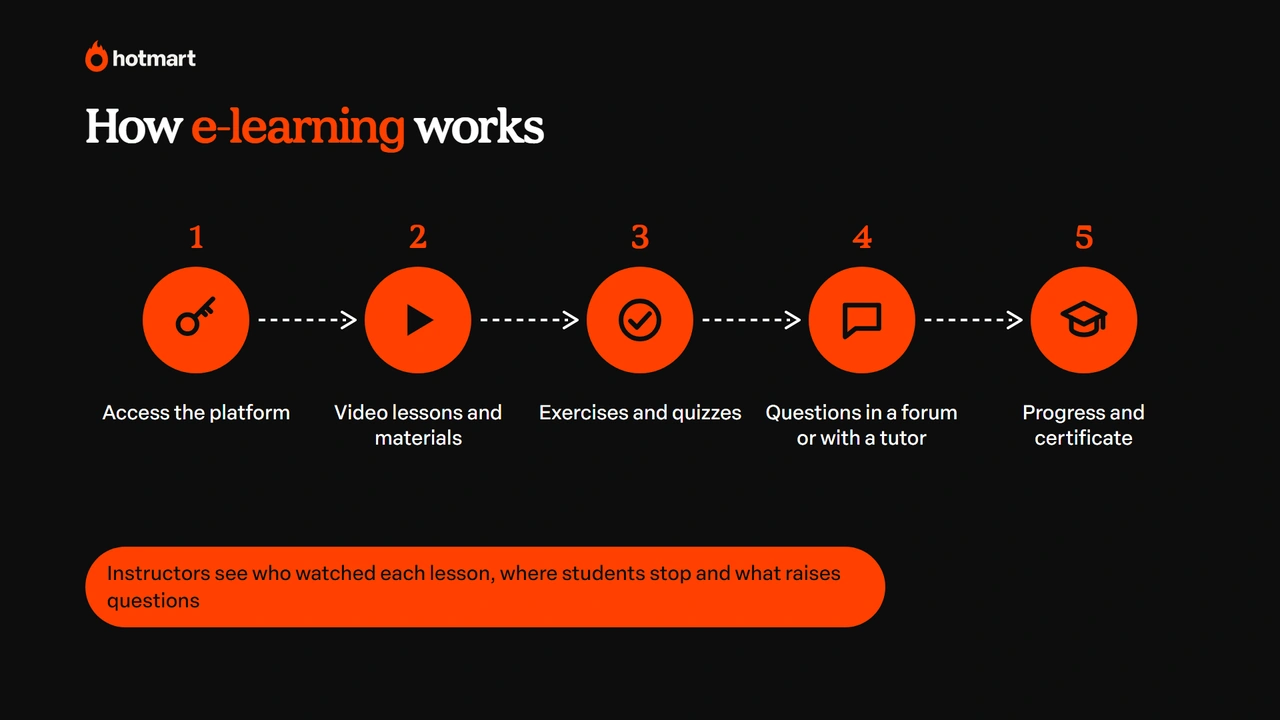
In a typical e-learning course, the student journey looks like this:
- the student signs up or buys the course and gets access to the platform;
- watches the video lessons, reads the materials and downloads the extras;
- completes exercises and quizzes to lock in what they learned;
- asks questions in forums, comments, communities or to a tutor;
- tracks their progress and gets a certificate on completion.
On the instructor’s side, the platform shows who watched each lesson, where students drop off and which activities raise the most questions. That data helps improve the course over time, something that’s much harder to do in a classroom.
E-learning vs. distance learning, blended learning, m-learning and microlearning: what’s the difference?
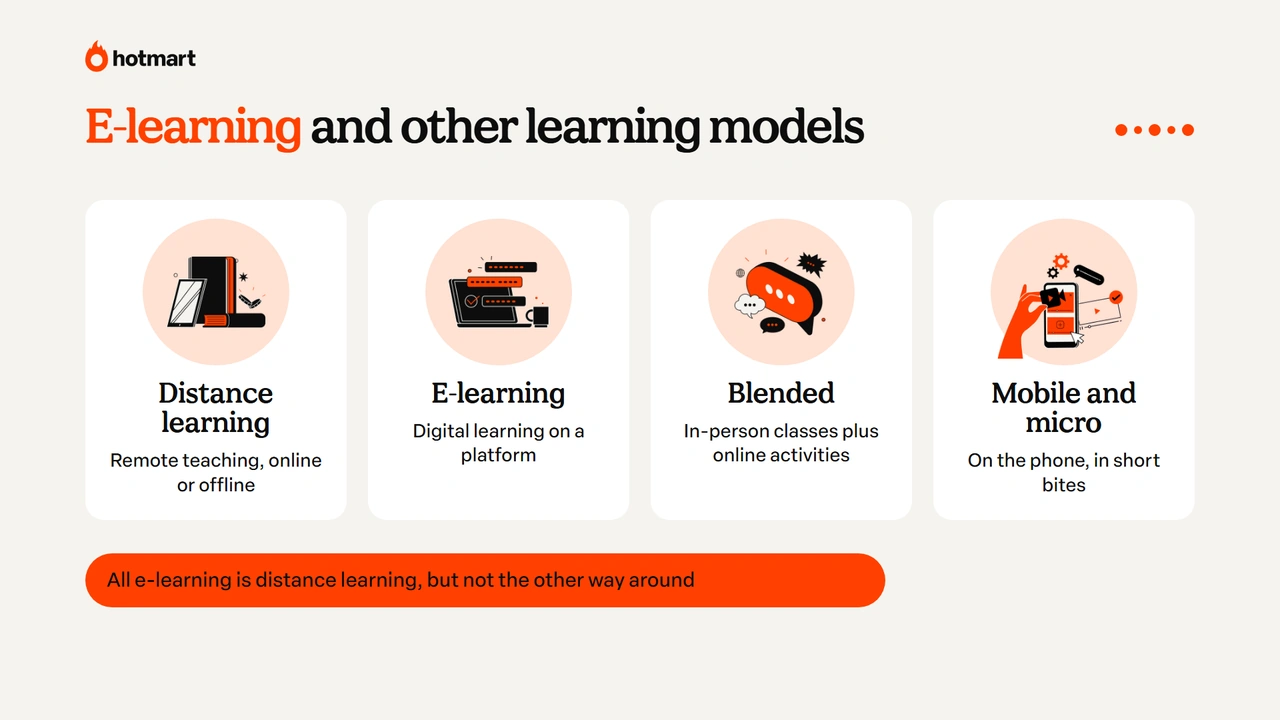
The difference between e-learning, distance learning, blended learning, m-learning and microlearning comes down to the scope of each term. Distance learning is the broadest concept; e-learning is its digital version; and the others are models or formats that use e-learning in specific ways.
| Term | What it is | Example |
|---|---|---|
| Distance learning | Any teaching where student and instructor are separated by space or time, with or without the internet | Online degree programs, old correspondence courses and TV courses |
| E-learning | Learning through digital media, inside an online platform | An Excel course with video lessons and exercises in a members area |
| Blended learning | A mix of in-person classes and online activities | A class that studies theory at home and practices in the classroom |
| M-learning (mobile learning) | E-learning designed for the phone | A language app with 5-minute lessons |
| Microlearning | Content in short bites, with one goal at a time | A 3-minute video on a single Excel formula |
In short: all e-learning is a form of distance learning, but not all distance learning is e-learning. To dig deeper into each model, read our guides on distance learning and blended learning. And if your audience mostly studies on their phones for a few minutes a day, these articles on mobile learning and microlearning course examples show how to adapt your lessons.
Types and formats of e-learning
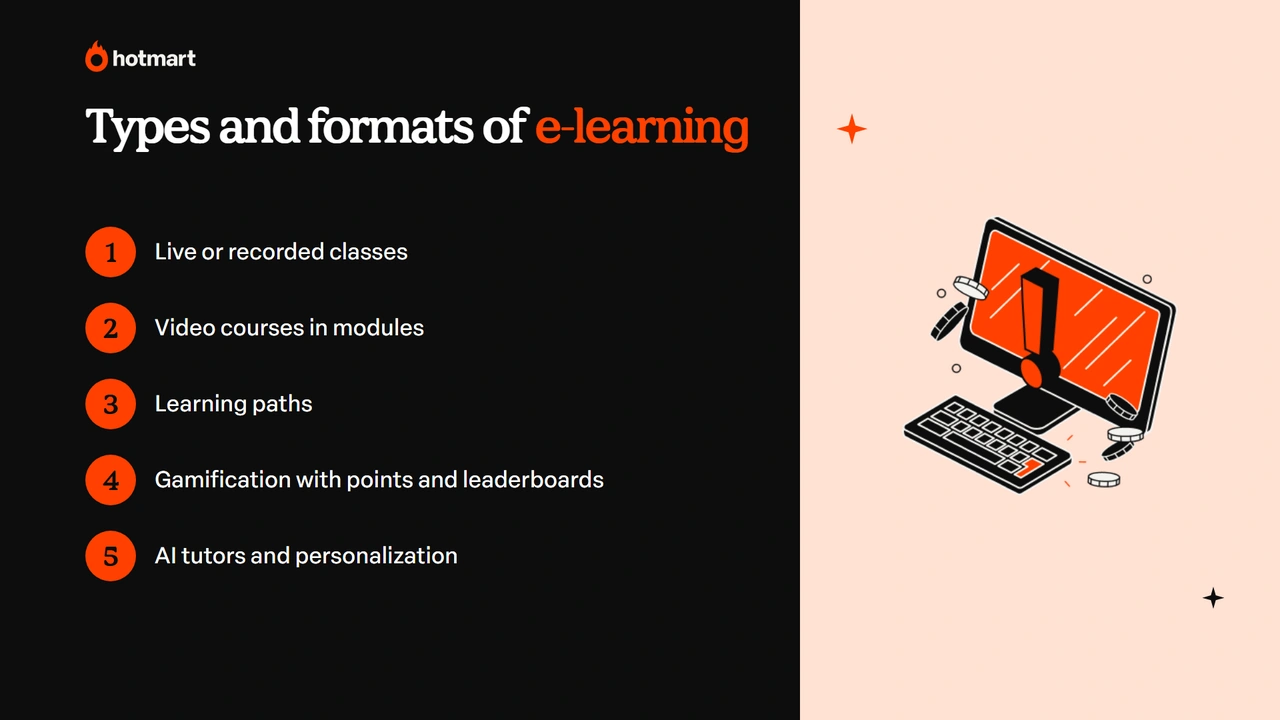
The types of e-learning vary by when the lesson happens and by the content format. The main ones are:
- synchronous and asynchronous e-learning;
- video courses;
- learning paths;
- gamification;
- AI-powered e-learning.
In practice, the best courses combine two or more of these formats. Here’s how each one works.
Synchronous and asynchronous e-learning
Synchronous e-learning happens live, with the instructor and students online at the same time in webinars, livestreams and virtual classrooms. It encourages interaction, real-time answers and a sense of community. Asynchronous e-learning is all about recorded lessons: each student studies whenever and wherever they want, at their own pace, and can rewatch a lesson as many times as they need.
Video courses
Video courses are the most popular e-learning format. Video lessons are organized into modules and usually come with PDFs, spreadsheets and exercises. If you’re just getting started, this guide to creating online video courses covers the technical side.
Learning paths
Learning paths organize e-learning content in a logical sequence, from basic to advanced, and show the student what comes next. They’re common in corporate training and longer courses. This article on the learning path explains how to build one.
Gamification in e-learning
Gamification in e-learning uses game elements such as points, badges, leaderboards and challenges to keep students motivated until the end of the course. It works well for long or repetitive content, as long as the rewards are tied to learning and not just to clicking through lessons. Learn more about gamification and how it boosts engagement.
AI-powered e-learning
AI-powered e-learning personalizes the experience: virtual tutors answer questions based on the lessons, adaptive systems adjust the order of content to each student’s performance and AI tools generate exercises and summaries. We cover this in more detail in its own section below.
Pros and cons of e-learning
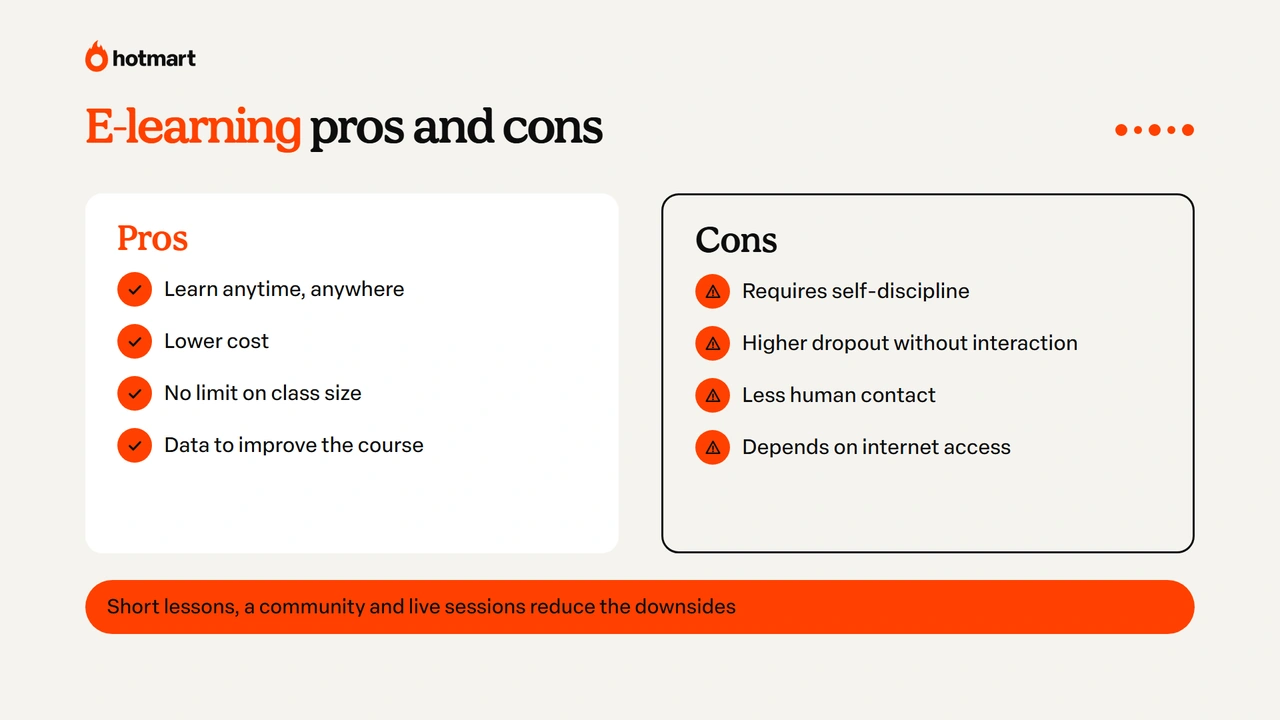
The pros and cons of e-learning need to be weighed together, because the model works very well for organized learners and can frustrate anyone expecting the structure of a classroom. Here’s the breakdown:
| Pros | Cons |
|---|---|
| Study anytime, anywhere | Requires discipline and time management from the student |
| Lower cost for instructors and learners | Dropout tends to be higher when students study alone |
| No class size limit | Less human contact, if the course has no interaction |
| Students can rewatch lessons as often as they like | Depends on internet access and a suitable device |
| Content is quick to update | Hands-on and lab skills are harder to teach |
| Progress data to improve the course | Quality varies a lot from course to course |
The good news is that most of the downsides of e-learning can be solved through course design. Short lessons, an active community, live sessions, hands-on exercises and fast support reduce dropout and keep students engaged.
E-learning statistics in the US and worldwide
E-learning statistics show a large and growing market, in formal education as well as in non-credit courses and corporate training.
In the US, online learning is now part of college for most students. According to the National Center for Education Statistics (NCES), Digest of Education Statistics, table 311.15, in fall 2023 about 10.3 million students, or 54.1% of everyone enrolled in degree-granting postsecondary institutions, took at least one distance education course. Nearly 5 million (26.1%) studied exclusively online.
Those numbers cover accredited colleges and universities. Online courses sold by independent creators and businesses, such as skills or hobby courses, don’t need accreditation, which is one reason that market has grown so quickly.
Worldwide, e-learning generated around US$325 billion in 2025 and could reach US$665 billion by 2031, an average growth of 12.7% a year, according to Arizton’s Global E-Learning Market 2026-2031 report. Estimates vary between research firms depending on what each one counts as part of the market, but they all point to growth.
E-learning platforms: what to look for in an LMS
E-learning platforms are the environments where the course is hosted and where students learn. They’re also called an LMS (*Learning Management System*) or a virtual learning environment. Well-known examples include Moodle and Canvas, widely used by schools and universities, and the members areas of digital product platforms, used by people who sell courses.
To choose an e-learning platform, look at these points:
- student experience: simple navigation, a reliable video player and a good mobile version;
- teaching features: quizzes, certificates, comments, community and drip release of modules;
- content protection: video encryption and watermarks against piracy;
- reporting: student progress, completion and engagement;
- built-in sales: your own checkout, payment methods and an affiliate program, if you want to sell the course;
- cost: a flat monthly fee or a fee per sale, and what’s included.
How much each point matters depends on your goal. A company training its team needs reporting and integrations; someone selling a course needs sales and the members area to work together. To understand the concept in depth, read what an LMS platform is and how to choose the best online course platform.
How to create an e-learning course step by step
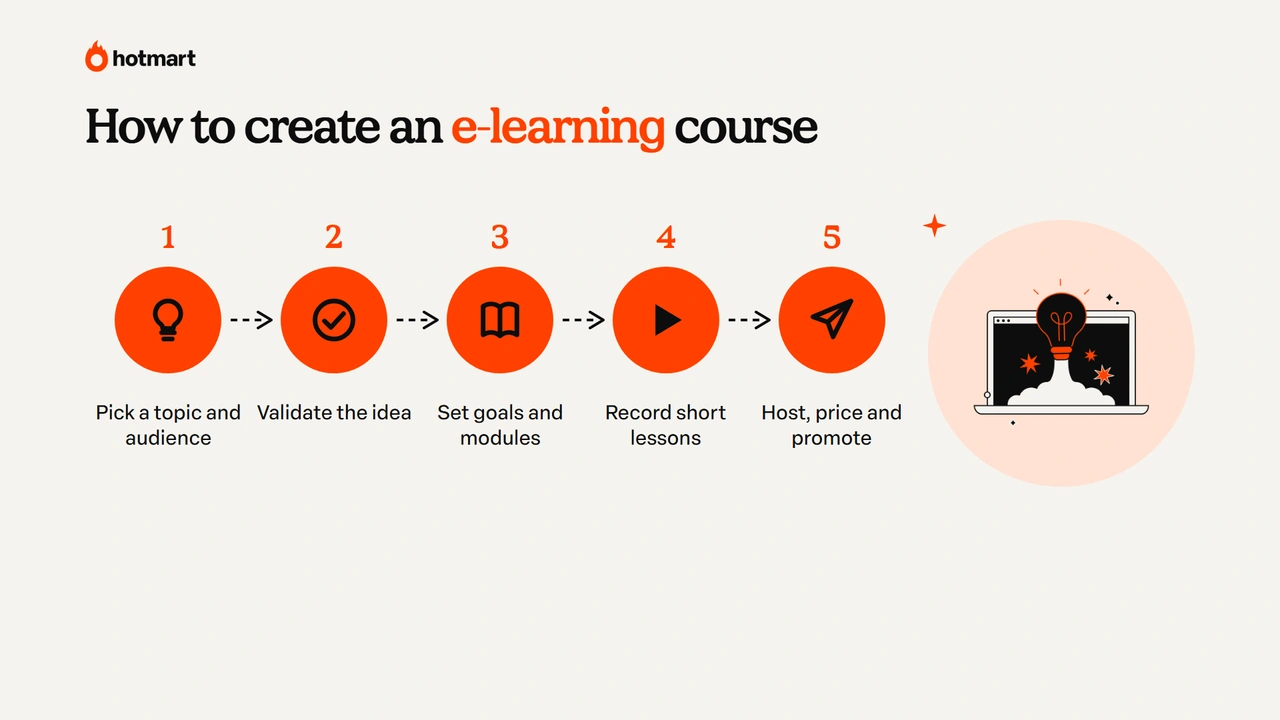
Creating an e-learning course to sell what you know is more accessible than it seems: you can start with a phone, a good microphone and a free platform to host it. Follow these steps:
- choose your topic and audience;
- validate the idea;
- set the learning objective;
- outline the modules;
- produce the lessons and materials;
- host the course on an e-learning platform;
- set your price and promote it.
Below, we break down each step.
1. Choose your topic and audience
Start with what you do well and who needs it. “Excel for sales teams” is clearer and easier to sell than “The complete Excel course.”
2. Validate the idea
Before you hit record, make sure there’s demand: talk to potential students, run a poll on social media, look at the questions you get most often and check whether similar courses are already selling.
3. Set the learning objective
Write one sentence describing what the student will be able to do by the end of the course, for example: “build an automated sales report in one afternoon.” That objective guides every lesson and becomes the main selling point on your sales page.
4. Outline the modules
Split the content into modules with short lessons, 5 to 15 minutes each, built around one core idea. Include hands-on exercises and one supporting resource per module.
5. Produce the lessons and materials
Record with good lighting and clean audio, even if you’re using your phone. Add PDFs, checklists and templates. If you’d rather not appear on camera, screen recordings with voice-over work well too. This article on online course content shows which formats work best.
6. Host the course on an e-learning platform
Upload your lessons to a members area with a protected video player, certificates and space for students to comment. Test the navigation as if you were a student before you open sales.
7. Set your price and promote it
Consider the value the course delivers, the competition and your audience. Then choose your promotion channels: this guide on how to sell online courses walks you through it.
The role of AI in e-learning
Artificial intelligence in e-learning works on both sides: it helps instructors create courses faster and helps learners get answers and move forward at their own pace.
For creators, AI speeds up tasks such as:
- suggesting a module structure from a topic;
- writing lesson scripts, summaries and exercises;
- generating quizzes, captions and transcripts;
- repurposing the same content into other formats, like an ebook or social posts.
For learners, the biggest win is the AI tutor: an assistant that answers questions based on the course lessons, at any time, and points to the lesson where the explanation is. That eases the feeling of studying alone, one of the weak spots of e-learning.
AI, however, doesn’t replace the instructor’s expertise. It speeds up production, but the method, the real-world examples and the content review are still yours. This guide on how to make money with AI shows how to turn what you know into a digital product.
E-learning on Hotmart: how to host and sell your course
If you want to turn your knowledge into an e-learning course and sell it, Hotmart brings hosting, a members area and checkout together in one place. Signing up and publishing your course are free, and you only pay a fee of 9.9% + US$1.00 per approved sale, with no monthly fee and the video player included. Your course can be sold in 188 countries, with checkout in the local currency.
The Hotmart members area is free and offers more than 20 layout styles, community, gamification with points and leaderboards, automatic certificates and a video player with encryption, watermarking and offline mode. When you’re planning, Hotmart AI suggests modules, pricing and a launch plan for your course.
And when student questions start eating up your day, Tutor is an AI assistant inside the members area that answers based on your lessons, 24/7, with your name and your brand. It learns your course in up to 24 hours and can cut the questions you have to answer by up to 50%.
## Ready to get started with e-learning?
E-learning is no longer the alternative; it’s the most common way to learn. More than half of US college students already take at least one online course, and the global market is worth hundreds of billions of dollars. For instructors, that means a huge audience and the chance to reach students anywhere.
The path is simpler than it looks: pick a topic you know well, validate it with your audience, build short, practical lessons and host them on a platform that handles the rest. The next course someone takes on their phone could be yours. 🚀
Get started now: create your free Hotmart account
Frequently asked questions about e-learning
Still have questions? Here are answers to the most common questions about e-learning.
What does e-learning mean?
E-learning means "electronic learning." It's teaching delivered through digital media, with content, activities and progress tracking on an online platform you can access from a computer or phone.
What's the difference between e-learning and distance learning?
Distance learning is any teaching where student and instructor are apart, with or without the internet, like the old correspondence courses. E-learning is the digital form of distance learning, delivered on online platforms.
What is an e-learning platform?
An e-learning platform, also called an LMS or virtual learning environment, is the online space where a course is hosted. It organizes lessons, controls student access, runs activities, issues certificates and shows progress reports.
Do e-learning courses come with a certificate?
Yes. Non-credit e-learning courses can issue a certificate of completion, usually generated automatically by the platform. Online degrees and academic credits, on the other hand, must come from an accredited institution.
How can you make money with e-learning?
The most direct way to make money with e-learning is to create and sell an online course about something you know well. You structure the lessons, host them on a platform with a members area and checkout and promote the course to your audience.