
Skyscraper technique: what it is, how it works and how to use it to earn backlinks and traffic
Discover what the skyscraper technique is, created by Brian Dean, how to apply it in 7 steps with tools, the criticism backed by data, skyscraper 2.0 and how to become the source AI answers cite.

What will we see in this post

Imagine you want to build the tallest building in town. The first step is to find the tallest skyscraper that already exists and then build a bigger one. 🏙️ The skyscraper technique applies that logic to SEO: you find the piece of content that earns the most links on a topic, create a clearly better version and reach out to the people who linked to the original.
In this guide, you’ll learn what the skyscraper technique is, who created it and how to apply it step by step with the right tools. We also cover the criticism backed by data, the 2.0 version, how the technique adapts to AI answers and how creators use the skyscraper technique to drive organic traffic to their own products. 🚀
| Question | Quick answer |
|---|---|
| What is the skyscraper technique? | A link building strategy: create a better version of a heavily linked piece of content and ask the sites that linked to the original to link to yours |
| Who created the skyscraper technique? | Brian Dean, founder of Backlinko |
| What are the steps? | Find content with lots of backlinks, create something better and promote it to the people who already linked to it |
| Does the skyscraper technique still work? | It works when the content is genuinely better and the outreach is personalized; mass emailing has lost its power |
| Does it work for AI answers? | Yes, as long as the content offers original, clear and trustworthy information, the kind of source AI tools cite |
What is the skyscraper technique?
The skyscraper technique is a link building and content marketing strategy: find a piece of content that has already earned lots of backlinks, create a clearly superior version and ask the sites that linked to the original to cite yours instead. The name comes from the idea of building something taller than what’s already on the skyline.
The skyscraper technique was created by Brian Dean, founder of Backlinko, and became one of the most talked-about link building tactics in the world from the mid-2010s on (Ahrefs dates its public debut to 2015). In Backlinko’s original case study, Dean applied the technique to his “Google’s 200 Ranking Factors” list, published in April 2013: he sent 160 emails, landed 17 links (an 11% success rate) and saw organic traffic to his entire site double in 14 days.
What sets the skyscraper technique apart from “writing a good post” is going after the people who have a reason to link. Since backlinks are still a signal of authority for Google, that logic remains useful.
How the skyscraper technique works: the 3 steps
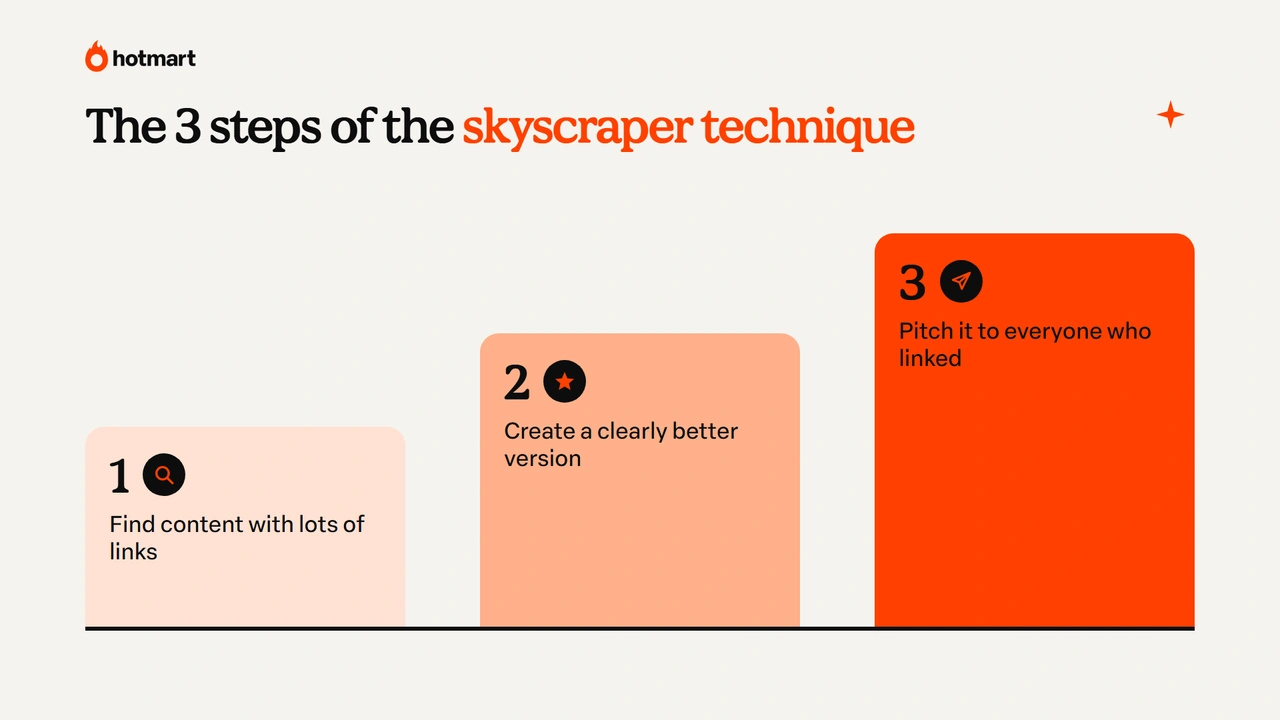
The skyscraper technique works in 3 steps: find content with lots of backlinks, create something better and promote it to the people who already linked to the original. They sound simple, but each one has a detail that shapes the result:
- find “linkable” content: a guide, a list, a study or a tool cited by dozens of sites in your niche, a sign that there’s demand for a strong reference on the topic;
- create something clearly better: more up to date, more complete, better designed or with something the original lacks, in a way anyone can notice within a few seconds;
- promote it to the people who already linked: reach out to the sites that cite the original, because they’re the audience most likely to find a better reference useful.
The third step is what really sets the skyscraper technique apart from other content strategies, and it’s also the one most people skip.
How to use the skyscraper technique step by step
To use the skyscraper technique today, it helps to break the 3 classic steps into 7, with tools and measurement:
- choose the topic based on demand and search intent;
- find the content with the most backlinks on it;
- analyze what’s missing;
- create your superior version;
- build and segment your link building prospect list;
- do personalized outreach, with follow-ups;
- measure the results and update.
Each step leads to the next, so don’t skip the analysis before you start writing.
1. Choose your skyscraper technique topic based on demand and intent
The best topic for the skyscraper technique is one that’s related to your business, gets searched and attracts links. Use keyword tools to check search volume and Google Search Console to find topics where you already show up but aren’t at the top yet. Also check the search intent: does the searcher want a definition, a step-by-step guide, a list or a tool?
2. Find the content with the most backlinks
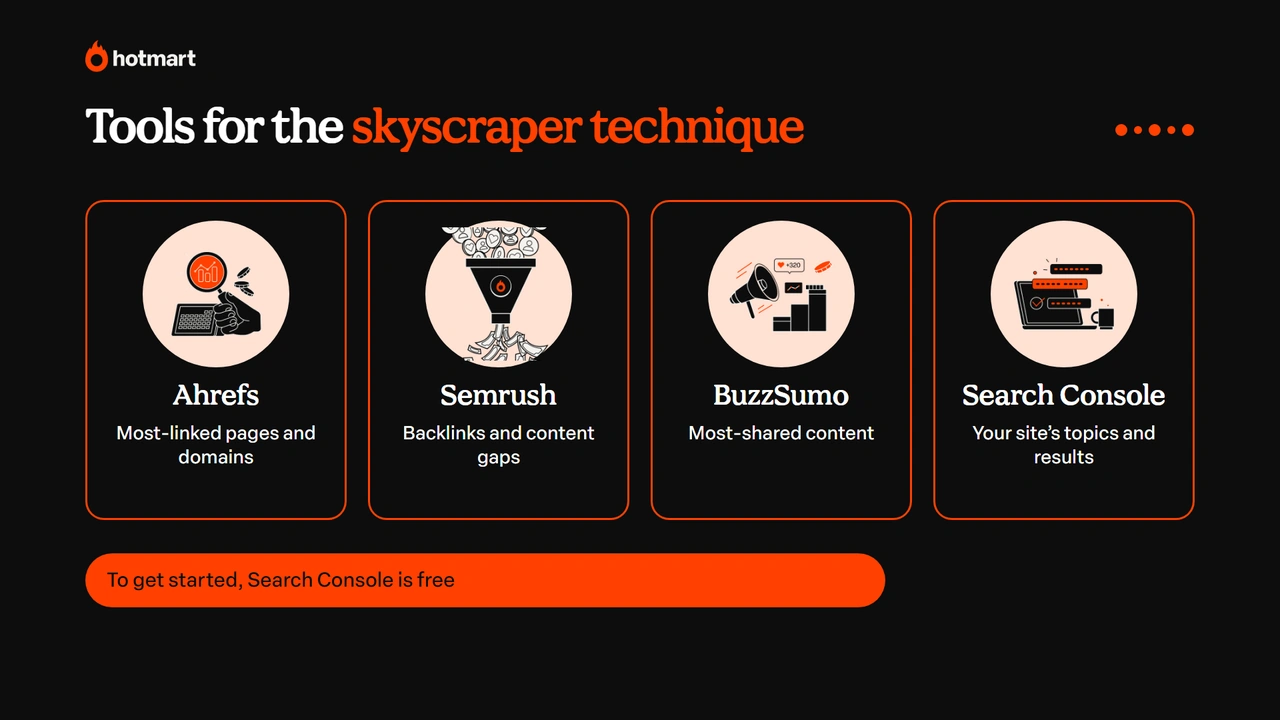
To find the content that earns the most links for your skyscraper technique, use backlink analysis tools such as Ahrefs, Semrush and BuzzSumo (see the table at the end of this section). If you don’t have a paid tool, start with Google advanced search, using queries like “your topic + guide” or “your topic + statistics”, and check who cites those results.
3. Analyze what competitors are missing
Before you write, the skyscraper technique calls for a critical read of the competition. Open the top results on the SERP and note what’s outdated, the questions left unanswered (the “People also ask” box helps), the weak examples and the formats nobody offers.
4. Create your skyscraper content
With your list of gaps in hand, create your skyscraper technique content by answering the searcher’s question right away and delivering what the others don’t. In its guide to helpful, reliable content, Google says there’s no preferred word count, so the goal is to be more useful, not longer. Our guide to SEO content writing can help with the structure.
5. Build your link building prospect list
The prospect list for the skyscraper technique comes from the backlinks of the original content and of the other top results for the same keyword. Export the domains, remove unrelated sites, directories and low-quality pages, and group the rest by the context of the link (who cited a statistic, who recommended the guide as further reading).
6. Do personalized outreach, with follow-ups
Skyscraper technique outreach works best when every message shows you’ve actually read the person’s site. Tell them where they linked to the original content, what’s new in your version and why it helps their readers. The Backlinko and Pitchbox outreach study (2019), which analyzed about 12 million emails, shows why that care matters: only 8.5% of messages got a reply, a single follow-up increased replies by 65.8% and personalized body copy got 32.7% more replies.
7. Measure your skyscraper results and update
The last step of the skyscraper technique is measurement: check how many new domains are linking to the page and track impressions, clicks and position in Google Search Console. And revisit the content at least once a year: an outdated skyscraper becomes the target of the next one.
To sum up the role of each tool in the skyscraper technique, check the table below:
| Tool | What to use it for in the skyscraper technique |
|---|---|
| Ahrefs | Find the most linked pages (Site Explorer and Content Explorer) and the domains pointing to them |
| Semrush | Analyze competitors’ backlinks, keywords and content gaps |
| BuzzSumo | Discover the most shared and most linked content on a topic |
| Google Search Console | Find topics where you already rank and measure impressions, clicks and position after publishing |
| Google advanced search | Find guides, lists and studies on the topic without a paid tool |
Plans and pricing for these tools change often, so check each one’s website. To get started, Search Console and Google advanced search are enough.
How to outdo content with the skyscraper technique
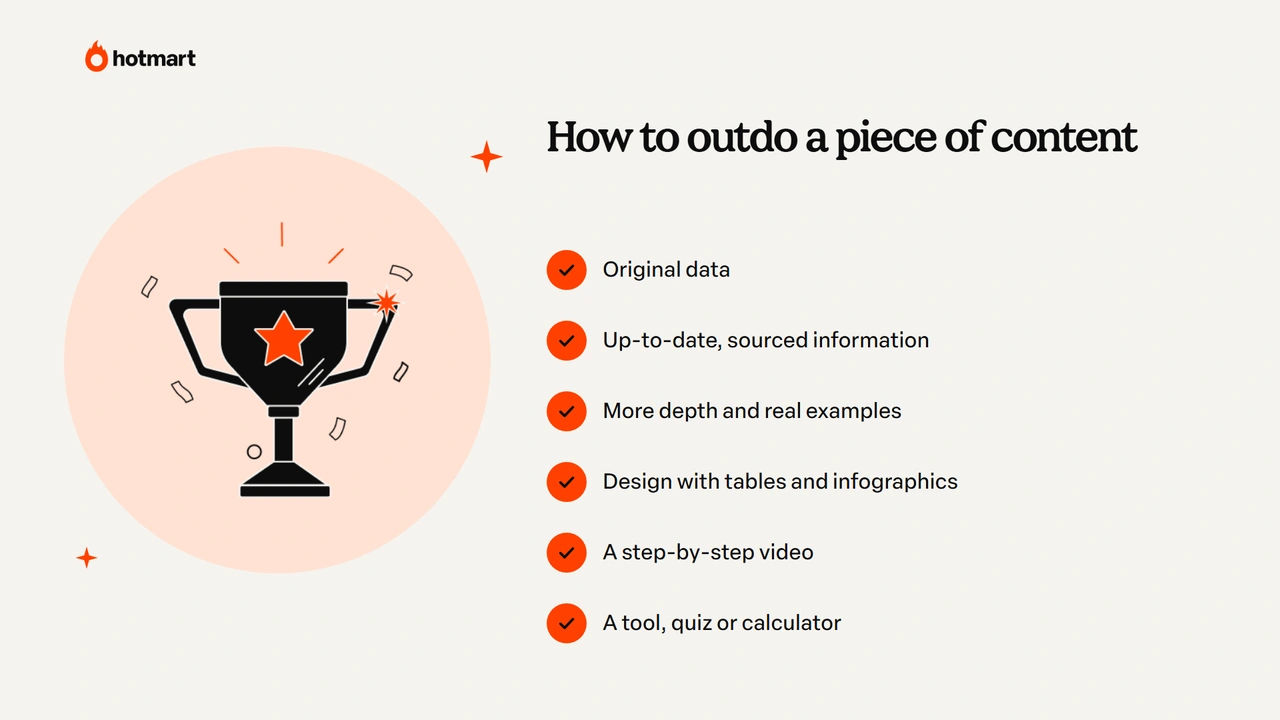
Outdoing content with the skyscraper technique means delivering something the original doesn’t, not just writing more words. The right question is “what does someone get from reading my version that they wouldn’t get from the other one?”. Here are 6 practical ways:
| Way to outdo it | Practical example |
|---|---|
| Original data | A survey of your followers or students, with numbers nobody else has |
| Freshness | Swap old statistics for recent data, with source and year, and remove tools that are no longer around |
| Depth | Explain the “how to” with real examples, where the original only lists ideas |
| Design | Organize it into tables, steps and an easy-to-cite infographic |
| Video | Show the process on screen when the topic is hard to explain with text alone |
| Tool | A calculator, a quiz or a ready-to-use template that solves the problem on the spot |
The last two rows tend to earn the most links, because tools and original data are the kind of resource other sites love to cite. A free tool like our Instagram engagement rate calculator is hard to copy and stays useful for years, which fits the logic of evergreen content.
Does the skyscraper technique still work? Limitations and criticism
The skyscraper technique still works, but not the way it did when it was created. It got so popular that many sites receive dozens of identical emails asking for links to “a better version”. These are the main criticisms:
- low outreach response rates: in the Backlinko and Pitchbox study (2019), only 8.5% of outreach emails got a reply;
- declining use: Ahrefs (Feb 2023) cites Aira’s link building report, in which only 18% of SEOs were still using the skyscraper technique;
- copied templates: lots of people used Brian Dean’s email template word for word, and recipients now recognize it and delete it;
- links that depend on the brand: Ahrefs itself reports that great content doesn’t always earn links when the site isn’t well known yet;
- “better” that’s just longer: padding the text without adding anything convinces neither linkers nor Google.
The takeaway isn’t to drop the skyscraper technique, but to use it more selectively: fewer emails, better targeted and personalized, for content with a real differentiator. Building your brand’s authority also helps, because people who know your brand are more likely to reply.
Skyscraper 2.0: the technique with a focus on search intent
Skyscraper 2.0 is the updated version of the technique, also created by Brian Dean, which shifts the focus from links to search intent. According to Backlinko (updated in April 2025), it has three steps: understand what people want when they run the search, satisfy that intent and optimize the on-page experience.
As Dean explains it, the two versions complement each other: skyscraper 1.0 brings in the links that help you reach the first page, and 2.0 keeps the page there. In the case study he presents, rewriting an SEO checklist around search intent increased the page’s organic traffic by 652.1% in 7 days, with its ranking moving from 11th to 5th. In practice, that means answering quickly and delivering the format the search calls for: if Google shows videos and lists, a giant wall of text isn’t the best version.
The skyscraper technique in the AI era: E-E-A-T, helpful content and GEO
The skyscraper technique in the AI era is still valid, but the goal has grown: beyond earning links, your content needs to be the source AI answers choose to cite.
The first point is E-E-A-T (experience, expertise, authoritativeness and trustworthiness), the set of signals Google uses to assess whether content can be trusted. In its guide to helpful content, Google asks whether the page provides original information, research or analysis and whether it offers substantial value compared with other pages in the search results, and advises against simply copying or rewriting other sources, a test that a skyscraper that just reshuffles what already exists won’t pass.
The second point is AI Overviews and AI Mode in Search. According to Google’s documentation on AI features, there are no additional requirements to appear in them: the page needs to be indexed and follow SEO best practices. Google explains that these answers run several related searches and may show links to a wider set of supporting pages. This is where GEO (generative engine optimization) comes in: optimizing to be cited by AI search engines and assistants like ChatGPT.
To be the cited source, the AI-era skyscraper needs:
- original or hard-to-find data, with source and year;
- clear definitions at the start of each section, easy to extract;
- an identified author with real experience in the topic;
- frequent updates, with the date clearly visible;
- an organized structure, with tables, lists and questions answered directly.

Notice that this list is the same as the one for a good skyscraper. The difference is that the reward now comes in links and also in citations in AI answers.
Common skyscraper technique mistakes
The most common skyscraper technique mistakes happen when someone copies the process without understanding why it works:
- just making the content longer: more words without more value won’t convince anyone to swap a link;
- picking a topic without search intent: content with lots of links that nobody searches for brings little traffic;
- sending the same email to everyone: generic messages get ignored or flagged as spam;
- giving up after the first email: a polite follow-up greatly increases your chances of a reply;
- buying links: Google’s spam policies treat buying and selling links to manipulate rankings as link spam;
- publishing and forgetting: without updates, your content becomes the next skyscraper target.
Avoiding these mistakes already puts you ahead of most people. To see how the skyscraper technique fits into a bigger strategy, check out these SEO tips.
How creators use the skyscraper technique to attract organic traffic
For content creators and digital product creators, the skyscraper technique is a way to put their blog or website in front of people who are already searching for the topic of their product. Every piece of content at the top becomes a gateway for organic traffic, without relying on ads or social media algorithms.
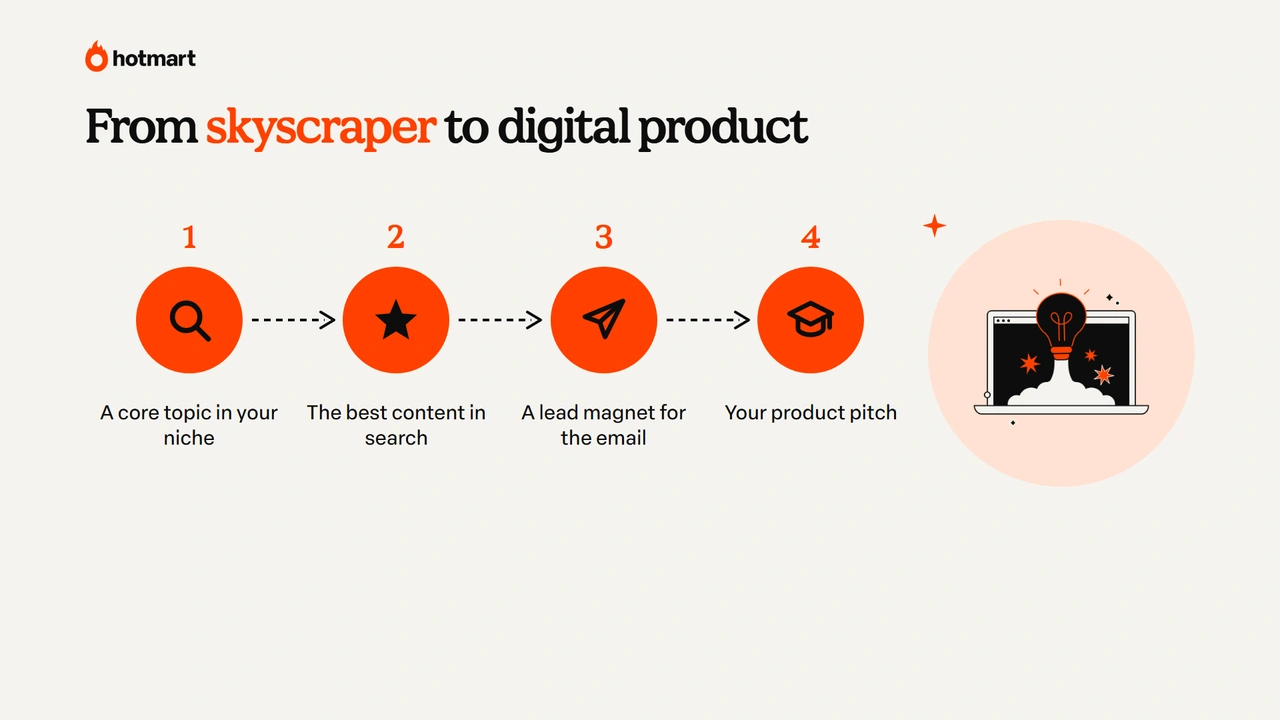
In practice, the path usually looks like this:
- choose a core topic in your niche: someone who sells a personal finance course could aim for the most complete guide on how to build an emergency fund;
- create the best content on the SERP: with the experience of someone who teaches the topic, student examples and original data;
- offer an incentive: a spreadsheet, a checklist or a mini-course in exchange for an email address, the lead magnet that turns a visitor into a contact;
- connect to your product: once people trust your content, they’re more likely to check out your course, ebook or mentoring program.
This path is the foundation of content marketing for anyone who sells digital products, and the skyscraper technique speeds up the hardest part, which is reaching the top.
For when you want to create a calculator, a quiz or a simulator that other sites will want to cite, but you don’t know how to code, Hotmart Launchpad builds websites, pages and apps from a plain-language description. You fine-tune the result by chatting with the AI and publish it in one click, with domain, hosting and Hotmart checkout included, so you can send the people who found you through the tool straight to your product.
Ready to build your skyscraper?
Now you know what the skyscraper technique is: find the most linked content on a topic, create a genuinely better version and show it to the people who have a reason to cite it. It still works, as long as “better” comes from data, experience and usefulness, not more words, and your outreach is personalized.
Start with a single topic tied to what you teach, and build the most useful piece of content anyone can find about it. In the AI era, the tallest skyscraper is the one that offers something nobody else has. 😉
Frequently asked questions about the skyscraper technique
Still have questions? Below, we answer some of the most frequently asked questions about the skyscraper technique.
Who created the skyscraper technique?
The skyscraper technique was created by Brian Dean, founder of Backlinko. In the original case study, he applied the technique to a list of Google ranking factors published in 2013, landed 17 links from 160 emails and saw his site's organic traffic double in 14 days.
Does the skyscraper technique still work?
Yes, but there's less room for mass emailing. The skyscraper technique gets results when the content has a real differentiator, like original data or a tool, and when the outreach is personalized and includes follow-ups.
What's the difference between the skyscraper technique and link building?
Link building is the set of strategies used to earn links from other websites. The skyscraper technique is one of those strategies, combining the creation of superior content with direct outreach to the people who already linked to similar content.
How long does the skyscraper technique take to show results?
It depends on the topic, the competition and your site's authority. The first links may come in the weeks after outreach, but the impact on rankings and traffic usually takes a few months, so keep an eye on the page in Google Search Console.