What Is the Creative Economy? Sectors, Examples and How It Works
Learn what the creative economy is, its main sectors, real examples, how it generates income and how it differs from the creator economy.

What will we see in this post

The creative economy is made up of activities that turn creativity, knowledge, culture and intellectual capital into products, services and experiences with economic value. Music, film and TV, design, fashion, architecture, advertising, crafts, video games and publishing are some of the sectors that are part of it.
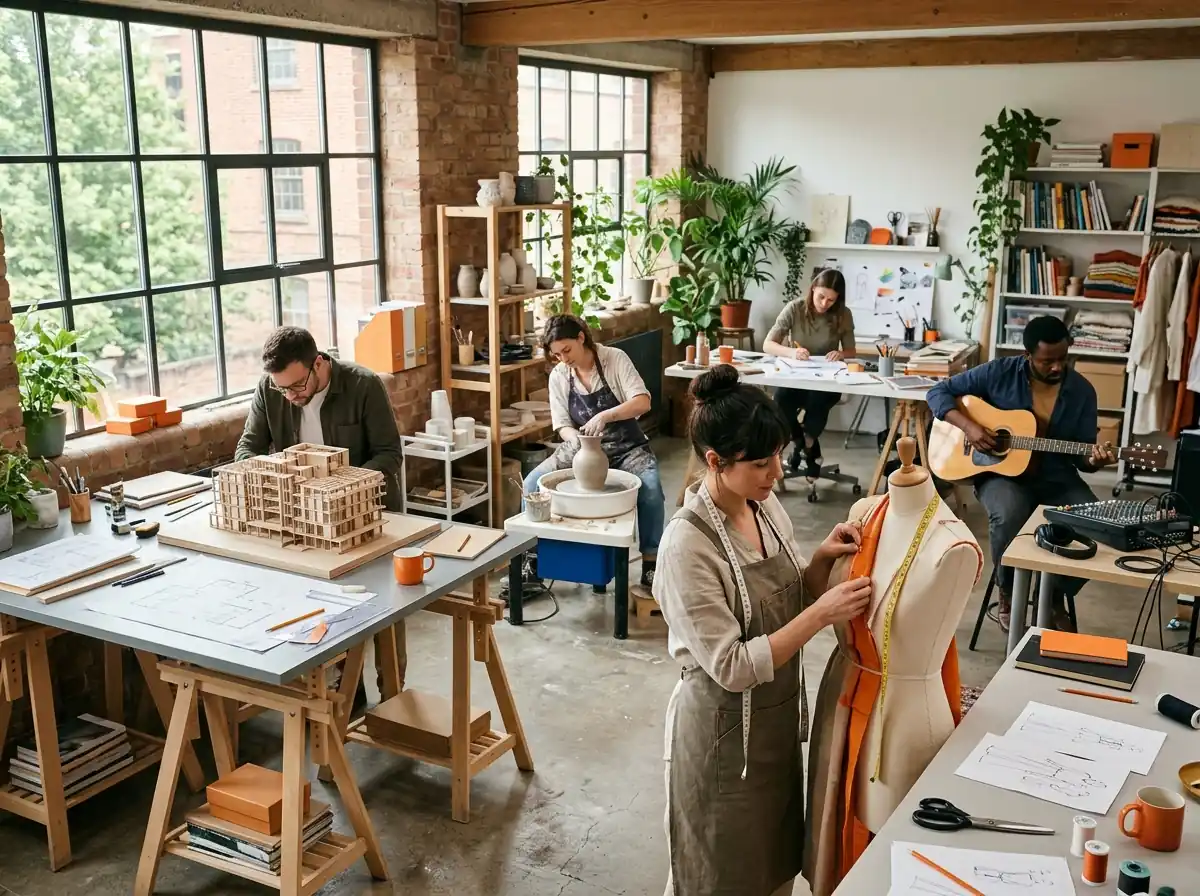
The concept is much older and broader than the internet. It covers everything from an independent fashion label and an architecture firm to a music festival, a film studio or a craft cooperative. What these activities have in common is that most of their value comes from ideas, not raw materials.
In this guide, you will learn what the creative economy is, which sectors it includes, how big it is in the United States and worldwide, how it generates income and how to build a career in it.
What is the creative economy?
The creative economy is the set of economic activities that rely on creativity, knowledge, talent, culture and intellectual capital as their main resources to create products, services and experiences with economic and cultural value. In other words, these are activities in which ideas and creative work play a decisive role in the value of what is sold.
Unlike sectors where value depends mostly on raw materials or physical goods, in the creative economy intangible assets account for a large share of the value. Think of a song, a story, a visual identity, an architectural design, a fashion collection or a film.
Consider a writer who turns a story into a book. Paper and ink have a cost, but the most important part of the book’s value lies in the author’s intellectual work. The same logic applies to musicians, designers, screenwriters, architects, advertising professionals and game developers.
That is why the creative economy is not limited to arts and culture, nor to people who create content online. It includes traditional and digital sectors, large companies and independent professionals, and its exact boundaries depend on the institution or methodology used. In Latin America, the same concept is often called the orange economy.
Where did the concept of the creative economy come from?
The concept of the creative economy emerged in the late 1990s and early 2000s, when governments and researchers began measuring the economic weight of activities based on creativity, culture and intellectual property. A few milestones help tell the story:
- 1998, United Kingdom: the British government published the first official mapping of the creative industries, with 13 sectors such as advertising, architecture, design, fashion, music and software.
- 2001, John Howkins: the British author published The Creative Economy, the book that popularized the term.
- 2008 onward, United Nations: the UN Conference on Trade and Development (UNCTAD) began publishing reports on the global creative economy.
- 2021, International Year: the UN General Assembly declared 2021 the International Year of Creative Economy for Sustainable Development.
That does not mean the creative economy was born then. Writers, musicians, artists and artisans were making a living from creativity long before. What changed was the recognition of these activities as an economic sector, with its own data, public policies and development strategies.
What are the main characteristics of the creative economy?
The main characteristics of the creative economy are tied to the role of creativity, knowledge and intangible assets in creating value. None of them alone defines whether an activity belongs to the sector, but they usually appear together:
- Creativity as a core resource: ideas, talent and expertise are the foundation of products, services and experiences.
- Intangible assets: works, brands, designs and stories account for much of the value.
- Intellectual property: copyrights, trademarks and licenses protect creative work and generate income from it.
- Economic and cultural value: a creation can generate revenue while also carrying cultural, aesthetic or social meaning.
- A mix of sectors and sizes: large companies, small businesses, collectives and freelancers coexist in the same ecosystem.
- Innovation: new formats, processes and experiences set professionals and companies apart.
Which sectors are part of the creative economy?
The sectors included in the creative economy vary by classification. UNCTAD, one of the most widely used international references, groups creative activities into four broad categories:
| Category | Sectors |
|---|---|
| Heritage | Traditional cultural expressions, crafts, festivals, museums and cultural sites |
| Arts | Visual arts (painting, sculpture, photography) and performing arts (live music, theater, dance) |
| Media | Publishing, print media and audiovisual (film, television and radio) |
| Functional creations | Design, fashion, architecture, advertising, new media, software and video games |
Other institutions draw the lines differently. In the United States, the Bureau of Economic Analysis (BEA) measures arts and cultural production, which includes performing arts, museums, design, publishing, broadcasting and film, among other industries.
More important than memorizing a list is understanding the principle behind it: the creative economy includes activities in which creativity, culture and intellectual capital carry significant weight in creating value. That is why, when citing figures about the sector, it is worth noting which classification was used.
How big is the creative economy?
The creative economy is worth trillions of dollars worldwide and represents a significant share of the US economy. The figures vary by methodology, but the main studies show the scale of the sector:
- Worldwide: according to UNCTAD’s Creative Economy Outlook 2024, exports of creative services reached $1.4 trillion in 2022, and exports of creative goods totaled $713 billion.
- In the United States: according to the BEA, arts and cultural production added about $1.1 trillion to the US economy in 2022, or 4.3% of GDP.
These numbers only capture part of the sector, since many creative professionals work as freelancers or informally and do not show up in official statistics. Still, they show that the creative economy is a major economic sector, comparable to traditional industries.
Who works in the creative economy?
Anyone who uses creativity, technical knowledge or cultural expertise as their main resource to create value works in the creative economy. That includes very different professions, such as:
- Musicians, songwriters, music producers and sound engineers
- Actors, dancers, directors and arts administrators
- Architects, urban planners and landscape architects
- Graphic, product and UX designers
- Fashion designers, pattern makers and stylists
- Writers, editors, translators and illustrators
- Filmmakers, screenwriters, photographers and animators
- Advertising professionals, copywriters and brand strategists
- Video game and software developers
- Artisans, chefs and keepers of local cultural traditions
- Content creators and educators who turn their knowledge into products
These people may work as employees, freelancers, business owners or in collectives. A designer who creates visual identities for companies is part of the creative economy just as much as a theater company or an architecture firm. Working online does not, by itself, define who belongs to the sector: what matters is how much creativity and knowledge drive the value delivered.
What are examples of the creative economy?
Examples of the creative economy appear whenever creativity, knowledge or intellectual capital is turned into products, services or experiences. Here are situations from different sectors:
- Publishing: an author writes an original story, and a publisher prints and distributes the book.
- Film and TV: a studio turns a script into a movie or series, bringing together professionals from many creative fields.
- Music: a songwriter records their songs and earns from streaming, live shows, licensing and royalties.
- Design: a studio creates the visual identity of a company.
- Fashion: an independent label launches a collection with its own identity.
- Architecture: a firm designs a public space or a home.
- Video games: a studio combines code, storytelling, illustration and music to create a game.
- Crafts: an artisan cooperative turns traditional techniques into pieces sold at home and abroad.
- Festivals: a film or music festival boosts tourism, hospitality and local businesses.
- Food: a restaurant turns local ingredients and recipes into a signature experience.
The creative economy does not depend on a single format. Sometimes there is a physical product; other times, customers pay for a service, access, usage rights or an experience. What they share is the weight of intellectual creation in generating value.
How does the creative economy work?
The creative economy works as a value chain that turns ideas, talent and intellectual property into products, services or experiences that reach audiences and generate income. The process varies by sector, but it usually follows these stages:
- Creation: the idea, work or project is conceived.
- Production: the work takes shape with the help of different professionals and suppliers.
- Distribution: the product or service reaches people through stores, theaters, platforms, galleries, events or contracts.
- Consumption or experience: people buy, watch, use or experience the work.
- Return: revenue flows back through the chain, including royalties and licensing fees.
In music, a songwriter creates a song, a studio records it, a distributor sends it to streaming platforms and radio, and the revenue goes back to songwriters, performers and producers. That is why the creative economy also drives supporting industries such as tourism, technology, retail and services.
How does the creative economy generate income?
The creative economy generates income from selling products and services, from experiences and from licensing creative work to others. The same professional or business can combine several revenue streams:
- Physical products: books, artwork, fashion, crafts and design objects.
- Services: architecture, design, photography, advertising and video production projects.
- Tickets and experiences: concerts, plays, exhibitions, festivals and workshops.
- Royalties: payment for the use or reproduction of a protected work.
- Licensing: permission for others to use songs, characters, brands or other creations.
- Grants and public funding: support for creative projects from arts councils, foundations and programs such as the National Endowment for the Arts.
- Sponsorships: companies that associate their brand with cultural and creative projects.
- Digital products and education: online courses, ebooks and coaching that turn expertise into an offer. You can even create an ebook with AI.
These models often work together. A musician can earn from streaming, play live shows, license songs for ads and win a grant to record an album. Good ideas matter, but a creative business only lasts when it finds an audience, a clear value proposition and a viable revenue model.
Why is the creative economy important?
The creative economy is important because it turns creativity and knowledge into jobs, income, innovation and development. Its impact goes beyond money: creative activities strengthen cultures and local identities and create new ways to produce and consume.
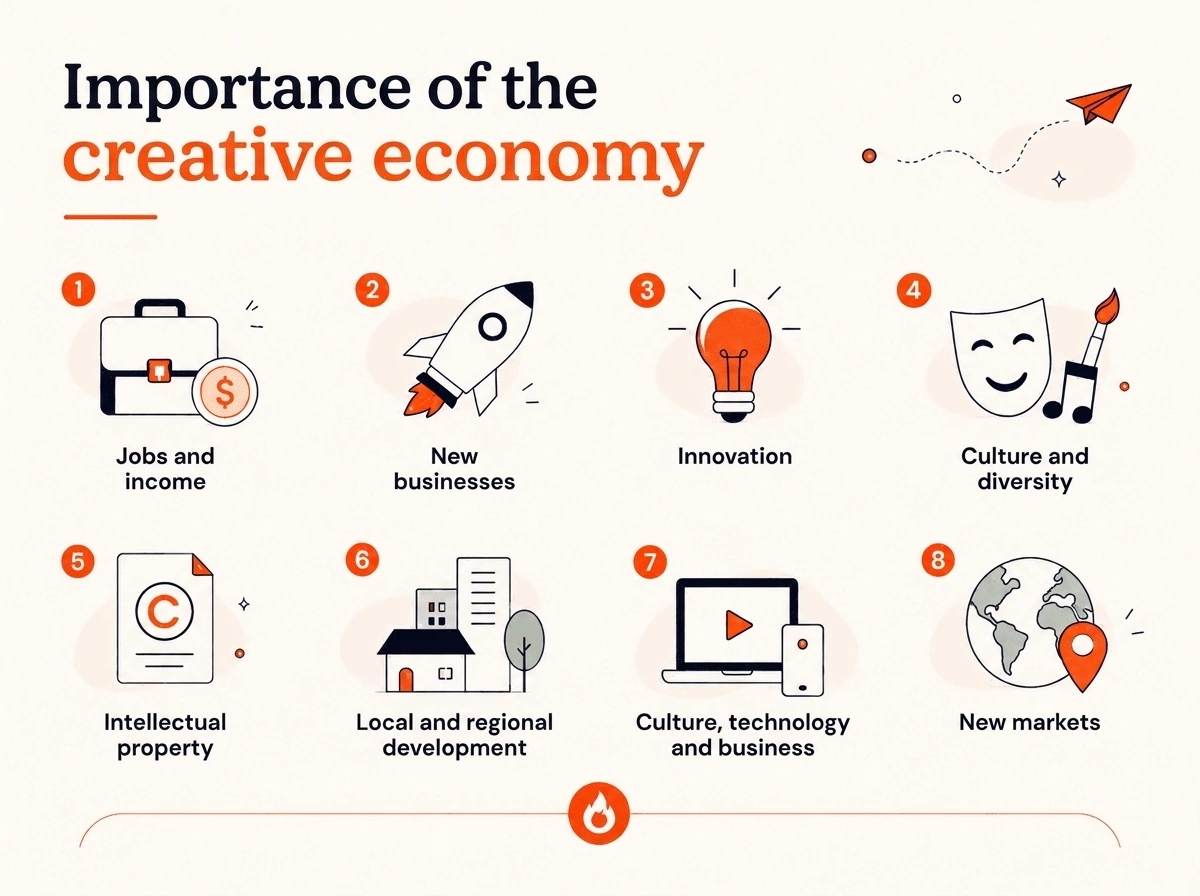
- Jobs and income: the sector employs people with very different profiles and backgrounds.
- New businesses: talent and knowledge give rise to products, services and companies.
- Innovation: the search for new formats pushes professionals and companies to innovate.
- Culture and diversity: music, literature, the arts and traditional crafts are preserved and shared.
- Intellectual property: works, brands and designs become valuable intangible assets.
- Local and regional development: festivals, design districts and film productions revitalize entire cities.
- New markets: creative products and services reach customers in other countries.
That is why the creative economy increasingly appears in economic development policies in the US and around the world. It relies less on natural resources and more on people, which makes it strategic for cities and regions.
Are the creative economy and the creative industries the same thing?
The creative economy and the creative industries are related, but they are not exact synonyms. The creative economy is the broader ecosystem of activities based on creativity, culture and intellectual capital, including their links to other sectors. The creative industries are the specific sectors within that ecosystem, such as film, music, publishing, design and advertising. Put simply, the creative industries are the sectors that make up the creative economy.
What is the difference between the creative economy and the creator economy?
The main difference between the creative economy and the creator economy is scope. The creative economy is the broad concept that covers every sector in which creativity, culture and intellectual capital generate value, such as architecture, fashion, music, film and design. The creator economy is a specific, more recent ecosystem made up of content creators, their audiences and the digital platforms they use to produce and monetize content.
| Creative economy | Creator economy |
|---|---|
| A broad concept, used since the late 1990s | An ecosystem that grew with social media in the 2010s |
| Includes sectors such as architecture, fashion, music, film, design and crafts | Includes content creators, influencers and online educators |
| Exists with or without the internet | Depends on digital platforms and an online audience |
| Value comes from creative work and intellectual property | Value comes from content and a direct relationship with the audience |
| Measured by governments and bodies such as the UN and the BEA | Measured mostly by consulting firms and digital platforms |
An architect, a fashion designer or a stage actor is part of the creative economy without necessarily being part of the creator economy. Someone who makes videos, builds an audience and sells digital products, on the other hand, can belong to both. In short, the creator economy is one part of the creative economy, not a synonym for it.
How is technology changing the creative economy?
Technology is changing the creative economy by expanding the ways people create, produce, distribute and get paid for creative work. Technology did not create the creative economy, but it transformed how its sectors operate:
- Software and digital equipment lowered the cost of producing music, video, design and games
- Streaming services changed how music, film and TV are distributed
- Online stores and marketplaces took fashion, design and crafts to new markets
- Digital product platforms make it possible to sell knowledge online
- Business and automation tools helped small creative businesses become more professional
Generative AI is the most recent shift. AI tools can support research, ideation, editing and production, but they also raise important questions about authorship, copyright and fair pay for artists and authors whose work is used to train AI models.
What are the main challenges of the creative economy?
The main challenges of the creative economy involve turning creativity into a financially sustainable activity. Talent and good ideas matter, but professionals and companies also have to deal with:
- Irregular income: people who work project by project face busy and slow periods.
- Lack of benefits: many creative professionals are freelancers without employer-provided health insurance or retirement plans.
- Pricing: putting a price on intellectual work is harder than adding up material costs.
- Protecting intellectual property: copyrights, trademarks, contracts and licensing require specific knowledge.
- Access to funding: grants and investment are competitive and require well-structured projects.
- Technological change: tools such as AI quickly reshape workflows and pay models.
That is why working in the creative economy takes more than creative skills. Knowing the basics of entrepreneurship, management, marketing and copyright makes a real difference in turning talent into sustainable work.
How to work in the creative economy
To work in the creative economy, start by identifying your skills and knowledge and the sector where they create value. From there, you choose a field, build your skills and decide how you want to work. These steps help:
- Choose a field: design, music, film and video, fashion, architecture, games, advertising or another area you enjoy.
- Invest in training: courses, degrees, workshops and constant practice.
- Build a portfolio: gather projects that show your work to clients and employers.
- Pick your work model: full-time job, freelance, your own business, a collective or a mix.
- Research grants and programs: arts councils and foundations can fund creative projects.
- Learn the business side: pricing, contracts, copyright and sales.
- Build your network: events, associations and industry groups create opportunities.
There is no single formula. An illustrator can work at an agency, take freelance clients and sell original pieces at the same time. A fashion expert can offer consulting and also turn what they know into an online course. For more paths, check out these business ideas.
What are the trends in the creative economy?
Trends in the creative economy are linked to digitalization, regional development and new debates about intellectual property. Some of the most relevant movements are:
- Creative cities: the UNESCO Creative Cities Network recognizes cities that use creativity as a development strategy, such as Austin (media arts), Detroit (design) and Santa Fe (crafts and folk art).
- Creative economy and sustainability: the UN links the sector to the Sustainable Development Goals because it creates income with less dependence on natural resources.
- AI and copyright: rules on using creative works to train AI will shape how creators are paid.
- Digital distribution: streaming, online stores and digital platforms extend the reach of creative products.
- Global reach: music, film, games and fashion from around the world reach new markets faster than ever.
- Hybrid experiences: events, exhibitions and courses that blend in-person and online formats.
These trends do not mean that every opportunity is online. In-person activities, physical products and cultural experiences remain at the heart of the creative economy, and digital tools work as an extension of those possibilities.
The creative economy: creativity that drives the economy
Throughout this guide, we saw that the creative economy turns creativity, knowledge, culture and intellectual capital into products, services and experiences with economic value. It brings together sectors as diverse as music, film, design, fashion, architecture, games and crafts, and it accounts for a significant share of the US economy.
We also saw that the creative economy is not the same as the creator economy: the creator economy is one part of this universe, but the creative economy is much broader and exists with or without the internet.
If you have knowledge or a creative skill you want to turn into a digital product, Hotmart gives you the tools to create, sell and manage your online business, so you can focus on what sits at the center of the creative economy: using what you know and create to bring value to other people.
Frequently asked questions about the creative economy
Still have questions about the creative economy? Below, we answer the most common ones.
What is the creative economy in simple terms?
The creative economy is the set of economic activities that use creativity, knowledge, culture and intellectual capital as their main resources to create products, services and experiences. It includes sectors such as music, film and TV, design, fashion, architecture, advertising, video games, crafts and publishing.
What are the sectors of the creative economy?
According to UNCTAD, the creative economy falls into four broad categories: heritage (crafts, festivals and cultural sites), arts (visual and performing arts), media (publishing and audiovisual) and functional creations (design, fashion, architecture, advertising, software and video games). Other institutions use different groupings.
What is the orange economy?
The orange economy is another name for the creative economy, widely used in Latin America. The term was popularized in 2013 by a book from the Inter-American Development Bank (IDB), which associated the color orange with culture and creativity.
What is the difference between the creative economy and the creator economy?
The creative economy is the broad concept that covers every sector in which creativity and intellectual capital generate value, with or without the internet. The creator economy is one part of it, made up of content creators, their audiences and the digital platforms where they produce and monetize content.
Does the creative economy only exist online?
No. Music, theater, literature, fashion, architecture, design and crafts existed long before the internet. Digital tools expanded the ways to produce, distribute and sell creative work, but the creative economy includes both in-person activities and physical products as well as digital products and services.