
ROAS: what it is, how to calculate it and what a good ROAS looks like for profitable ads
Find out what ROAS is, how to calculate and read it, what break-even ROAS looks like for creators and affiliates, and how to improve the return on your ads.

What will we see in this post

You put money into ads and the sales came in. But the question that really matters is a different one: did every dollar you spent come back with a profit? 💸 That’s exactly what ROAS answers. It’s the metric that shows how much revenue your ads bring in for every dollar spent, and it’s the number Meta Ads and Google Ads use to optimize sales campaigns.
In this guide, you’ll learn what ROAS is, how to calculate it with a dollar example, how to read the result, what a good ROAS is (and the break-even ROAS, which changes a lot for creators and affiliates), how it differs from ROI, CPA and CAC, where to find the metric on ad platforms and what to do to improve yours.
| Question | Quick answer |
|---|---|
| What is ROAS? | Return on ad spend: the revenue generated by your ads divided by the amount you spent on them |
| What’s the formula? | ROAS = ad revenue ÷ ad spend |
| What does a ROAS of 3 mean? | Every $1 in ads brought in $3 in sales (or 300%) |
| What’s a good ROAS? | There’s no single number: it has to stay above your break-even ROAS, which is 1 ÷ margin |
| Is ROAS the same as ROI? | No: ROAS only looks at revenue and ad spend; ROI looks at profit and all costs |
What is ROAS?
ROAS stands for return on ad spend. It’s a digital marketing metric that shows how much revenue a campaign, ad set or single ad generated for every dollar spent on paid media.
ROAS is mainly used in sales-focused paid traffic campaigns on Meta Ads (Facebook and Instagram), Google Ads, TikTok Ads and other platforms. It quickly tells you whether your ads are bringing money back, and it helps you decide where to put more budget and what to pause.
One important detail: ROAS measures revenue, not profit. It doesn’t subtract product costs, fees, taxes or commissions. That’s why a high ROAS doesn’t guarantee profit, and that’s where break-even ROAS comes in, which you’ll see further down.
How to calculate ROAS: formula and example
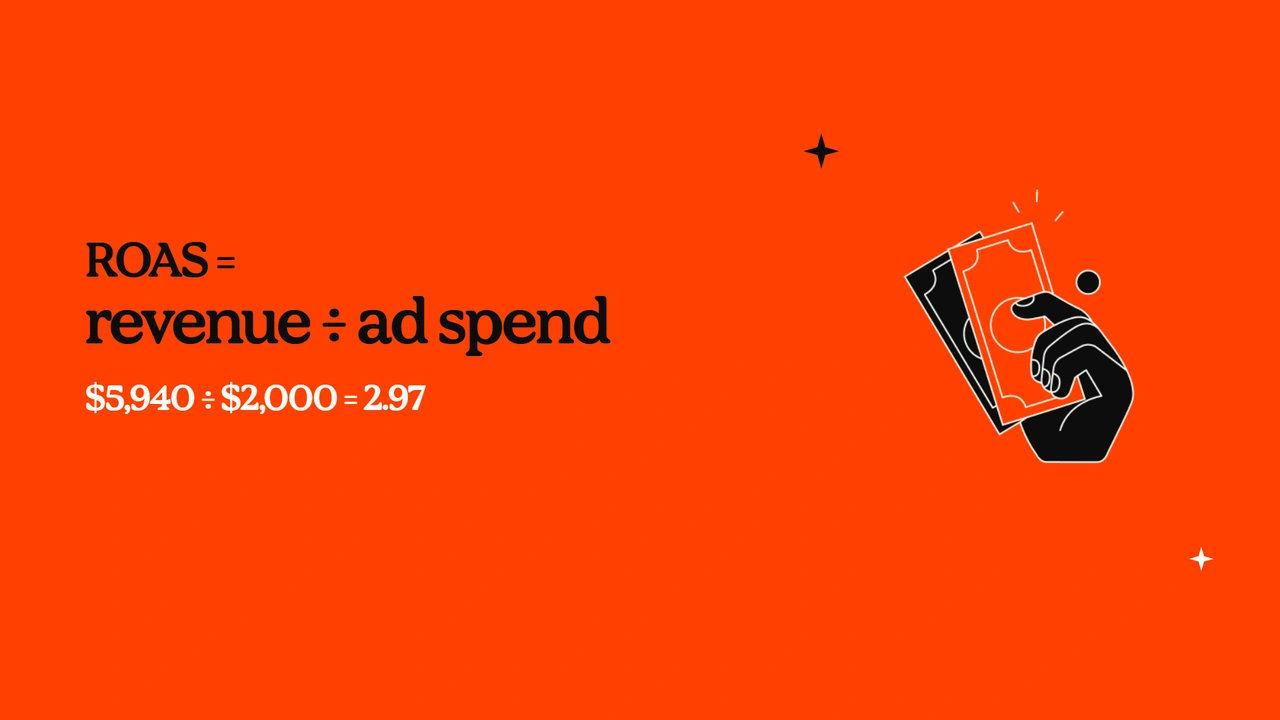
ROAS is calculated by dividing the revenue generated by your ads by the amount spent on those same ads, over the same period:
ROAS = revenue attributed to ads ÷ ad spend
If you’d rather see it as a percentage, just multiply the result by 100. In practice, marketers say “a 3x ROAS” or “ROAS of 3” more often than “300% ROAS,” but both mean the same thing.
Here’s an example with a $297 online course:
- monthly ad spend: $2,000;
- sales attributed to ads: 20;
- revenue generated: 20 × $297 = $5,940;
- ROAS: $5,940 ÷ $2,000 = 2.97 (or 297%).
In other words, every $1 spent brought in $2.97 in sales. To keep the math fair, always use the same time window and the same data source for revenue and spend, and leave out sales that didn’t come from ads (organic, email, referrals).
How to interpret ROAS
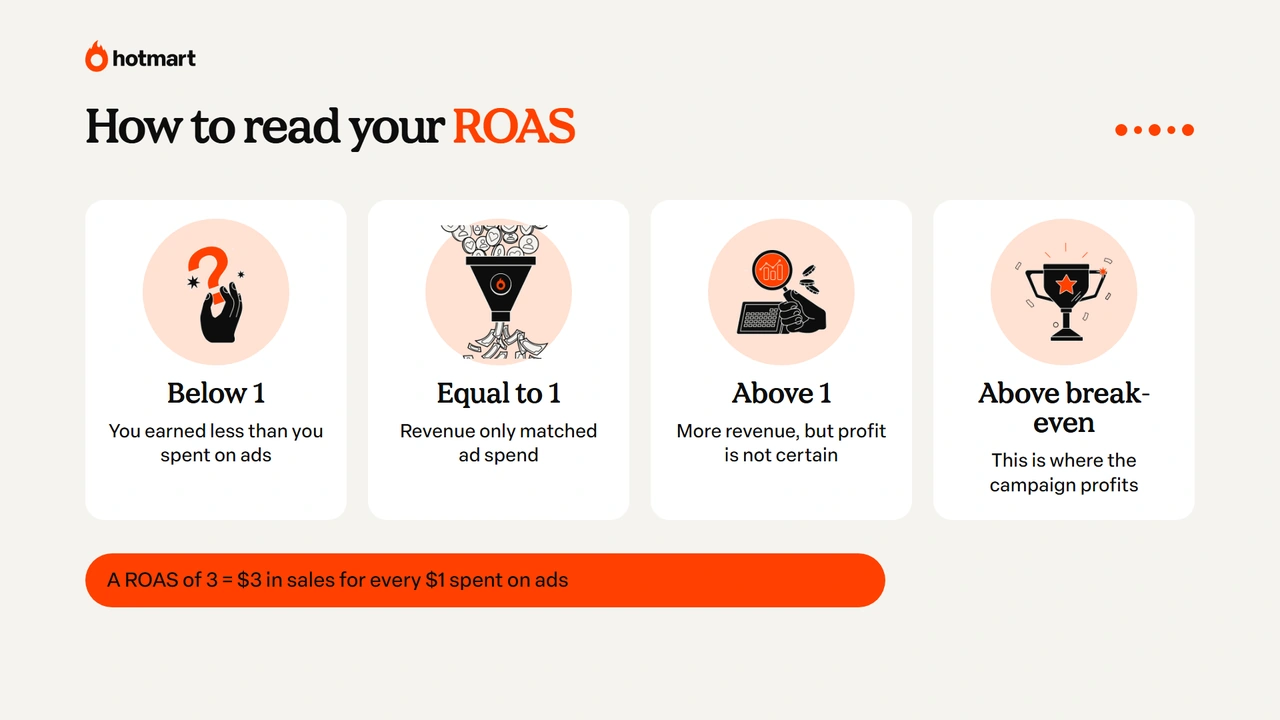
Interpreting ROAS is simple: the number shows how many dollars in sales come back for every dollar spent. A ROAS of 3 means $3 in revenue for every $1 in ads. Here’s how to read the most common results:
- ROAS below 1: the campaign brought in less than it cost (a ROAS of 0.5 = $0.50 back for every $1);
- ROAS equal to 1: revenue only matched ad spend, without covering any other cost;
- ROAS above 1: the ads brought in more revenue than they cost, but that still doesn’t mean profit;
- ROAS above your break-even point: now the campaign is actually profitable after all the costs of the sale.
Notice that the rule “a ROAS above 1 means profit,” which shows up in a lot of articles, would only hold if the product had no costs at all. Since there’s always a fee, a tax or a commission, the number that separates profit from loss is your break-even ROAS.
Good ROAS and break-even ROAS: what is a good ROAS?
A good ROAS is one that sits above your break-even ROAS with enough room for the profit you want. There’s no universal “good ROAS”: a ROAS of 2 can be great for a high-margin digital product and a loss for a store with thin margins. To find your number, follow this order:
- calculate your margin per sale before ads;
- find your break-even ROAS;
- set your target ROAS by adding the profit you want.
Below, we break down each step, with the math for both creators and affiliates.
What is break-even ROAS?
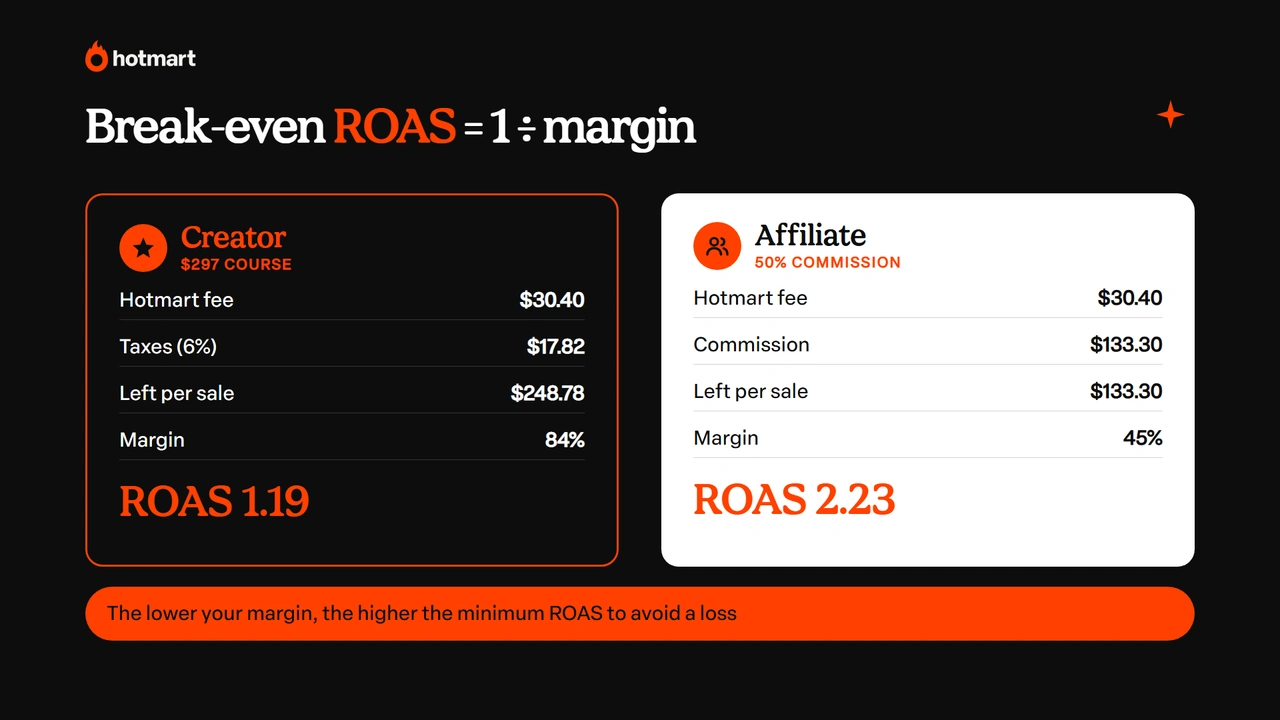
Break-even ROAS is the minimum ROAS a campaign needs to avoid losing money, that is, the point where what’s left from sales pays back exactly what you spent on ads. The formula is:
Break-even ROAS = 1 ÷ margin before ads
Margin before ads is the share of the price left after fees, taxes, commissions and product costs, but before media spend. If your profit margin is 50%, your break-even ROAS is 1 ÷ 0.5 = 2. If your margin is 25%, it goes up to 4. The lower the margin, the higher your ROAS needs to be.
Break-even ROAS for digital products: creator vs. affiliate
The break-even ROAS of a digital product changes a lot depending on who’s running the ads: the creator keeps most of the price, while the affiliate keeps the commission. Here’s the same $297 course, using simplified math:
| Item | Creator | Affiliate (50% commission) |
|---|---|---|
| Sale price | $297.00 | $297.00 |
| Hotmart fee (9.9% + US$1.00) | $30.40 | $30.40 |
| Net sale value | $266.60 | $266.60 |
| Affiliate commission | $0 (own sale) | $133.30 (50% of net) |
| Estimated tax (6%, varies by country and tax status) | $17.82 | not included here |
| What’s left per sale | $248.78 | $133.30 |
| Margin before ads | 84% | 44.9% |
| Break-even ROAS | 1.19 | 2.23 |
The gap is huge: with the same 2.97 ROAS from the earlier example, the creator keeps about $2,976 after the $2,000 in ads, while the affiliate keeps about $666 (before their own taxes). If ROAS drops to 2, the creator still makes a profit, but the affiliate is already losing money.
That happens because Ads Manager records the full sale value ($297), not the commission. So if you work as an affiliate, you need to aim for a much higher ROAS than a creator does. If you’re still choosing your path, it’s worth reading whether it’s better to become a creator or an affiliate. And for your real numbers, use your own commission, the taxes that apply in your country and tax status, and the Hotmart pricing for your revenue tier.
How to set your target ROAS
Your target ROAS (or ideal ROAS) is your break-even ROAS plus the profit margin you want after ads. A practical way to calculate it is:
Target ROAS = 1 ÷ (margin before ads − desired profit)
Example: the course creator has an 84% margin and wants 30% of revenue left over as profit. The target ROAS is 1 ÷ (0.84 − 0.30) = 1.85. For the affiliate, with a 44.9% margin and the same 30% profit goal, the target ROAS would be 1 ÷ 0.149, or about 6.7, which shows why affiliates tend to look for products with higher commissions and offers that convert really well.
That number becomes your benchmark: a campaign below break-even ROAS needs fixing or pausing; between break-even and target, optimization; above target, it’s a candidate for more budget.
ROAS vs. ROI vs. CPA vs. CAC: what’s the difference?
The difference between ROAS, ROI, CPA and CAC lies in what each metric measures: ROAS measures revenue per ad dollar, ROI measures profit on the entire investment, and CPA and CAC measure how much each sale or each customer costs. Here they are side by side:
| Metric | What it measures | Formula | Course example |
|---|---|---|---|
| ROAS | Revenue generated per ad dollar | Ad revenue ÷ ad spend | $5,940 ÷ $2,000 = 2.97 |
| ROI | Profit on the entire investment | (Gain − investment) ÷ investment | Also counts fees, taxes, team and tools |
| CPA | Cost of each conversion from ads | Ad spend ÷ conversions | $2,000 ÷ 20 = $100 |
| CAC | Total cost to acquire a customer | All marketing and sales costs ÷ new customers | Adds up ads, team, tools and production |
ROAS and CPA go hand in hand: at the same price, a $100 CPA on a $297 product gives you a 2.97 ROAS. ROI, on the other hand, is the view of the whole business, and CAC comes in when you want to know what it costs to bring in each customer, adding up every effort.
Where to find ROAS in Meta Ads and Google Ads
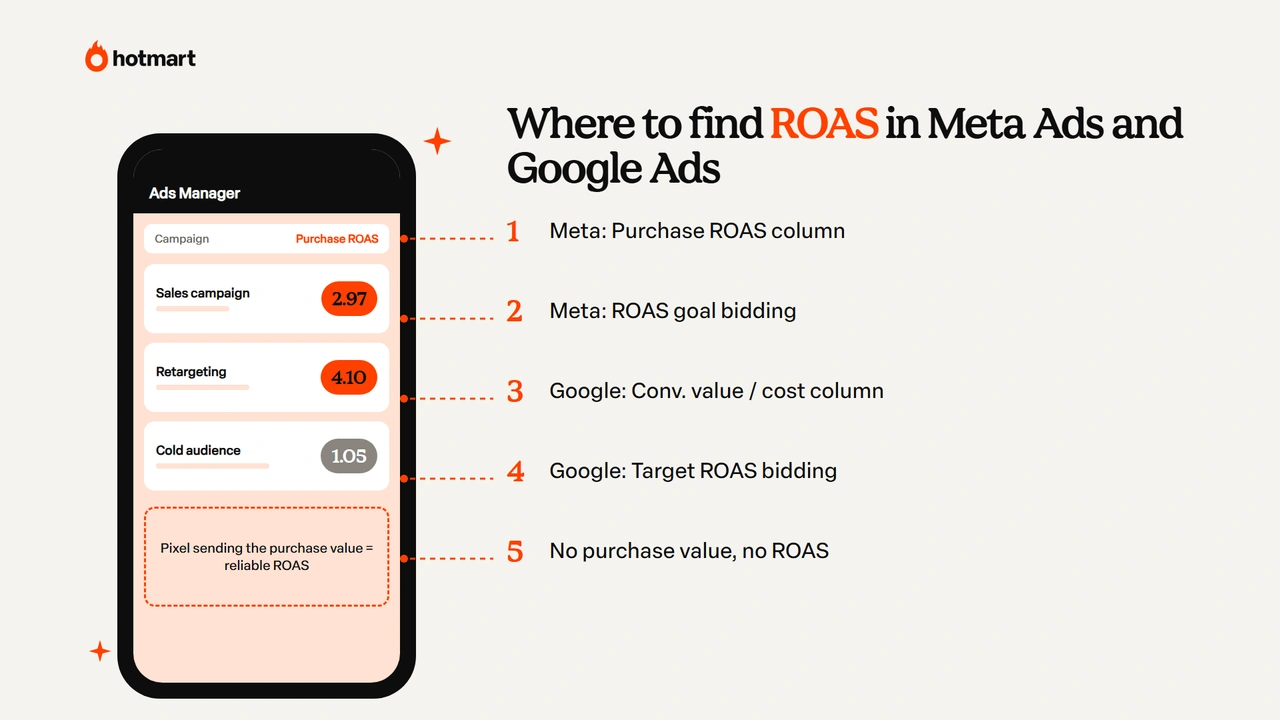
ROAS shows up ready-made in Meta Ads and Google Ads, as long as purchases are tracked with the sale value. Without the conversion value, the platform knows a purchase happened but not how much it brought in, and ROAS stays blank or wrong. That’s why the first step is setting up your conversion pixel and the purchase event with value. On Hotmart, creators and affiliates can set up the pixel on the product checkout.
ROAS in Meta Ads
In Meta Ads Manager, ROAS appears in the performance columns as “Purchase ROAS (return on ad spend)”, with a specific version for website purchases. According to the Meta Business Help Center, the metric takes the value of purchases tracked by the Meta Pixel or the Conversions API and divides it by the amount spent (Meta Business Help Center).
To see it, open Ads Manager, click “Columns,” choose a preset with conversions or customize it, and search for “ROAS.” For sales campaigns, there’s also the ROAS goal bid control, where you enter the return you want and the system tries to keep results close to it (Meta, Set up ROAS goal control). This guide to types of Facebook ads helps you pick the right format for your campaigns.
ROAS in Google Ads
In Google Ads, ROAS shows up in the “Conv. value/cost” column, found in the “Conversions” column group. The value appears as a decimal: a “Conv. value/cost” of 3 equals a 300% ROAS, and the Help Center itself says to multiply by 100 to get the percentage (Google Ads Help).
To optimize for return, Google offers the Target ROAS bid strategy: you set the goal and the system adjusts bids in each auction to reach an average ROAS close to it. If you’re just getting started on the platform, read this beginner’s guide on how to advertise on Google Ads first.
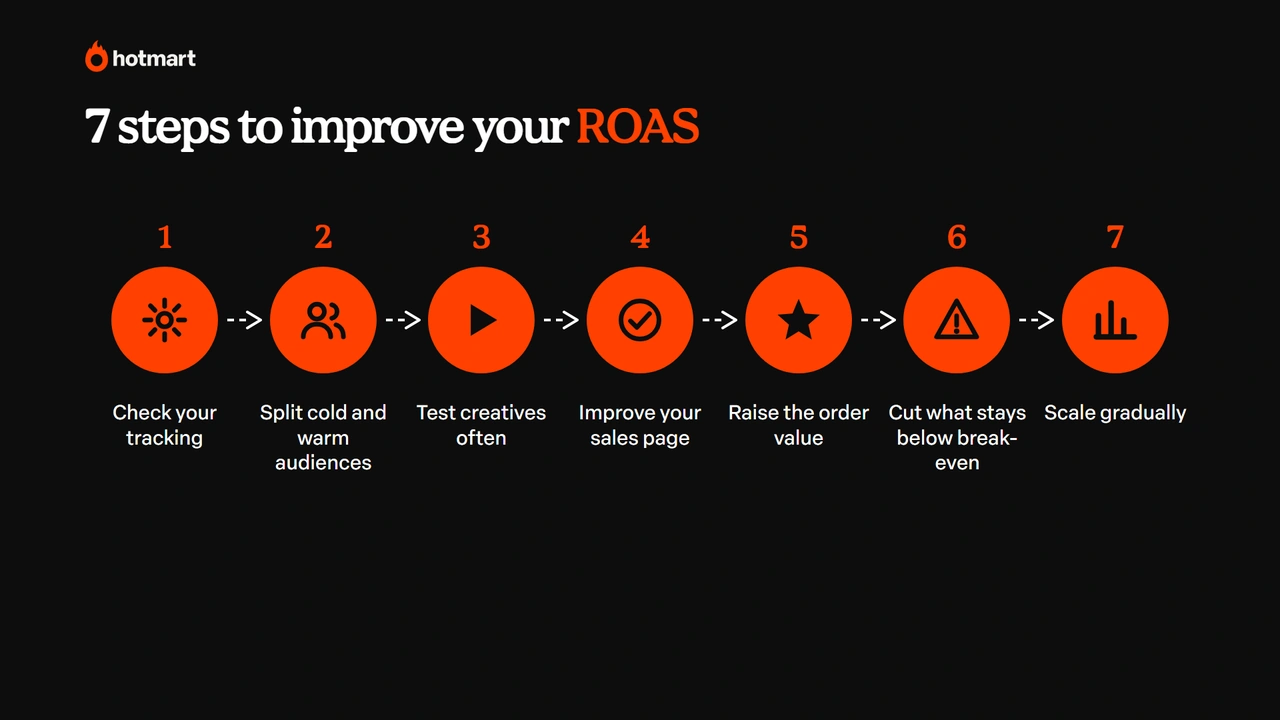
How to improve ROAS: 7 practical steps
Improving ROAS means generating more revenue with the same budget, or the same revenue while spending less. In practice, it comes down to measuring correctly, advertising to the people most likely to buy and selling better after the click. These are the steps:
- check your tracking before optimizing;
- separate cold and warm audiences;
- test creatives often;
- improve your sales page;
- increase the value of each sale;
- cut what stays below break-even;
- scale gradually.
Below, we explain each step to improve ROAS.
1. Check your tracking before touching ROAS
Before changing any campaign, make sure the purchase event fires with the right value and in the right currency. A duplicate purchase inflates ROAS, and a purchase with no value drags it down. Compare the sales reported by the ad platform with your actual sales for the period.
2. Separate cold and warm audiences
People who have already visited your page, watched your videos or joined your list usually convert more often and more cheaply. Remarketing campaigns for that audience tend to have a higher ROAS; cold-audience campaigns bring in new people, with a lower ROAS. Analyze them separately so you don’t draw the wrong conclusions.
3. Test creatives often
Creative is one of the biggest cost drivers on today’s ad platforms, which handle more and more of the targeting on their own. Test different hooks, formats (video, carousel, image) and offer angles, and keep only the ones that drive sales, not just clicks.
4. Improve your sales page to raise ROAS
If an ad gets clicks but sales don’t happen, the problem may be after the click. A fast, clear page with a well-explained offer increases your conversion rate, and every extra point of conversion raises ROAS without spending another dollar on media.
5. Increase the value of each sale
ROAS goes up when each purchase is worth more. Offers like an order bump at checkout, bundles and installment payments raise your average order value at the same ad cost.
6. Cut what stays below break-even ROAS
Compare each campaign, ad set and ad with your break-even ROAS, not with a generic goal. Give the algorithm time to learn, but pause or adjust anything that stays below break-even for several days in a row.
7. Scale ROAS gradually
When a campaign beats your target ROAS, increase the budget gradually. Big budget jumps tend to push ads toward less qualified audiences, and ROAS drops. Track the effect of each increase before the next one.
ROAS limitations: what the metric doesn’t show
ROAS is a great campaign metric, but it doesn’t tell the whole story of your business. Before pausing or scaling based on it alone, keep these limitations in mind:
- attribution: each platform attributes the sale according to its own window (for example, days after a click or a view) and may count the same purchase another channel also counted. Adding up Meta and Google ROAS usually gives you more sales than you actually had;
- repeat purchases and LTV: ROAS only looks at the first sale. If customers come back, subscribe or buy other products, their lifetime value can justify a lower initial ROAS;
- affiliates: sales made by affiliates may have come from their ads, not yours, and the creator pays commission on them. Separate your own sales from affiliate sales before calculating;
- costs outside media: ROAS ignores team, tools, production and refunds. Those costs show up in ROI;
- brand effect: top-of-funnel ads can have a low ROAS and still feed sales that happen later through organic search or email.
That’s why ROAS works best as a compass for your campaigns, alongside ROI, CPA and LTV, and not as the sole judge of your business.
Ready to calculate your ROAS?
ROAS shows, in a simple way, how much each ad dollar returns in sales. But the number only makes sense when you compare it with your break-even ROAS, which depends on your margin, and that’s why creators and affiliates aim for such different goals.
Grab last month’s numbers, calculate your margin, find your break-even point and set your goal before your next campaign. With accurate tracking and that benchmark in hand, it gets much easier to decide where your next dollar should go. 📈
Frequently asked questions about ROAS
Still have questions? Below, we answer some of the most frequently asked questions about ROAS.
What is ROAS and what does it mean?
ROAS stands for return on ad spend. It's the revenue generated by your ads divided by the amount you spent on them, and it shows how many dollars in sales come back for every dollar spent on media.
What is a good ROAS?
A good ROAS is one above your break-even ROAS, which is 1 divided by your margin before ads. For a digital product creator with a high margin, a ROAS around 2 can bring a healthy profit; for an affiliate earning a 50% commission, the minimum just to break even is already above 2.
How do you calculate ROAS as a percentage?
Divide ad revenue by ad spend and multiply by 100. With $5,940 in sales and $2,000 spent, ROAS is 2.97, or 297%.
What's the difference between ROAS and ROI?
ROAS compares ad revenue with ad spend. ROI compares profit with the entire investment, including product costs, fees, taxes and team, so it shows whether the business as a whole is making money.
Can ROAS be negative?
No, ROAS can't be negative, because revenue and spend are always positive numbers. What can happen is a ROAS below 1 (the campaign brought in less than it cost) or below break-even, which in practice means a loss.