
Evergreen content: what it is, examples and how to create content that brings in visits for years
Discover what evergreen content is, where the term comes from, how it differs from seasonal and trending content, formats and examples by niche, and how to create, update and measure content that lasts.

What will we see in this post

You know that post you published two years ago that still brings in visits every week? 🌲 That has a name: evergreen content, the kind of content that stays useful long after it goes live and keeps working for your brand while you take care of everything else.
In this guide, you’ll learn what evergreen content is and where the term comes from, how it differs from seasonal and trending content, which formats work best and examples by niche. We’ll also show you how to find evergreen topics, the step-by-step process to create them, how to keep them up to date, how to measure them and how they differ from the “evergreen launch” used to sell digital products. 🚀
| Question | Quick answer |
|---|---|
| What is evergreen content? | Content that stays relevant and useful for a long time, without depending on a date, a news story or a trend |
| What does evergreen mean? | “Always green”: the name comes from trees that keep their leaves all year round |
| Does evergreen content need updating? | Yes. The topic lasts, but data, screenshots and examples get old and need to be reviewed |
| What are examples of evergreen content? | Guides, tutorials, glossaries, FAQs, case studies, video tutorials and online course lessons |
| Are evergreen content and an evergreen launch the same thing? | No. One is a type of content; the other is a model for selling a digital product continuously |
What is evergreen content?
Evergreen content is any content that stays relevant, accurate and in demand for a long time after it’s published, because it answers a question that doesn’t depend on a date, a news story or a fad. It’s also called timeless content. A tutorial on “how to make a budget spreadsheet” is evergreen; coverage of a new phone launch is not.
In practice, evergreen content is the foundation of a content marketing strategy: it brings people in from search month after month, answers the questions every beginner asks and leads readers to the brand’s other materials. It can be a blog post, a video, an email, a podcast episode or a lesson, as long as the topic still holds up.
One caveat: evergreen content is evergreen in its topic, not in its form. “What is cash flow” will keep being searched for, but the examples, screenshots and numbers in the text get old and need a review every so often.
Evergreen: meaning and origin of the term
Evergreen means “always green” and, in the literal sense, it describes trees that keep their leaves all year, like pines and firs. The Merriam-Webster dictionary also lists the figurative sense, something that retains freshness or interest and stays continually relevant, and uses the very example “evergreen content on a website”.
The term took off in journalism, where an evergreen story is a piece with no time hook, saved for slow news days. From journalism, the expression moved into digital marketing and SEO with the same logic: content that doesn’t “dry up” when the seasons change.
Evergreen content vs. seasonal content vs. trending content
The difference between evergreen content, seasonal content and trending content is how long the demand lasts: evergreen content has steady searches all year, seasonal content comes back on predictable dates and trending (or news) content has a sharp spike and then fades. Here they are side by side:
| Type of content | How searches behave | Example | Role in the strategy |
|---|---|---|---|
| Evergreen | Steady throughout the year and over the years | How to make a personal budget | Consistent traffic and authority |
| Seasonal | Rises and falls on recurring dates | Mother’s Day gift ideas | Predictable spikes, planned on the calendar |
| Trending or news | Short spike, then drops to almost zero | New feature launched by a social network | Timeliness and quick reach |
Between one type and another, there’s semi-evergreen content: the topic lasts, but the text depends on information that changes. A guide on “how to advertise on Instagram” or a list of tools keeps getting searched, but screens, plans and prices change. This kind of content only stays evergreen with an update routine.
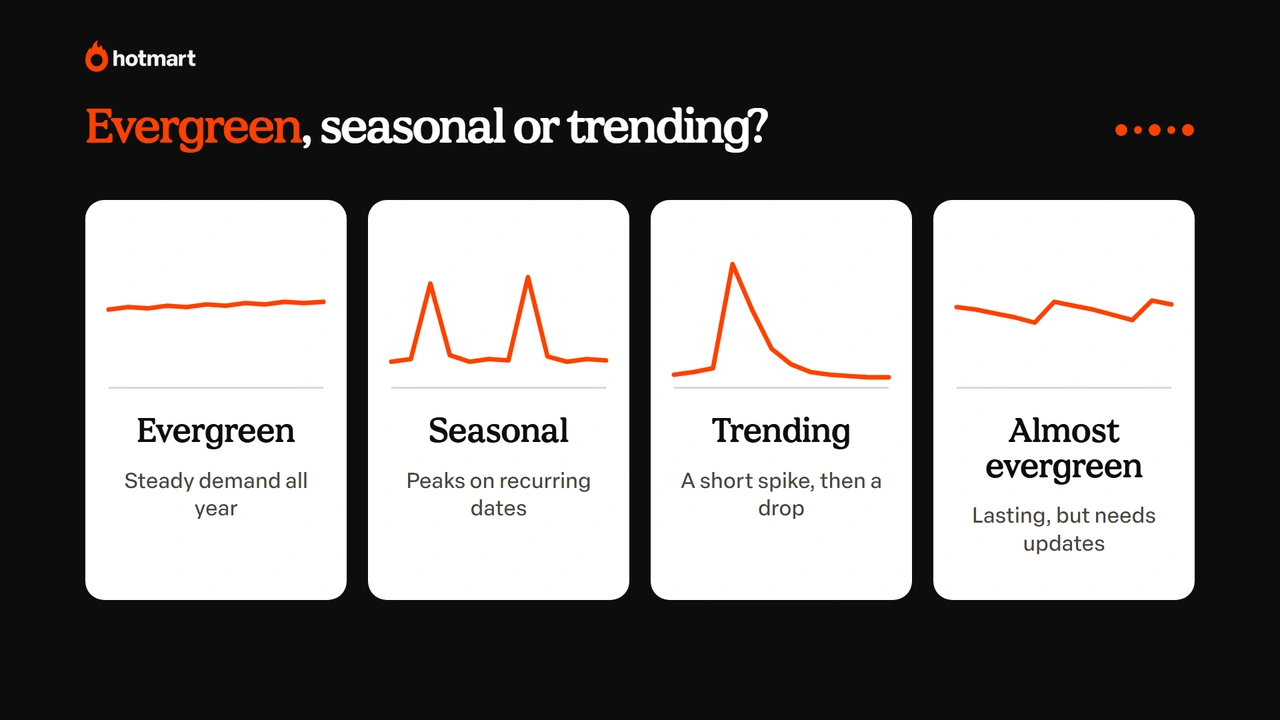
A good strategy mixes all three: evergreen content sustains traffic, seasonal content makes the most of the right dates and trending content shows the brand is paying attention to what’s happening now.
Why is evergreen content important?
Evergreen content is important because its results compound: each evergreen post keeps bringing in visits, links and leads months or years later, while a news story pays off for just a few days. These are its main benefits:
- organic traffic that adds up over time;
- better chances of ranking and earning backlinks;
- better chances of becoming a source for AI answers;
- lead generation all year long.
Below, each benefit with the data behind it.
Organic traffic that compounds over time
Traffic to evergreen content compounds because people keep finding it in search after the promotion is over. HubSpot, in the article introducing historical blog optimization (updated in June 2025), reported that 76% of its blog’s monthly views came from posts published before that month, and that 92% of the blog’s monthly leads also came from those “old” posts.
In other words, each piece of evergreen content becomes an asset: it adds visits to your organic traffic with no cost per click, unlike an ad, which stops bringing people in when the budget runs out.
Better chances of ranking and earning backlinks with evergreen content
Evergreen content has time to climb in Google, and that matters because ranking takes a while. In a study updated in May 2025, Ahrefs found that 72.9% of pages in Google’s top 10 are more than 3 years old, that the #1 result is 5 years old on average, and that only 1.74% of new pages in the sample reached the top 10 within a year.
Reference content also attracts links naturally, because people writing about a topic cite the most complete guide. That’s the logic behind the skyscraper technique: create the best version of a heavily linked piece of content and show it to the people who already cite the topic.
Evergreen content as a source for AI answers
Up-to-date evergreen content is more likely to be used as a source by AI assistants, which build answers from reference pages. A July 2025 Ahrefs study of almost 17 million cited URLs showed that ChatGPT, Perplexity, Copilot and Gemini cite pages that are, on average, 25.7% newer than those in organic results. Even so, the average age of cited content was 2.9 years: AI tools prefer long-lived content, as long as it’s up to date.
Google, for its part, says in its documentation on AI features that there are no additional requirements to appear in AI Overviews and AI Mode, and that these features run several related searches (query fan-out) to build an answer. An evergreen guide that answers many subquestions on a topic well gets more ways in.
Lead generation all year long
Evergreen content generates leads all year because it gets visits all year. An evergreen post with an offer tied to the topic, like a free resource, captures contacts without depending on a campaign, and those leads keep receiving content until they’re ready to buy.
Taken together, these benefits explain why mature blogs often get a large share of their traffic from a handful of well-maintained evergreen pieces.
Types and formats of evergreen content
The most common types of evergreen content are the ones that teach, explain or organize a topic that doesn’t change quickly, on a blog, on YouTube, on social media or by email. These are the formats that perform best:
- complete guides, which cover a topic from scratch to advanced;
- tutorials and step-by-step guides, like “how to make sourdough bread”;
- glossaries and definitions of the terms in your niche;
- FAQs with the questions customers ask over and over;
- resource lists, like books and tools (these need more frequent reviews);
- case studies of clients or students, with context and results;
- YouTube video tutorials, which get searched for years;
- pinned social media posts, with an introduction, rules or your most requested content;
- email sequences, like automated welcome and nurture emails;
- recorded course lessons, watched on any day, at the student’s own pace.
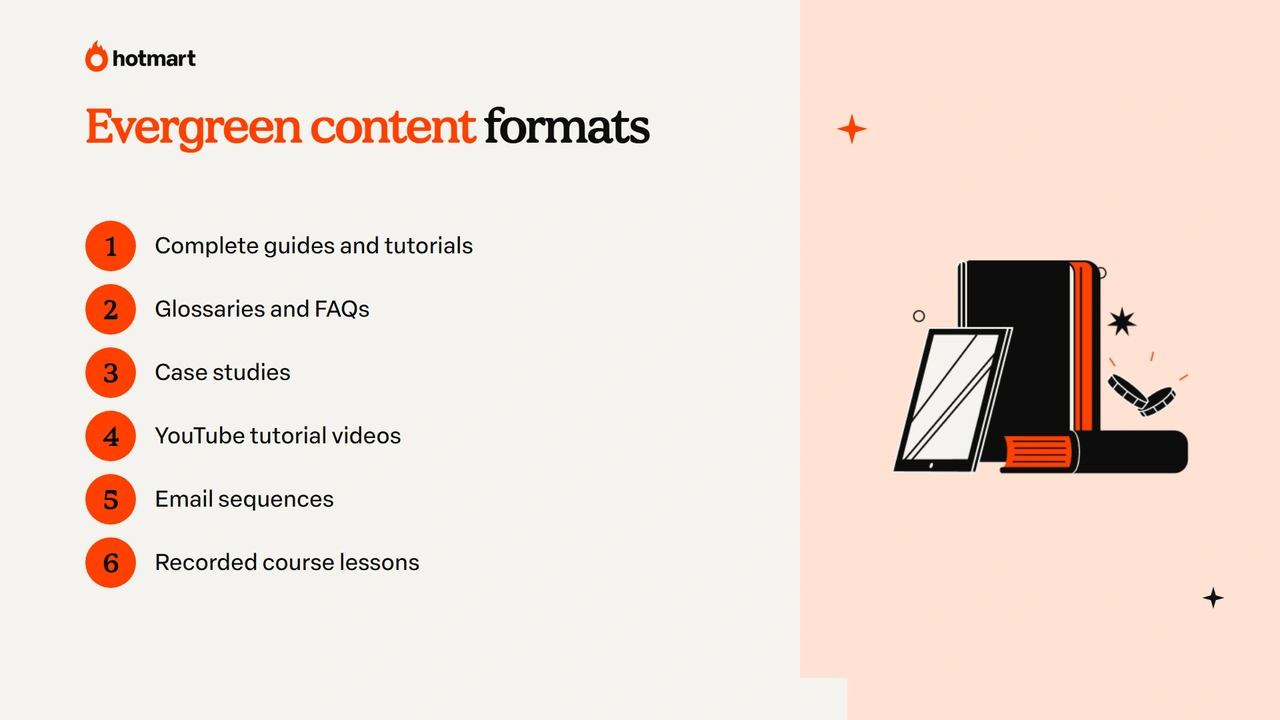
Notice that the format matters less than the topic: a video tutorial can be just as evergreen as a written guide. To see the whole process, from planning to distribution, check out our guide to content creation.
Evergreen content examples by niche
There are evergreen content examples in every niche, because every market has basic questions that keep coming up. The table compares an evergreen topic and a short-lived one in niches that are common among content creators:
| Niche | Evergreen content example | Example that isn’t evergreen |
|---|---|---|
| Personal finance | How to build an emergency fund | This month’s high-yield savings rates |
| Cooking | How to make sourdough bread | The recipe that went viral this week |
| Fitness | Beginner strength training workout | The latest social media challenge |
| Languages | The difference between “ser” and “estar” in Spanish | Slang that’s trending right now |
| Digital marketing | What a sales funnel is | Algorithm change announced yesterday |
| Parenting | How to build a baby’s sleep routine | Launch of a new stroller |
A quick test: “will someone search for this two years from now, using the same words?” If the answer is yes, the topic is evergreen, even if the text needs some updates along the way.
How to find evergreen content topics
To find evergreen content topics, you look for subjects with steady demand and recurring questions, combining search data with what your audience already asks. These are the most useful sources:
- Google Trends with a flat curve: Google Trends shows interest on a scale from 0 to 100, relative to total searches. Over a 5-year period, an evergreen topic shows up as a steady line (or with spikes that repeat every year), and a trend shows up as an isolated spike;
- consistent search volume: in keyword tools, look at the month-by-month history, not just the average;
- beginner questions: searches with “what is”, “how to” and “what’s the difference” tend to be evergreen, and the “People also ask” box shows variations;
- recurring questions from customers and students: what reaches your DMs, your support inbox and your live classes are real questions from your audience;
- Search Console queries: searches that already bring impressions to your site show where you can grow.
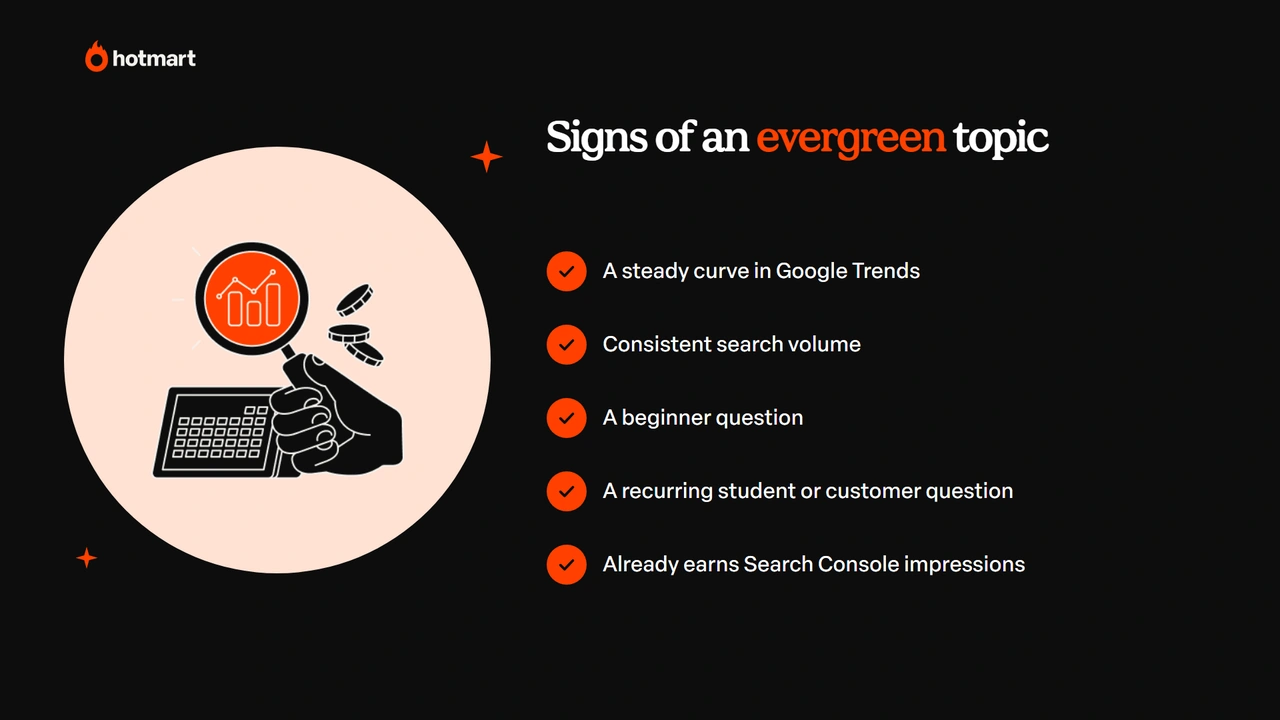
With your list in hand, prioritize the topics tied to what you sell or teach: a highly visited evergreen piece with no connection to your business brings in an audience that’s unlikely to become customers.
How to create evergreen content: step by step
Creating evergreen content means choosing an evergreen topic and writing it in a way that ages slowly, with direct answers, a clear structure and the parts that change kept separate. The process fits into 7 steps:
- choose a topic with steady demand;
- understand search intent;
- answer right at the start;
- separate what’s fixed from what changes;
- use a title and URL without a date;
- connect the content to other pages on your site;
- distribute it and repurpose it in other formats.
Here’s what to do at each stage.
1. Choose an evergreen topic with steady demand
Choose a topic from your list with consistent searches and a connection to your business. When in doubt, go with the most basic one: beginner topics last longer than advanced tactics, which change along with the tools.
2. Understand search intent
Search for the term on Google and see what comes up: guides, lists, videos or product pages. That reveals the search intent, meaning what the person wants to find. Evergreen content that ignores intent won’t be the one that gets picked.
3. Answer right at the start
Open the content and each section with a direct answer of 40 to 60 words that repeats the term from the question (“Evergreen content is…”, not “It is…”). That passage serves readers in a hurry and can be quoted by search engines and AI tools without the rest of the page. Then go deeper with examples, tables and lists.
4. Separate what’s fixed from what changes in evergreen content
Write the core explanation in a timeless way and keep what will age in separate blocks: prices, study figures, screenshots and platform rules. That way, updating means swapping out passages, not rewriting. Avoid “this year”, “recently” and “the latest thing”.
5. Use an evergreen content title and URL, without a date
Leave the year out of the URL and only use it in the title when it’s a fact in the content, like the year of a study. A URL like /evergreen-content works through any update; one like /content-tips-2024 forces you to change the address or looks dated. Google’s guide to URL structure also recommends simple, readable addresses.
6. Connect the content to other pages on your site
Include links to related content and get links from it. Evergreen content is often the most visited page on a topic, so it sends readers on to other materials and helps Google understand how your pages relate to each other.
7. Distribute it and repurpose it in other formats
An evergreen guide can become a video, a carousel, a podcast episode, an email sequence or a lesson. Repurposing content multiplies your reach without multiplying the research, and evergreen content is the best candidate, because it works on any channel.
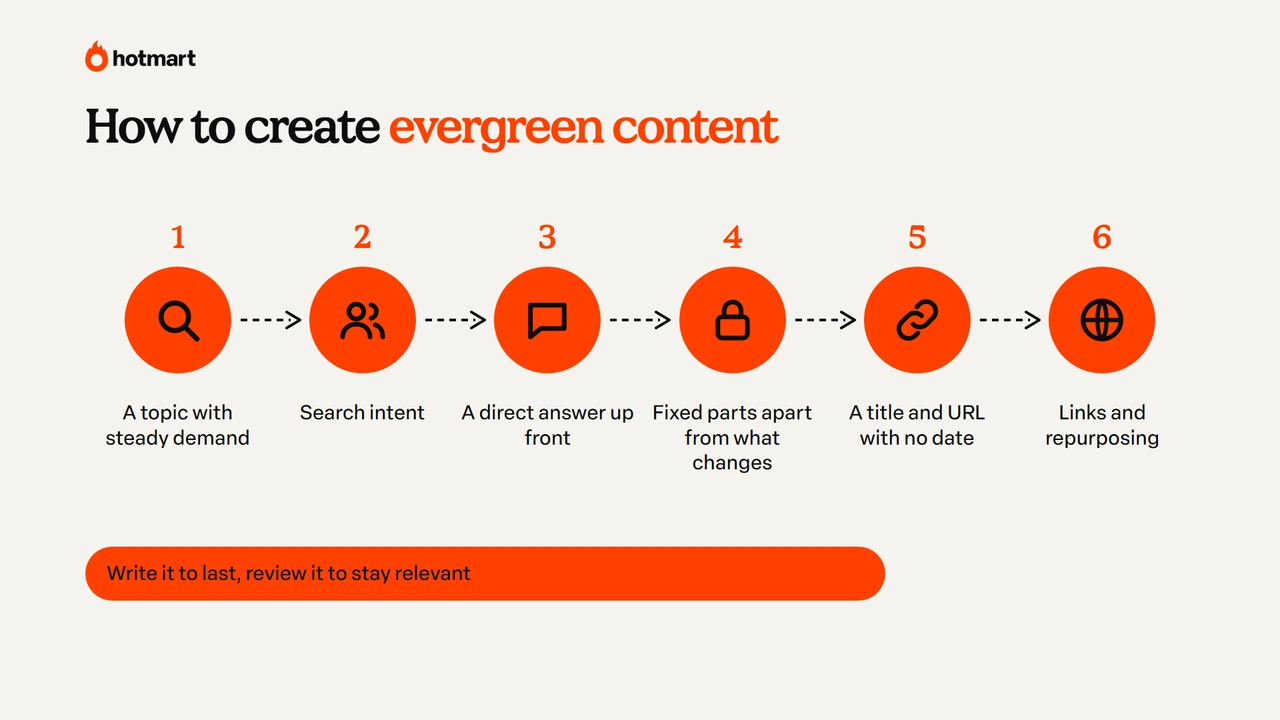
With these steps, your content is built to last. What keeps it evergreen, though, is what you do after you publish.
How to keep evergreen content up to date
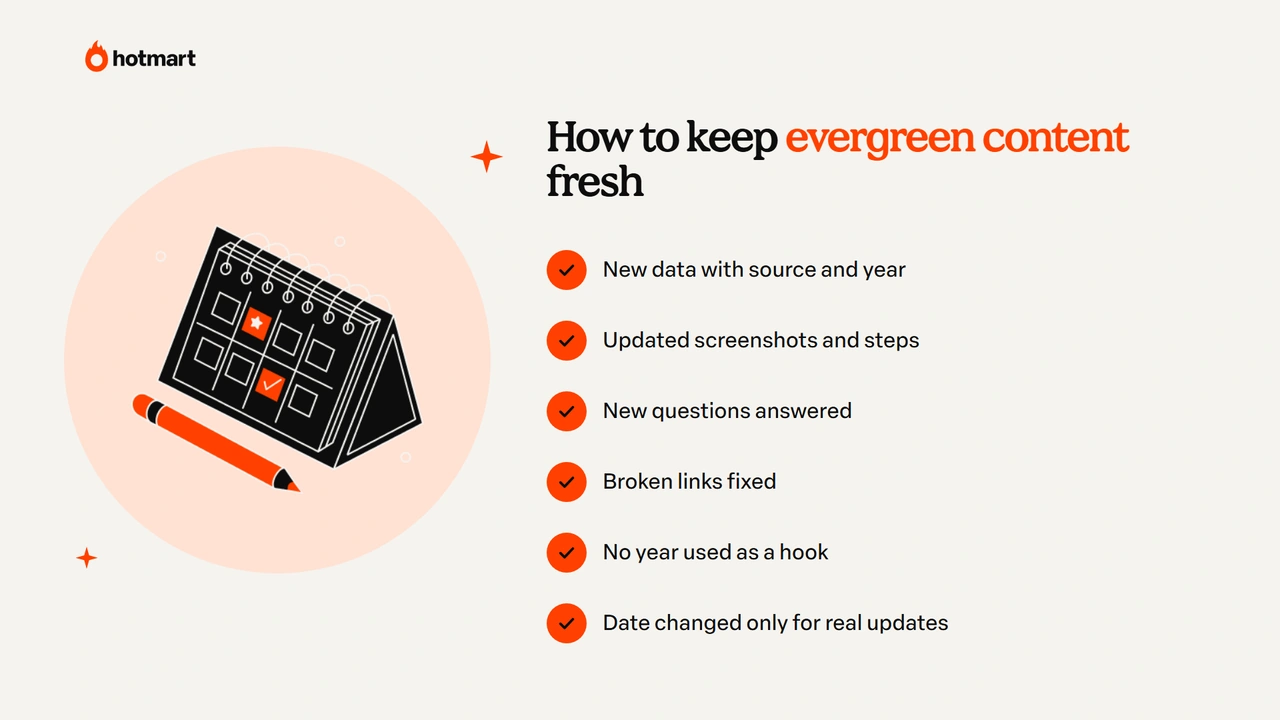
Keeping evergreen content up to date means reviewing it every so often to replace data, examples, screenshots and links that have aged, without changing the topic or the URL. This process, called a content refresh, is what separates evergreen content from forgotten content. A good refresh includes these steps:
- data with source and year: replace old statistics with more recent studies;
- screenshots and walkthroughs: redo the steps in the tools and replace screens that changed;
- new questions: add questions that have come up, like the ones that appear in Search Console;
- links: fix broken links and add new content from your site;
- years in the text: remove years used only as a hook (“tips for 2023”) and keep the ones that are facts.
A word of warning: changing only the date doesn’t make content current. In its guidance on helpful content, Google asks whether you’re changing the date of pages to make them seem fresh when the content hasn’t substantially changed. Update the date when the review is real.
There’s no official review frequency. Prioritize based on data: content that’s losing clicks, content about tools and prices and the pieces that matter most to the business. Here on the Hotmart blog, evergreen guides go through reviews like this one, which updated the data, examples and structure of a text published years ago. If your content relies on many third-party sources, content curation helps keep your references current.
How to measure evergreen content results
Measuring evergreen content results means tracking each page over months, not days, because its value lies in consistency. The main tool is Google Search Console, which is free and shows clicks, impressions, CTR and average position for each page on Google.
The performance report opens with the last 3 months, but you can choose longer periods, since Search Console keeps data for the last 16 months. Since December 2025, the charts also have weekly and monthly views, which smooth out daily swings. In your analysis, watch for these signals:
- clicks and impressions month by month: healthy evergreen content shows a steady or rising line;
- the same period last year: comparing against it takes seasonality out of the picture;
- page queries: they show the searches that bring people in and the questions you haven’t answered yet;
- a steady decline: several months of lost clicks mean the content needs a refresh;
- conversions: in Google Analytics, see how many leads or sales start on that page.
With these numbers, your reviews stop being guesswork: you know which evergreen pieces perform, which are aging and where your next refresh should go.
Common mistakes when creating evergreen content
The most common mistakes when creating evergreen content are the ones that make the text age too soon or never get found. Watch out for these:
- a date in the title or URL when it isn’t needed;
- publishing and forgetting, as if evergreen meant done forever;
- updating only the date, without changing the content;
- choosing topics with no demand, timeless but searched by no one;
- loose numbers and screenshots, with no source, year or separation from the rest of the text;
- relying only on evergreen content, giving up the quick reach of seasonal and trending content.
Avoiding these mistakes already puts your content ahead of much of the competition, which publishes a lot and reviews very little.
Evergreen content, evergreen launch and evergreen funnel: what’s the difference?
Evergreen content is a type of content; an evergreen launch and an evergreen funnel, on the other hand, are models for selling digital products that use the same word with a different meaning. In the digital product market, “evergreen” means the product is on sale all the time, instead of only during short windows:
- an evergreen launch is the model in which the product is on sale continuously, with an automated sequence of content and offers for each new lead;
- an evergreen funnel is the automated sequence that supports those continuous sales (lead magnet, emails, recorded class and sales page), which each person goes through at their own pace.
The two concepts work together: an evergreen funnel performs better when it’s fed by evergreen content, which brings in new people every day. That’s why it pays to build a base of evergreen content that drives steady traffic before you automate your sales.
Evergreen content for people who sell digital products
For people who sell digital products, evergreen content is the road that brings new people to the product every day: each evergreen post, video or tutorial attracts people with the exact question your course, ebook or coaching program solves. The path usually goes like this: the content answers the initial question, a free resource, like a lead magnet, captures the contact and the email sequence introduces the product.
The product itself can also be evergreen. A recorded course is evergreen content by nature: lessons stay available for students to watch whenever they want, and the same recording serves one cohort after another. The same rules as the blog apply: separate what’s fixed from what changes and update modules when a tool or rule changes.
On Hotmart, creating and publishing an online course is free (see how to sell online courses), and your lessons live in the Members Area, with the video player included. You’re only charged when you sell: 9.9% + US$1.00 per approved sale, with no monthly fee. That way, your blog’s evergreen content and your recorded course work together, one attracting and the other delivering.
Ready to plant your first piece of evergreen content?
Evergreen content is content that stays useful, searched for and accurate for a long time: guides, tutorials, glossaries and lessons on topics that don’t depend on a date. It builds up traffic, links and leads, is more likely to be cited by search engines and AI tools and only stays evergreen if you review the data and examples every so often.
Start small: pick a question your audience asks all the time, answer it better than any other result and put the first review on your calendar. A year from now, you’ll be glad you planted that tree today. 🌲😉
Frequently asked questions about evergreen content
Still have questions? Below, we answer some of the most frequently asked questions about evergreen content.
What's the difference between evergreen content and seasonal content?
Evergreen content has steady searches all year, while seasonal content spikes on recurring dates, like Christmas and Black Friday. Both are useful: evergreen content sustains traffic, and seasonal content takes advantage of predictable moments on the calendar.
Does evergreen content need to be updated?
Yes. The topic of evergreen content lasts, but data, screenshots, prices and examples get old. Review it based on performance, replace what has changed and only update the post's date when the review is real.
Can a video be evergreen content?
Yes. Video tutorials, lessons and explanations of concepts on YouTube keep getting searched for years. Avoid mentioning dates in what you say and in the title, and update the description and pinned comment when something changes.
How long does evergreen content take to deliver results?
It depends on the competition and the site's authority, but it usually takes months. In a study updated in 2025, Ahrefs found that only 1.74% of new pages in its sample reached Google's top 10 within a year, which is why evergreen content is a medium- to long-term strategy.
Are evergreen content and timeless content the same thing?
Yes. Evergreen content and timeless content are names for the same type of material: content that stays relevant for a long time, without depending on a date or a trend. "Evergreen" is the term most widely used in digital marketing.